
Industrial tomato production is on the rise, but drought and bad weather are reducing yields in the North
The volume of tomatoes supplied to the industry totalled 3.2 million tonnes: on the one hand, this is a positive record; on the other, it is well below the contracted amount

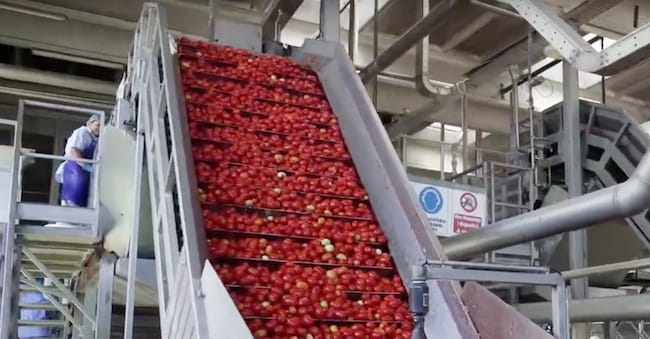
The Interprofessional Organisation OI Pomodoro da Industria Nord Italia has taken stock of the 2026 season in Emilia-Romagna, Lombardy, Piedmont, Veneto and the autonomous province of Bolzano: ‘The season,’ states a press release, ‘saw an increase in the area under cultivation and an unprecedented total volume of tomatoes supplied to the industry, but the quantities remained below those agreed in contracts. The campaign was primarily affected by climate change, low field yields and rising production costs, both agricultural and industrial.”
In 2026, the area under cultivation for processing tomatoes in Northern Italia reached 48,349 hectares, of which 43,477 were under integrated production and 4,872 under organic production, accounting for 10.1 per cent of the total. The total quantity supplied to the industry reached 3,205,126 tonnes, an unprecedented figure for the region, but representing a fall of around 14 per cent compared with contract tomatoes.
“This figure must be viewed in the context of yields,” explains the Oi, “which stood at 66.3 tonnes per hectare, compared with an average of 71.6 t/ha recorded over the last five years. In detail, yields were 68.0 t/ha for integrated production and 51.3 t/ha for organic production. These are among the lowest figures recorded by the Oi since 2011. The increase in cultivated area did not translate into a proportional rise in production, partly due to hailstorms that affected thousands of hectares across the region and reduced the quantity produced. Exceptionally high daytime temperatures, nights that were less cool than normal and almost no rainfall subjected the crops to severe stress’.
These difficulties were then exacerbated ‘by the limited availability of irrigation water, as early as the end of June, and by restrictions on water abstraction from surface water sources’.
For its part, the industrial sector has had to contend with high costs, particularly for the gas and electricity required for processing and for low processing yields, which have resulted in fewer finished products being produced than planned. The agricultural sector has also been affected by rising fuel prices, which have increased significantly since April.
“We are seeking to actively promote, in preparation for the 2027 campaign,” said Giuseppe Romanini, president of the Northern Italia Industrial Tomato Organisation (Oi Pomodoro da Industria Nord Italia) – ‘we are actively seeking to promote, in preparation for the 2027 campaign, the adoption by the supply chain of a method involving fixed deadlines and shared data between the agricultural and industrial sectors, on which to base annual production planning, going beyond the Organisation’s current role of providing data only when supply chain stakeholders deem it necessary. The aim is to strengthen coordination between the various stakeholders in the supply chain, making planning more timely and informed, in order to address climate uncertainty, improve the balance between supply and demand, and safeguard the economic sustainability of agricultural and industrial production of processing tomatoes in Northern Italia.”

