
Processing tomatoes: production on the rise, but high energy costs are a burden
Italia, with a production of 6.3 million tonnes, remains the world’s second-largest producer after the US and ahead of China. Rodolfi (Anicav): “There are significant cost-related challenges; careful planning is needed for 2027.”

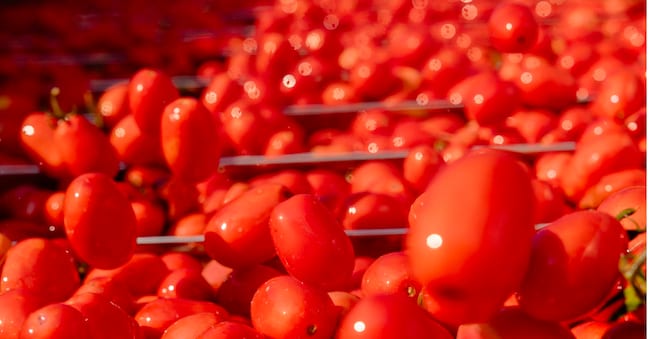
The transformation campaign of the industrial tomatoes in 2026 in Italia ended with a total production of 6.3 million tonnes, up on last year. This result consolidates our country as the world’s second-largest producer (after the USA and ahead of China) and comes against a backdrop of a significant increase in cultivated area, totalling 86,382 hectares (of which 48,313 are in the Northern Basin and 38,069 in the Central-Southern Basin). This was announced by Anicav, the National Association of Vegetable Food Preserves Manufacturers.
The heavy pressure of energy costs
The season proved particularly challenging for processing companies, which – in order to guarantee high-quality produce – had to contend with a sharp rise in energy costs. According to Anicav, during the tomato processing period, the average price of gas more than doubled compared with 2025 (+103 per cent), whilst that of electricity rose by 78 per cent,further exacerbating the pressure on industrial costs.
“These rises in energy costs, which have had a severe impact on both production processes and transport, and a tomato price that remains the highest in the world, have put processing companies under severe strain”, reiterates the chairman of Anicav, Aldo Rodolfi.
The geography of the collection
In the Central-Southern region, where 3.1 million tonnes of tomatoes were processed, the season was very long, starting early and continuing until the end of October, resulting in a considerable increase in production costs and a significant loss of economies of scale, given that the processing plants were not always able to operate at full capacity.
In the Northern basin, the final processed volume stood at 3.2 million tonnes. This result was influenced by the fall in crop yields, which recorded the worst performance in the last five years, due to adverse weather conditions, characterised by waves of heat, drought and hailstorms, and the limited availability of water resources. Added to this were lower-than-expected industrial yields, which resulted in final production falling short of the quantities initially planned.

