

Trade and Geopolitics in Economic Competition: The Impact on Investment and Strategies in the Wider Mediterranean
In the Chamber of Deputies, the international conference ‘The Hormuz Crisis and the New Eurasian Trade Routes: Challenges and Opportunities for Customs Policies’ was held to bring together institutions, experts and economic operators. The focus was on alternative trade corridors, from IMEC to the Iraqi Development Road, and the need to make trade between Europe, the Gulf and Asia faster and more secure.
by 24Ore NextMed
 Aggiungi Il Sole 24 Ore
ai preferiti su Google
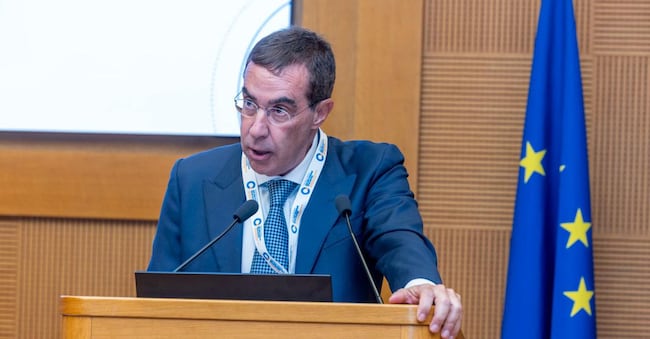
“The crisis that began with the blockade of the Strait of Hormuz has accelerated a profound reorganisation of trade routes between Asia, the Gulf, the Mediterranean and Europe,” explains Roberto Alesse, director of the Customs and Monopolies Agency. Today, from 9.30 am, the conference ‘The Hormuz Crisis and the New Eurasian Trade Routes. Challenges and Opportunities for Customs Policies’. The event is organised by the Customs and Monopolies Agency, in partnership with Confindustria, Il Sole 24 Ore NextMed, ISPI and SMR.
“The redesign of transit corridors, rising logistics and insurance costs, and the search for safer and more predictable alternative routes,” continues Alesse, “pose new challenges for governments, economic operators and, in particular, customs authorities, which are called upon to ensure the smooth running of checks, the facilitation and security of trade, and the resilience of supply chains. It is certainly a very demanding task, but one that cannot be postponed, for authorities tasked with managing the growth of e-commerce and combating increasingly sophisticated illicit trafficking against a backdrop of rapid technological change. The challenge remains to ensure effective controls whilst, at the same time, maintaining the smooth flow of legitimate trade, by updating tools and operational capabilities’.
This was followed by official addresses from the Speaker of the Chamber of Deputies, Lorenzo Fontana: ‘Faced with a situation that poses significant challenges to the stability of international markets, no country can act in isolation. In particular, it is necessary to strengthen institutional dialogue and cooperation between states, encouraging the sharing of knowledge, experience and innovative tools capable of enhancing the resilience of supply chains and safeguarding trade flows’, he stated in his message. The third-highest office of state continues: “In this regard, Italia can play a significant role in promoting dialogue between Europe, Asia, the Mediterranean and the Gulf region, drawing on its mercantile tradition, its history and its geographical position. It is therefore essential to identify concrete solutions to address current challenges and outline new opportunities for development and cooperation to ensure transparent and reliable trade relations. In this regard, customs authorities can make a significant contribution, as they play a central role in promoting business competitiveness, the smooth flow of trade and mutual trust between countries.”
The first panel, focusing on trade and logistics in the context of geo-economic competition and their impact on investment and strategies in the wider Mediterranean region, featured Filippo Fasulo, Research Coordinator and Head of Geoeconomics and Asia at ISPI; Afaq Hussain, Director of the Bureau of Research on Industry and Economics Fundamentals in India; Olaf Merk, Head of Ports and Maritime Transport at the ODEC International Transport Forum; and Massimo Deandreis, Director General of SMR, the research centre of the Intesa Sanpaolo Group. The presentations highlighted the importance of geography in trade – a subject that, until a few years ago, seemed to have been completely forgotten. The new trade routes certainly include the IMEC, namely the corridor linking India and the Middle East, the Iraqi Corridor and the Hejaz Railway, the former Ottoman railway system connecting the Arabian Peninsula and Turkey.
Equally important are the ports, once regarded merely as places through which people and goods passed, but which today serve as genuine hubs at the intersection of three dimensions: they are simultaneously strategic and energy centres, as well as key locations where technology and digitalisation must be developed.

