United States

Trump: Xi will be visiting on 24 September; I will discuss artificial intelligence with him

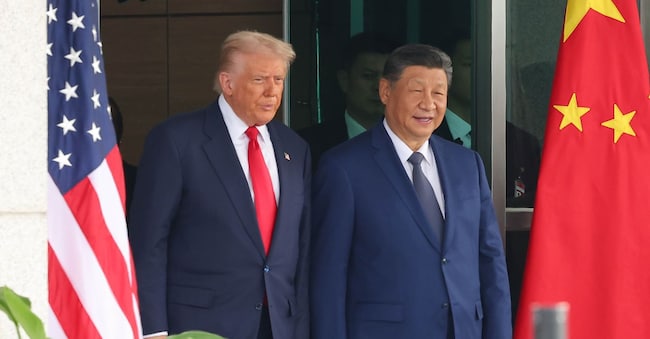
30 ottobre 2025, Corea: il vertice USA-Cina i Il nella foto : presidente Donald Trump   e il presidente cinese Xi Jinping   dopo i loro colloqui nella sala di ricevimento di Naraemaru all'interno di una base dell'aeronautica nella città sud-orientale di Busan  foto IPP/Yonhap News via ZUMA  (16878)

3' min read

Translated by AI
Versione italiana

3' min read

Translated by AI
Versione italiana

Chinese President Xi Jinping “will be visiting on 24 September and I will be discussing artificial intelligence with him”. This was stated by US President Donald Trump whilst speaking at the EPA headquarters in Washington, at an event dedicated to the launch of new initiatives aimed at cutting energy costs and supporting AI.

“The United States is leading the challenge with China and other countries over AI,” added the tycoon, presenting the issue as one of the key items on the agenda for the talks.

Loading...

In the IA, he added, “the United States will be second to none”.

Xi’s visit follows the meeting between the two leaders that took place during the tycoon’s trip to China in May, for the first time since 2017: on that occasion, in Beijing, Trump invited the Communist leader to the White House.

On Wednesday, on the sidelines of the ASEAN Foreign Ministers’ Meeting in the Philippines, US Secretary of State Marco Rubio and his Chinese counterpart Wang Yi discussed both Xi’s visit to the US and the need to identify areas of cooperation to pave the way for a “very positive visit”.

Mark Zuckerberg launches a campaign promoting optimism about AI

The head of Meta, Mark Zuckerberg, has outlined an optimistic vision of a future characterised by intelligent agents (autonomous AI), arguing that his company’s goal of connecting the world will be further strengthened by new artificial intelligence tools and technologies.

According to Axios, this stance stands in stark contrast to that of some of Meta’s main competitors in the AI sector who, according to a promotional video posted alongside Zuckerberg’s comments, are fuelling fear and painting a dystopian picture of the future.

“There are those who would have you believe that AI will make us less connected, that it will leave us behind. We couldn’t possibly be more at odds with that view. Call us optimists, call us dreamers. Just as we’ve always done, we’re putting our faith in people.”

Meta “has always believed in the importance of empowering people to share, connect and shape their world as they wish” and, as we enter this new phase of AI, “we continue to believe that the future belongs to everyone. Our aim is to provide every individual with the tools to realise their full potential and to ensure that the benefits of technology are accessible to all”.

The promotional video is part of a wider campaign – which includes both paid advertising and organic media coverage – aimed at promoting Meta’s vision for AI.

“Twenty-two years on, and with 3.5 billion people involved, we are relaunching the challenge: technology will change, but the purpose that drives it will remain the same,” added Zuckerberg, whose vision reflects greater confidence in Meta’s social role in a future dominated by intelligent agents than was the case in the social media era.

A data centre in space? Experts say it would be a ‘catastrophe’

The space-based data centres envisaged by Elon Musk’s SpaceX and Jeff Bezos’s Blue Origin would be ‘catastrophic’ for our planet.

This is the view put forward by space experts and environmental groups in a new petition calling for an analysis of the impact.

Filed by the non-profit organisations Public Employees for Environmental Responsibility, Earthjustice and DarkSky International, the petition The Guardian reports calls on the US Federal Communications Commission (the body responsible for approving data centres in orbit) to put new licences on hold, arguing that these plans breach federal law.

The petition states that data centre companies “describe their plans in grandiose terms, as capable of changing civilisation. But these same advocates have refused to accept any investigation into the impacts of their technology – which they themselves describe as epoch-making – on the environment, science, the economy or other values”.

Some scientists fear that the resulting pollution could destroy the ozone layer, expose some people to higher levels of ultraviolet radiation, or contribute to further destabilising the planet during the climate crisis. The pollution could also fall back to Earth, and millions of satellites would create a major source of light pollution.

Copyright reserved ©
Loading...

Brand connect

Loading...

Newsletter

Notizie e approfondimenti sugli avvenimenti politici, economici e finanziari.

Iscriviti