United States

Donald Trump-Xi Jinping phone call: 'Meeting on tariffs soon'

The call lasted about an hour and a half
Aggiornato alle ore 18:43

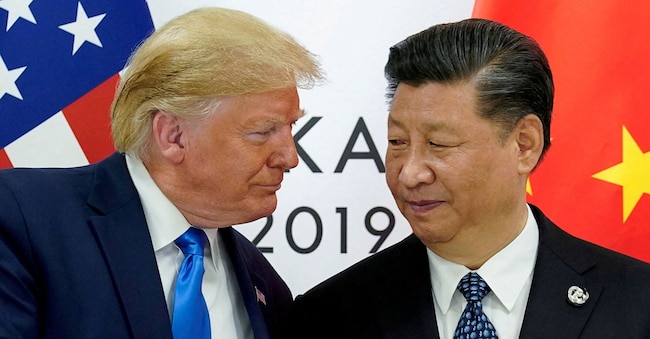
Donald Trump e  Xi Jinping (foto 2019) REUTERS/Kevin Lamarque//File Photo

4' min read

4' min read

Today there was the long-awaited phone call between Donald Trump and Xi Jinping.  The phone call accrued "at the request" of the tycoon, Chinese state media pointed out.

a punctuation, the latter, often used and aimed at the domestic audience to signal the strong position of the Mandarin leadership towards the United States.

Loading...

The talks between the two presidents are the first to be made public since those that took place in January, a few days before Trump took office, and they matured in the midst of the tariffs negotiations, currently stalled despite the 90-day truce reached in early May in the Geneva talks to suspend the bitter trade war. The talks are the first to be made public since the talks in January, a few days before Trump took office.

To correct the course of China-US ties, 'it is necessary to steer the ship well and set the direction, eliminating any kind of interference or even sabotage, which is of particular importance'. This is what President XI Jinping said. The economic and business leaders of the two countries held talks in Geneva, 'taking an important step to resolve' the relevant issues 'through dialogue and consultation'. A model, the state network Cctv reported, 'widely welcomed by all sectors of the two countries and the international community'.

"I just had an excellent phone call with Chinese President Xi to discuss some complex aspects of our recently concluded and agreed trade agreement. The call lasted about an hour and a half and resulted in a very positive conclusion for both countries. There should no longer be any doubt about the complexity of rare earth products," Trump later wrote on Truth. The president of the United States wrote that the conversation was "almost entirely about trade. We did not discuss Russia/Ukraine, or Iran," he specified on Truth.

"Our respective teams will meet shortly at a location to be determined. We will be represented by Treasury Secretary Scott Bessent, Commerce Secretary Howard Lutnick, and U.S. Trade Representative Ambassador Jamieson Greer," Donald Trump wrote, also on Truth.

Xi would go on to say that the US should handle the Taiwan issue "carefully to prevent a very small number of Taiwan independence separatists" from dragging China and the US into a "dangerous situation of conflict and confrontation".

Trump, Chinese students in US? They are coming, honoured to have them

'Chinese students are coming, I am honoured to have them': this is how Donald Trump played down his close circle's fears about Chinese students at American universities.

Still on the subject of tariffs, Canada's trade deficit in April reached an all-time high of an impressive C$7.1 billion ($5.2 billion), as tariffs imposed by Trump reduced demand for Canadian goods from the United States.

Exports to the rest of the world increased, but failed to offset the decline in exports to the US, according to Statistics Canada data. Exports to the US shrank by 15.7 per cent, the third consecutive monthly decline, StatsCan reported, adding that exports south of the border fell by more than 26 per cent from their peak in January.

Trump, we will have a great relationship with Germany

Trump then received German Chancellor Friedrich Merz for a bilateral in the Oval Office. The tycoon said he was "sad about what is happening with Russia and Ukraine". During his visit to the White House, German Chancellor Friedrich Merz brought with him not only political messages, but also a symbolic gift: a gilt-framed copy of the birth certificate of the grandfather of US President Donald Trump, Friedrich Trump, who was born in 1869 in Kallstadt (now Rhineland-Palatinate). An elaborate translation is also included.

"We will have a great relationship with Germany," Trump said, adding that he wanted gas and oil to be part of the deal. "Merz is a good man to deal with, but it is difficult," he later remarked.

Trump bans travel to US from 12 countries

On the domestic front, however, Donald Trump has imposed a ban on entry into the US from 12 countries: Afghanistan, Myanmare, Chad, Republic of Congo, Equatorial Guinea, Eritrea, Haiti, Iran, Libya, Somalia, Sudan and Yemen. The ban is intended to protect the country from "foreign terrorists and other national security threats," reads a White House memo.

Trump also decided to partially restrict the entry of citizens of seven countries: Burundi, Cuba, Laos, Sierra Leone, Togo, Turkmenistan and Venezuela.

The restrictions, the White House memo points out, apply to both migrants and non-migrants.In light of the restrictions, Venezuelan Interior Minister Diosdado Cabello said: 'Being in the United States is a great risk for anyone, not just Venezuelans.

The US president said he decided on the ban after the anti-Semitic attack in Boulder, Colorado. Egypt, the home country of the attacker Mohamed Soliman, is not among the countries affected by the measure.

Trump also announced that he had banned visas for foreign students at Harvard. "I have decided," reads a note, "that it is necessary to restrict the entry of foreign nationals seeking to enter the United States solely or primarily to participate in a course of study at Harvard or in an exchange programme hosted by the university".Harvard University called the executive order issued by Donald Trump a "retaliatory measure".

"This is yet another illegal retaliatory action by the administration in violation of Harvard's First Amendment rights. Harvard will continue to protect its international students," said a spokesperson for the institution.

The Trump administration also started the process on Wednesday to revoke Columbia University's accreditation due to anti-Semitism allegations against the university. The move represents an escalation by the administration after blocking $400 million in federal funding that was never restored, despite the university caving in to White House demands on admissions and curriculum that included harsh punishments for students and alumni involved in pro-Palestinian protests.

Biden investigation

The president finally ordered the Justice Department to open an investigation into the alleged cover-up of Joe Biden's health condition, the White House reported in a note.

Copyright reserved ©

Brand connect

Loading...

Newsletter

Notizie e approfondimenti sugli avvenimenti politici, economici e finanziari.

Iscriviti