United States

Trump does not rule out declaring a state of emergency ahead of the mid-term elections

Pete Hegseth has announced that Elon Musk will co-lead a Pentagon project aimed at studying “the future of warfare”. This marks the first time that the CEO of SpaceX has returned to work in Donald Trump’s administration since his time as head of the Office of Management and Budget.

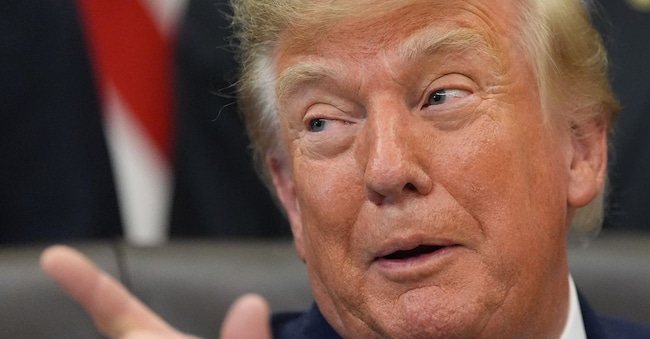
Il presidente Donald Trump parla nello Studio Ovale della Casa Bianca, mercoledì 30 settembre 2026, a Washington. (Foto AP/Alex Brandon) APN

4' min read

Translated by AI
Versione italiana

4' min read

Translated by AI
Versione italiana

Donald Trump is raising the spectre of a state of emergency and the invocation of the Insurrection Act in the United States ahead of the parliamentary elections in early November, in which the Republican Party is lagging behind in the polls. “I’m not committing to anything,” he told *Time* magazine when asked about the possibility of taking such drastic measures.

In this scenario, the forces deployed at the polling stations could include both National Guard troops called up to serve directly under the leadership of the White House and the Pentagon, and federal immigration enforcement personnel from ICE, which was significantly expanded under Trump to include some 30,000 uniformed officers.

Loading...

The president had already raised the idea of militarising the vote, citing – without ever providing any evidence, and despite being contradicted by studies and the courts – serious electoral fraud perpetrated by the democratic opposition. But this new warning, if repeated, risks taking on unprecedented significance in the run-up to the polls on 3 November. According to critics and civil rights organisations, the very act of taking this stance – even without leading to widespread, concrete action – could intimidate the electorate, particularly working-class and ethnic minority voters, and reduce voter turnout, which would currently favour the Democrats. Not only that: it may herald further, aggressive efforts – in the courts or by putting pressure on state authorities – to more easily challenge election results and attempt to overturn them. Trump has repeatedly claimed that the polls showing him and his allies trailing – particularly over the war in Iran and economic management – are ‘fake’.

“I’m not ruling anything out,” Trump told *Time*, referring to extraordinary measures. “We’ll see.” The Insurrection Act dates back to 1807 and had been considered but not invoked in response to street protests against aggressive ICE raids. Trump had subsequently resorted to a more limited federal law to deploy National Guard troops to assist local law enforcement.

When it comes to the ballot box, the White House has repeatedly denounced the alleged mass voting by illegal immigrants in US elections, despite the fact that its claim has been refuted by the facts and by analyses which, at most, have found only a handful of errors in the electoral registers.

The Insurrection Act – rarely invoked; the last time was in 1992 to quell serious racial unrest in Los Angeles – allows the President to mobilise troops on national soil ‘in all cases of insurrection or obstruction of the laws, in the United States or in individual states and territories, for the purpose of suppressing such insurrection and enforcing the laws’.

A declaration of a national emergency, in the absence of widespread violence or grounds of national security, would appear just as dramatic. It would allow the President to implement measures such as restrictions on voting and on the movement of Americans without the need for congressional approval. Speaking to a right-wing podcaster last month, Trump was cryptic: ‘I’ll just say that even stranger things have happened,’ he said, alluding to the idea of a state of emergency.

Musk returns to Trump’s orbit and explores the future of warfare

The approach of the crucial mid-term elections this coming November also marks a rapprochement with the White House by Elon Musk, who previously played a leading role in the 2024 presidential campaign, and who appears to have returned definitively to Donald Trump’s orbit. Following last year’s high-profile split, the billionaire is not only once again committed to supporting the Republicans through his America PAC, but has also resumed an official role alongside the administration. Defence Secretary Pete Hegseth has in fact chosen the founder of SpaceX, alongside Anduril founder Palmer Luckey and former Speaker of the House Newt Gingrich, to lead ‘Project Meridian’, a Pentagon initiative to study the wars of the future and identify the technologies and weapons systems that the United States will need to develop over the coming decades.

A comeback that seemed hard to imagine just a year ago, following a summer of 2025 in which the relationship between Trump and Musk had appeared irreparably damaged, particularly given the president’s well-known ruthlessness towards former allies. Having invested over $250 million to support the 2024 Republican presidential campaign andhad become one of the new president’s most influential advisers at the helm of the Department of Government Efficiency (Doge), Musk left the administration and launched a frontal attack on the major tax and spending bill, the ‘One Big Beautiful Bill’, championed by Trump, calling it a “disgusting abomination” that would cause the debt to skyrocket. A bitter clash ensued: Trump threatened to cancel federal contracts and subsidies for the billionaire’s companies, whilst Musk went so far as to suggest that Vice-President JD Vance should replace Trump and subsequently floated the idea of creating a new party, the America Party, with the aim of challenging the two-party system of Republicans and Democrats and winning key seats in Congress. The proposal did not cause much of a stir: having been born in South Africa, Musk is not constitutionally eligible to stand for the US presidency.

The South African billionaire’s timing

In recent days, Musk also attended Trump’s meeting at the White House with the heads of major technology firms, which focused on artificial intelligence and ‘superintelligence’; during the meeting, the participants signed a voluntary agreement on principles and responsibilities regarding the development of cutting-edge technologies. The rapprochement between Trump and Musk appears to be taking place at a moment that is perhaps no coincidence. The billionaire has reactivated America PAC, the political machine previously used in 2024, with the aim of mobilising the Republican electorate through door-to-door canvassing, digital advertising and targeted campaigns. His group has thus returned to working firmly within the same political camp as Trump after, at the height of the row, the Tesla boss had even floated the possibility of backing challengers to Republican MPs. This rapprochement is particularly strategic for the GOP, which is thus regaining one of its most important financial backers just as the campaign for control of Congress enters its decisive phase.

Copyright reserved ©

Brand connect

Loading...

Newsletter

Notizie e approfondimenti sugli avvenimenti politici, economici e finanziari.

Iscriviti