Trade war

Trump threatens the EU with tariffs: ‘You’ll pay for this – lift the fines on US companies’

The US President has once again criticised the EU, this time over the fines imposed on American companies, the most recent of which was against Google

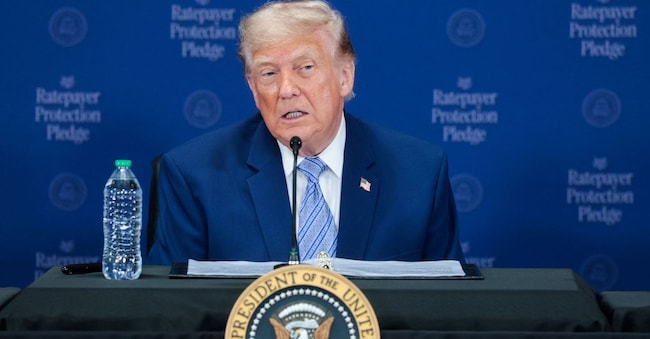
Il 23 luglio 2026, presso la sede dell’Agenzia per la protezione dell’ambiente (EPA) a Washington, D.C., negli Stati Uniti, il presidente degli Stati Uniti Donald Trump presenta il suo “Ratepayer Protection Pledge” (Impegno a tutela dei consumatori), volto a proteggere le famiglie dai costi dell’energia elettrica legati al boom dell’intelligenza artificiale. REUTERS/Jonathan Ernst REUTERS

4' min read

Translated by AI
Versione italiana

4' min read

Translated by AI
Versione italiana

Donald Trump has criticised the European Union over the fines imposed on American companies, the most recent being the one against Google. The EU “will pay a very high price for this illegal and deeply unfair conduct, against which I had repeatedly warned them”, Trump wrote on his social media platform Truth, announcing the launch of “an investigation (under Section 301) into this practice of extortion”.

The United States, he added, is not Europe’s “piggy bank” and “will not become one. The sanctions will be completely lifted and we plan to impose heavy tariffs on them as soon as possible”.

Loading...

The US President’s remarks had been foreshadowed by the US Trade Representative, Jamieson Greer, who had hinted – albeit in less blunt terms – at possible tariff consequences for the EU following the record fine imposed on Google on Thursday.

Trump’s new tariffs do not catch the EU off guard, but there is a clash over Big Tech

A repeat of that dreadful summer of 2025 has, at least for now, been avoided.

The latest blow that Donald Trump has sought to deal to international trade – this time on the pretext of goods produced using forced labour – has not caused any alarm in Brussels. The 15 per cent cap set out in the Turnberry Agreement is well above the 10 per cent tariff imposed by Washington. So much so that it has created an apparent paradox in transatlantic relations: that of bringing about a reduction in tariffs (including the Most-Favoured-Nation clause) for certain products, such as cheese. The storm, however, may simply have been postponed.

The Digital Services Act and the Digital Markets Act, the two instruments with which the EU is attempting to regulate the digital Wild West, risk becoming the real bone of contention across the Atlantic in the coming months.

As far as the Commission is concerned, however, this is simply a matter of applying the rules, without singling anyone out. And it has been reiterated on several occasions from Brussels that not even the US can interfere with the rules the EU sets for itself.

“Today we have issued a yellow card to TikTok; our rules are impartial”, remarked a source from the European Commission.

However, the announced new US investigation is casting a further shadow. This is partly because Brussels is viewing the use of such trade investigations with growing scepticism.

The rationale behind the tycoon’s decision to impose new tariffs – imposed under Section 301 of the Trade Act, which is designed to counter countries that engage in forced labour – has, for example, caused no small amount of irritation at the Berlaymont Building.

“The allegations of shortcomings in the checks are unfounded,” EU High Representative Kaja Kallas remarked from Manila whilst speaking to Reuters.

“We already have strict rules in place, and we therefore completely reject the idea that the EU could be seen as a factor contributing to the global problem of forced labour,” reiterated Commission spokesperson Paula Pinho.

 Trump’s new tariffs range from 10 to 12.5 per cent and affect over 60 countries: from European nations to Japan, from China to Canada, and from South Korea to the United Kingdom.

Reactions have been mixed. The new British government led by Andy Burnham has played down the significance of the move, pointing out that the 10 per cent cap established under bilateral agreements with the US remains in place. Beijing’s response was quite different, emphasising that “tariff and trade wars are not in the interests of either party”.

These new tariffs are unfair, and the justification is completely arbitrary,” retorted Brazil under Luiz Inácio Lula, which has long been at loggerheads with Washington. Everyone, starting with the EU, is nevertheless united on one principle: Trump’s trade war, with the world in turmoil, is not good for anyone.

The agreement comprises 29 chapters covering, amongst other things, trade in goods and services, investment, e-commerce, labour, the environment and dispute settlement.

The Ecuadorian government has clarified that protective measures will be maintained for 227 strategic agricultural products, including rice, maize, milk, meat and sugar , in addition to the ban on the import of second-hand clothing.

In 2025, non-oil trade between the two countries recorded a surplus of 85 million dollars (73 million euros) in Ecuador’s favour, with exports up by 91 per cent on the previous year.

Tariffs on Mexico because of lettuce linked to an outbreak of dysentery in several US states, or on Canada because of the wildfires and the resulting smoke that has spread across a significant part of the United States? Speaking in the Oval Office, when asked whether it would be safe to eat lettuce in the US again, the President stated that he would impose a “heavy tariff” on Mexico over the lettuce, but also another on Canada because of the smoke from the forest fires causing stagnant and toxic air over the United States – even on the day of the World Cup final. “Which would you prefer: lettuce or smoke? I think I’d go for the smoke,” joked the tycoon, prompting laughter from those present.

Loading...

Brand connect

Loading...

Newsletter

Notizie e approfondimenti sugli avvenimenti politici, economici e finanziari.

Iscriviti