Trento Festival of Economics

Trump the picketer: the impact on Beijing, Europe and Italia

European manufacturing has not lost its know-how. Not even under Trump's pickaxe

by Lello Naso

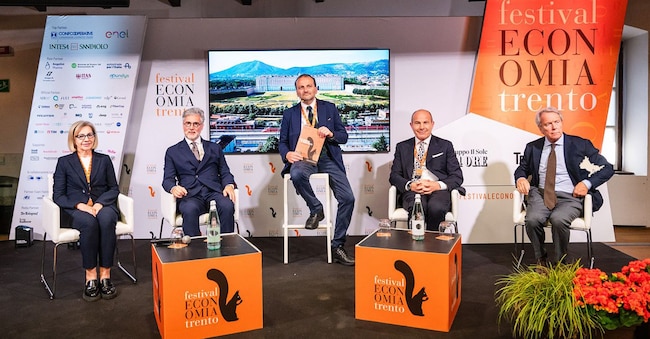
L’incontro. Da sinistra: Adriana Castagnoli, Josef Nierling, Daniele Bellasio, Giuliano Noci e Marco Fortis

3' min read

Translated by AI
Versione italiana

3' min read

Translated by AI
Versione italiana

By the time this article is read, it is very likely that things have changed. Trump the global piker, as the title of the panel that took place on 21 May at the Trent Economics Festival defines him, may have rendered many of the reasoning of the speakers who debated under the guidance of the deputy editor of Il Sole 24 Ore, Daniele Bellasio, outdated.

At worst, The Donald could have ordered the aircraft carrier stationed in front of Cuba to invade the island. It would not be a harmless act, like his many shootings over the past two years.

Loading...

But the analyses of economic historian Adriana Castagnoli, economist Marco Fortis, Porsche Consulting CEO Josef Nierling and Milan Polytechnic's pro-rector Giuliano Noci, as well as being relevant again after a denial or an exact contrary statement by The Donald, would stand the test of time.

Because, the speakers agree, they are looking at the long term, at the trend of Trump's actions. All of which go in the same direction: picketing what existed before, branded as bankrupt, in order to rebuild it in a similar manner.

It happened with tariffs, especially those towards China, back to square one. It will happen, in all likelihood, with the nuclear deal that the US is discussing with Iran and which follows the one signed by Obama and sunk by The Donald.

So, what do Trump's picks produce? 

According to Noci, a twofold effect: the pit for The Donald, the recognition of China as an equal power to the United States.

A boomerang aggravated by the loss of American credibility that has already resulted in significant economic damage: the rise in interest rates on debt and the flight of foreign capital from US equity. With China in parallel increasing its sphere of influence in Africa and South America and its ability to influence in Iran and the Middle East. With Putin being bypassed, but retaining his weight in the global chessboard. The pendulum of history swings to the East.

Trump's US, after all, Castagnoli argues, has renounced its role as a benign post-war hegemon and has turned into a predator. Europe, which benefited from early US policy, today pays the price to the predator. Which, Castagnoli argues, considers it an enemy.

While China and Russia are no longer identified as hostile powers. Putin and Trump resemble each other much more than The Donald resembles the West, says Castagnoli. They both talk about civilisation. Trump, in addition, aspires to a Carolingian, emperor-pope role.

The economic impact of this American U-turn has already had an effect on Italia, explains Fortis. While it is true that exports to the US have increased (partly due to domestic sales by American pharmaceutical companies with plants in Italia), Italy's trade balance surplus with the US has decreased by EUR 4 billion.

Weighing heavily, the iAmerican gas import sold to Italia at exorbitant prices. But even the US has little to cheer about: Trump's mess has produced an increase in debt (in 2030 it will be 150% of GDP compared to Italy's 135%) and growth in 2025 of 0.7%, one decimal point more than Italia.

Nierling highlights, however, how Trump picks at the cracks in our walls. Europe's inability to reduce its competitiveness and productivity deficits, to scale industry. But Trump is not America, says Nierling.

So much so that the polls show it in free fall. European industry must be good at growing where, paradoxically, Trump's own America creates the spaces. In automation, in air conditioning. It must, however, be able to self-reform. The US is not growing because of artificial intelligence, but because of data centres. There is a new wave to intercept. New markets, new opportunities. Even in the rural areas so dear to Trump.

Europe, and Italia, can carve out a role for itself. Not least because China is already grappling with managing production overcapacity and the need to grow domestic demand (with the risk of increasing citizen autonomy to the detriment of the party oligarchies).

On how the Old Continent industry can grow, the speakers' opinions diverge. For Noci, it must be good at digitising its skills, to turn data into value. For Fortis, on the other hand, it is precisely poor digitisation that will save European knowledge and protect it from plagiarism by artificial intelligence.

For Nierling, the European trump card will be the ability to bring artificial intelligence into physical products using US digital companies as service providers.

European manufacturing, after all, has not lost its know-how. Not even under Trump's pickaxes.

Copyright reserved ©
Loading...

Brand connect

Loading...

Newsletter

Notizie e approfondimenti sugli avvenimenti politici, economici e finanziari.

Iscriviti