War

Trump: two-week ceasefire agreement with Iran

The US president suspends his threat to destroy an entire civilisation, while internal political division grows. From Pakistan the decisive mediation. Hormuz open, truce also promised in Lebanon

from our correspondent Marco Valsania

Aggiornato l’8 aprile 2026

Aggiungi Il Sole 24 Ore
ai preferiti su Google
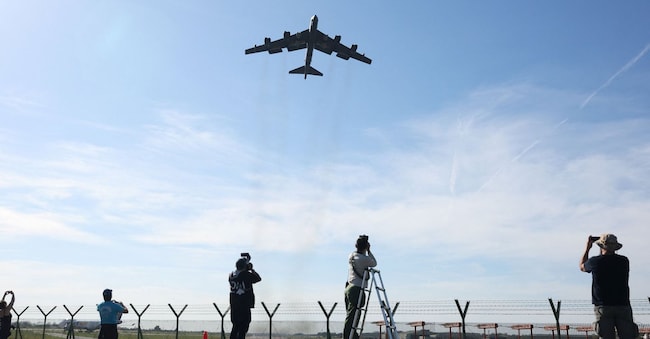
Un bombardiere B-52 Stratofortress dell'Aeronautica Militare degli Stati Uniti (USAF), carico di munizioni, decolla dalla base aerea della RAF di Fairford, nel contesto del conflitto tra Stati Uniti e Israele con l'Iran, a Fairford, nel Gloucestershire (Regno Unito), il 7 aprile 2026. REUTERS/Toby Melville REUTERS

5' min read

Translated by AI
Versione italiana

5' min read

Translated by AI
Versione italiana

NEW YORK - A two-week ceasefire agreement in extremis to prevent a devastating escalation of the war against Iran. Donald Trump announced the agreement an hour and 28 minutes before the expiry of his ultimatum, at 8pm US time, with which he had threatened the destruction of an entire civilisation if Tehran did not come to terms. The markets' reaction to the ceasefire announcement was swift, with oil down 15 per cent.

Trump indicated that he had suspended a new offensive on the condition of an immediate reopening of the Strait of Hormuz. And he cited the ten-point Iranian plan as a "working basis on which to negotiate": according to rumours it includes a permanent end to hostilities, guarantees of no future attacks by the US and Israel, an end to sanctions against Tehran and its allies, control of the Strait of Hormuz, tolls paid to Iran for the passage of ships with which to finance a reconstruction of the country and shared with Oman. Tehran said it also included uranium enrichment in the ten points.

Loading...

Trump stated that "almost all of the various previously disputed points have been agreed upon" and the two-week break will allow the agreement to "be finalised and implemented".

Pakistan's mediation was decisive, as it appealed for a two-week truce observed by both sides while during the agreed period, the Islamic republic would allow ships to pass through the Strait of Hormuz, which it now blocks. The ceasefire, if observed, could give time for the search for a more lasting agreement to end the conflict. Trump acknowledged Islamabad's role: 'Based on conversations with Prime Minister Shebbaz Sharif and Field Marshall Asim Munir, who had requested that I stop sending a destructive force into the night against Iran, and provided the Islamic Republic agrees to a full, immediate and safe opening of the Strait of Hormuz, I have agreed to suspend bombing and attacks on Iran for a period of two weeks

Iran then confirmed that naval passage through the strait will be allowed for a fortnight if attacks are suspended. Pakistan also added that the truce includes Lebanon.

Pakistani Prime Minister Shebbaz Sharif, in more detail, had indicated on social media that 'powerful and steady' progress was being made on the diplomatic front, despite both the US and Iran issuing threatening messages. And he had explicitly asked Trump to avoid an attack, intended to hit Iran's infrastructure en masse. Announcing now 'humbly' that the US and Iran have agreed to an immediate truce, he has already invited the parties to a meeting in Islamabad on 10 April for 'further negotiations' in the wake of the first understanding.

Until the last, diplomatic efforts had instead seemed uncertain if not wrecked. Trump had turned up the rhetoric. 'An entire civilisation will die tonight, never to return. I don't want it to happen, but it probably will'. Although he had not closed to twists and turns: 'Something magnificently revolutionary may happen, who knows. We will find out tonight, one of the most important moments in the long and complex history of the world'. This is because 'we now have a complete and total regime change, where different, more intelligent and less radical minds prevail'. One way or another, '47 years of extortion, corruption and death will finally come to an end'.

Concealed in the rhetorical bombast was and still is the political drama of a White House engaged in an unpopular war, one that shakes the economy and markets, and one with uncertain outcomes despite the firepower deployed by a veritable US army. Whichever way it goes, the challenge for Trump is to present it as a victory and it is not easy: in presenting the two-week agreement, he tried to stress that it was possible because the US had already 'exceeded its military objectives' in the conflict. But if with an agreement the Iranian regime survives and controls at least part of Hormuz, it will be hard to convince them that it was worth the cost, in treasure (to date it has demanded 200 billion for the war) and human lives (13 US soldiers killed and almost 400 wounded; perhaps two thousand Iranians killed, among them 1,600 children and civilians). If the path once again becomes one of blanket attacks, the risks of destabilising the Middle East and the global economy and accusations of committing war crimes will multiply.

The threats were accompanied by strenuous diplomatic efforts to find an acceptable solution. The US had presented a 15-point plan for a total Iranian renunciation of nuclear and missile capabilities, the Arab mediators a proposal for a temporary ceasefire, Tehran a ten-point plan for a complete end to hostilities.

But crusader tones had so far dominated. Trump's Secretary of War, Pete Hegseth, a great fan of bloody medieval campaigns and a follower of Christian nationalism, had the day before already discomfited divine parallels. He had compared the shooting down and rescue of an American pilot on Easter weekend to the crucifixion and resurrection of Christ. Trump had not been outdone: he had argued that God is with the Americans 'because God is good',

Even before the ultimatum expired, the war had continued unabated, indeed rising in intensity. American bombs, at least 50 of them, hit Kharg Island, Iran's major oil export terminal. US officials and Vice President JD Vance, on a visit to Hungary, confirmed that military targets on the island had been targeted and that the US had now almost achieved its aims in the war, with a 'very close' conclusion. Although the 'nature of the conclusion will depend on the Iranians'.

The escalation of Trump's threats, however, already presented growing unknowns, including domestic ones. It has aroused reactions of shock and denunciation in the Democratic opposition: "He is very sick," Senate Minority Leader Chuck Schumer said of the president. A group of Democratic parliamentarians called on the government to remove the president for manifest incompetence using the 25th Amendment of the Constitution.

Even within the Republican ranks, distinctions and concerns are surfacing: Wisconsin Senator Ron Johnson, an ally of the president, told a conservative podcast that he hoped Trump's words, which had already conjured up hell and a return of Iran to the stone age in four hours by destroying power plants and bridges, were just rhetoric. "I hope it's bluster. I don't want to see civilian infrastructure blown up, we're not at war with the population,' Johnson said. Polls show an approval rate for the war at 38%, according to averages from the specialist website Silver Bulletin. With divisions within the loyal Maga movement itself, where the more isolationist currents perceive it as a betrayal of the promises of America First. Tensions had emerged within an administration also of trusted allies over Trump's interventionist ambitions: Vance was sceptical of the whole war, while Secretary of State Marco Rubio and the CIA doubted the motives and Isralian intelligence on the weakness of the Iranian regime. A course correction could now be Trump's response to a conflict whose repercussions he had underestimated. Whether it will go all the way and heal his credibility and popularity remains to be seen.

© REPRODUCTION RESERVED

Copyright reserved ©
Loading...

Brand connect

Loading...

Newsletter

Notizie e approfondimenti sugli avvenimenti politici, economici e finanziari.

Iscriviti