

Trump’s plans for the Caucasus remain on paper
The Tripp project promises to link Asia and Europe via Armenia, reshaping the balance of trade. However, with shareholdings, funding yet to be finalised, costs to be borne by Yerevan and hostility from Tehran, key issues regarding governance and economic sustainability remain unresolved. Brussels will need to ensure that the new infrastructure does not duplicate that already in operation without adding value.
by 24Ore NextMed
 Aggiungi Il Sole 24 Ore
ai preferiti su Google
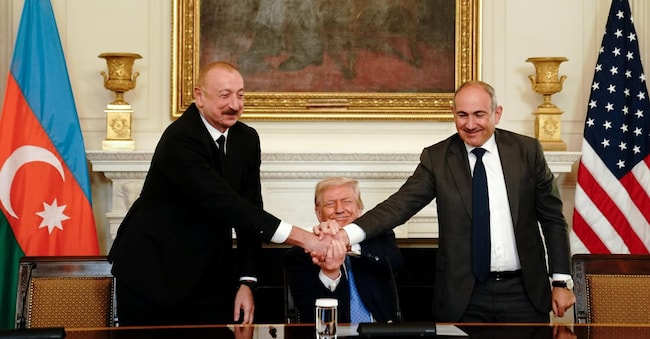
The fate of the Trump Route for International Peace and Prosperity, the US-backed project to build a transport link through Armenia, will depend on the ability to transform a political agreement into a manageable infrastructure system, even when the interests of its promoters diverge. For Yerevan, the issue concerns market access, the sustainability of public commitments and the effective exercise of sovereignty; for Tehran, it concerns the distinction between US commercial participation and a security-focused presence; for Europe, the compatibility between new connections, development funding and existing energy infrastructure. Tripp cannot be assessed solely on the basis of the shares held by the company tasked with developing it.
At the time of the signing of the treaty between Armenia and Azerbaijan, on 8 August 2025, President Donald Trump had stated: ‘It’s been a long time; they’ve been fighting for 35 years, and now they’re friends and will remain so for a long time to come. It is a great honour to welcome everyone to the White House for this historic peace summit.’ He added: “I would like to congratulate these two visionary leaders, the Armenian Prime Minister Pashinyan and the Azerbaijani President Aliyev, for coming to Washington to sign this historic joint declaration. It is an extremely important document that has been long awaited.”
The economic factor
Under the proposed structure, the US side would hold a 74 per cent stake in the development company and Armenia a 26 per cent stake, for an initial period of 49 years. A possible extension of a further 50 years, subject to mutual agreement, would bring the Armenian stake to 49 per cent. These figures define ownership and duration, but do not quantify the capital actually available to build railways, roads and electricity connections. The documentation from the US International Development Finance Corporation also distinguishes between the parent company and individual projects: the establishment of the former does not oblige the DFC to finance the latter, and should it invest in their capital, its direct and indirect stake should not exceed 40 per cent. This has a clear industrial implication: each infrastructure project will have to strike its own balance between capital, debt, revenue and contractual obligations.
The DFC announcement of 3 June 2026 must also be interpreted within its own context. The approved $2.5 billion relates to several operations, including a $1.5 billion investment platform in the Indo-Pacific, and does not constitute an overall allocation for the Tripp. The company’s approval represents an institutional step forward; the financing of a specific project requires further steps. Confusing the two levels would result in a misleading financial representation and could encourage public commitments before it has been determined who will bear additional costs, delays or lower-than-expected revenues. Furthermore, the economic value of improved accessibility does not automatically correspond to the revenue the company can collect: savings for exporters and importers may benefit the Armenian economy without translating into an equivalent sum available to repay lenders.
Infrastructure under construction
The trilateral declaration published by Armenia on 7 November 2026 established the first technical working groups on transport and electricity transmission. On 2 November, the Armenian Prime Minister Nikol Pashinyan had identified railways, roads and power lines as immediate priorities, leaving gas and oil pipelines for later discussion. This distinction prevents the project from being described as a single infrastructure, with every component already defined. A railway requires operational connections, services and maintenance; a power line requires operational coordination, metering and load balancing; digital systems must have clear responsibilities for access, support and recovery. Economic risk arises when a project is completed before the connections necessary for its operation are in place, generating costs without the expected revenue.

