
The TV no longer wants to stay in its place
The TV set changes its nature: it is no longer just a screen to watch, but an object that furnishes, disappears and integrates into the domestic space
Televisions are going through an identity crisis, and it is perhaps the most interesting thing that has happened to them in years. For decades they had a simple task: to stand there, big, black, switched off most of the time and then switch on at the right moment to show us movies, games, series, news, reality TV fights and sometimes even streaming TV and video games. They were surfaces. Screens. Luminous frames. Now they want to become something else. They want to disappear, decorate, float, look like aquariums, paintings, digital windows. In some cases, they even want to stop looking like televisions. Transforming the 'small screen' into something beautiful has been the forbidden temptation of the home audio-video industry for years. Forbidden firstly because usually people who watch a lot of TV don't pay attention to design. And secondly because the price of TV sets has fallen over time for so many years that it has become increasingly difficult to convince the public to spend more when the screen is turned off.
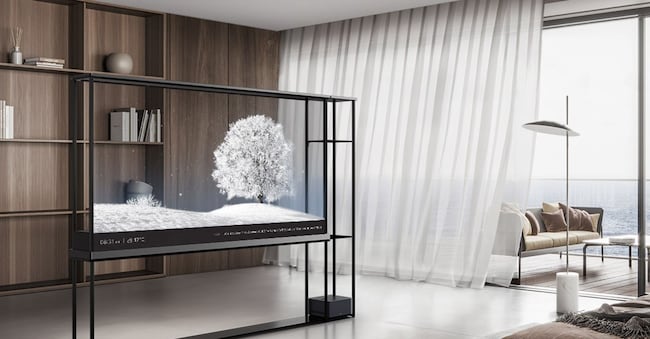
The Lg Signature Oled T, also just brought to Italia, is the perfect manifesto of this mutation. Not because it solves an urgent human problem, but precisely because it stages a new ambition of consumer electronics: to amaze again. The point here is not just to see well. It is to see through. Literally. When switched off, this 77-inch transparent OLED almost disappears. When switched on, it can show images suspended in the air as if the TV had decided to take lessons in illusionism.
It is an object that speaks volumes about where the market is going. The classic TV has reached an almost boring level of maturity. The panels are great, the blacks deep, the resolution plentiful, the diagonals huge. What was missing was something resembling a breakthrough, or at least a coup de theatre. And in fact LG has presented not just a TV, but a living room talking point. The wow effect is there, all right, especially when the transparent mode creates an almost alienating sense of depth. The problem is that along with the wow comes the compromise. To turn it into a 'normal' TV, LG uses a contrast filter that rises behind the panel. And even then, according to The Verge, the result doesn't quite reach the level of the best conventional OLEDs from the same manufacturer, because the MLA technology that pushed up the brightness of the G series is missing here.
And this is where it gets interesting. The TV set of the future is no longer just the one with the best picture. It is the one with the strongest personality. It is the one that comes into the house and says: look at me. Actually no, don't look at me, look through me. It is a small but revealing paradigm shift. TV is no longer just the centre of entertainment. It is a piece of technological set design.
This is why new TV sets are becoming hybrids. Part display, part design object, part information hub. LG's T-Bar, that low-end that remains active by showing news, weather or the title of the song playing, goes in this direction: no longer a screen that monopolises space, but a lighter, intermittent, almost ambient presence. The fact that all connections are handled by the separate wireless box should also be read in this way: freeing the panel from cables, making it less of an appliance and more of an installation.


