

A terracotta jar for storing insulin: this is how MSF is helping Rohingya refugees with diabetes
A solution introduced by Médecins Sans Frontières in Bangladesh enables self-administration at home, but the issue of access to more manageable devices remains unresolved

Key points
Seno Ara Begum is 27 years old. She lives with her husband and three children in a bamboo house in Bangladesh and has been living with diabetes for three years. A Rohingya refugee, she lives in a refugee camp, where managing a chronic illness means facing daily challenges, starting with access to treatment and the storage of medication.
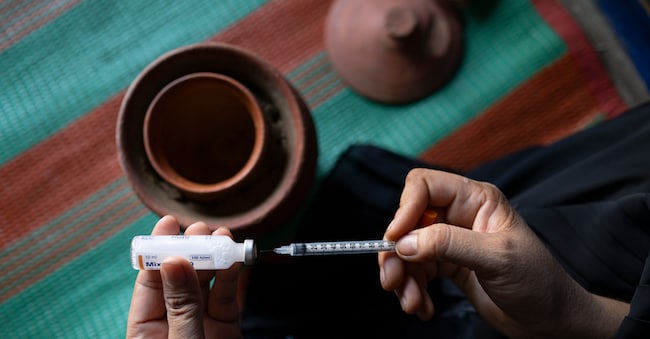
When she was diagnosed with diabetes, Begum had to visit the hospital frequently to receive insulin injections. About a year ago, however, her situation changed thanks to a solution as simple as it is ingenious, introduced by Médecins Sans Frontières (MSF): a terracotta pot that allows her to keep her insulin cool and administer it herself at home. “It’s convenient for me, and it gives me greater peace of mind to be able to do everything this way,” says Begum. Now she only has to go back to hospital once a month to collect her supply of the medicine.
How it works
The system is based on a simple physical principle: evaporative cooling. Two terracotta pots are placed one inside the other, and the space between them is filled with wet sand. As the water evaporates, it draws heat away from the inner pot, helping to keep the insulin cool. This is a particularly useful solution in a setting where average temperatures reach 32 degrees and most people do not have access to electricity.
The plight of refugees
In the Kutupalong refugee camps, where over a million Rohingya refugees live, living conditions make the management of chronic illnesses particularly challenging. The settlements stretch across steep hills, with difficult-to-navigate paths and areas prone to flooding and landslides during the rainy season. For diabetic patients, this often means having to undertake long and arduous journeys simply to check their blood sugar levels or receive insulin.
“These people often walk for three hours or more to get to their appointments, travelling on foot because motorised vehicles – or indeed any wheeled vehicles at all – are not permitted inside the camp,” explains Anjoli Anand, MSF’s non-communicable diseases coordinator. As the number of diabetic patients has risen, MSF teams have had to find a solution to reach people more easily and ensure they have access to treatment. “Terracotta pots are cheap and readily available; they can be found in local markets practically everywhere MSF operates,” adds Anand. In this way, MSF has sought to bring care closer to patients by distributing the terracotta pots and teaching them how to use them.

