On newsstands 10 June

University Guide 2026/27: how to choose a course and find a job

More than 5,600 degree courses including three-year, two-year master's and single-cycle master's degrees, in a university system that continues to update around certain keywords: healthcare, artificial intelligence, sustainability, data, internationalisation and hybrid skills

by Francesca Barbieri

2' min read

Translated by AI
Versione italiana

2' min read

Translated by AI
Versione italiana

Choosing a university is no longer just about deciding 'what to study'. For freshmen in the 2026/27 academic year, the real question has become broader: which path gives me spendable skills? How flexible is it if I change my mind? How does it relate to work? How much does it really cost to study there? And what tools do I have to prepare for tests, get a scholarship, find accommodation or build an international experience?

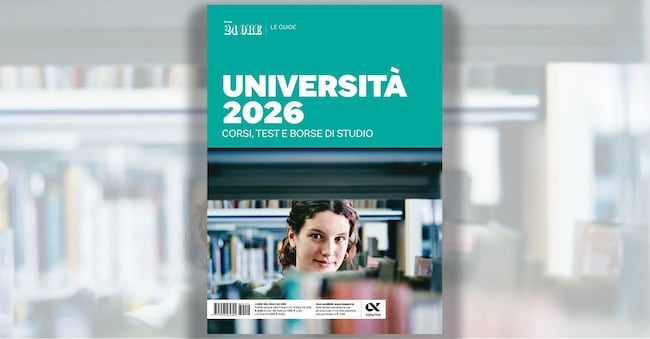
This is the starting point for the new University Guide of Il Sole 24 Ore, on newsstands on 10 June with the daily newspaper: 120 pages dedicated to courses, tests, scholarships, accommodation, fees, deductions and honour loans, with the aim of accompanying students and families through an increasingly complex choice.

Loading...

The starting point is a very wide range of courses on offer: over 5,600 degree courses including three-year, two-year master's and single-cycle master's degrees, in a university system that continues to update around certain keywords: healthcare, artificial intelligence, sustainability, data, internationalisation and hybrid skills.

The new proposals from the universities tell of a university that tries to intercept the changes in the labour market and society: healthcare profiles with digital skills, innovation lawyers, sustainability-oriented economists, engineers and designers called upon to measure themselves against energy transition, advanced manufacturing and automation, humanists capable of dialogue with Ai.

The Guide organises this universe into six 'missions'.

Care looks at Medicine, Health Professions, Psychology, Exercise Science, Pharmacy and Biotechnology.

 Design crosses Engineering, Architecture, Design, Fashion, Energy and Materials.

Deciding brings together Economics, Management, Finance, Law and Political Science. Understanding and Communication enters the humanities, languages, communication, education and cultural heritage.

Calculate and Protect focuses on Mathematics, Computer Science, Statistics, Data Science, Cybersecurity and Artificial Intelligence.

Regenerate follows the thread of environment, agriculture, biology, chemistry, geology, energy and sustainability.

It is not only a course map. It is also a practical compass. The guide explains how to read a syllabus, what questions to ask at open days, how to evaluate internships, workshops, transitions between courses and professional outlets. Ample space is devoted to artificial intelligence, which enters university curricula but also study tools and preparation for entrance tests.

For those who have to face a course with programmed access or an assessment test, the simulations edited by Alpha Test are back: from Medicine to the Health Professions, from Psychology to Architecture and Design, up to the economic-legal, scientific and humanistic areas. A way to measure yourself immediately with logic, text comprehension, mathematics, biology, chemistry and general culture.

Then there is perhaps the most concrete chapter: the life as a student. Because the cost of university is not just fees. Rent, transport, canteen, books, computers, software, travel, commuting time all weigh in. This is why the Guide devotes a section tooff-campus students, student halls of residence, colleges, no tax areas, scholarships, tax breaks and honour loans from banks.

Copyright reserved ©
Loading...

Brand connect

Loading...

Newsletter

Notizie e approfondimenti sugli avvenimenti politici, economici e finanziari.

Iscriviti