
University (interdisciplinary) laboratory of hope for young people
Rector Beccalli explained how the university sees itself as an educating community that goes beyond mere education, promoting generational dialogue and multidisciplinary paths to address contemporary challenges

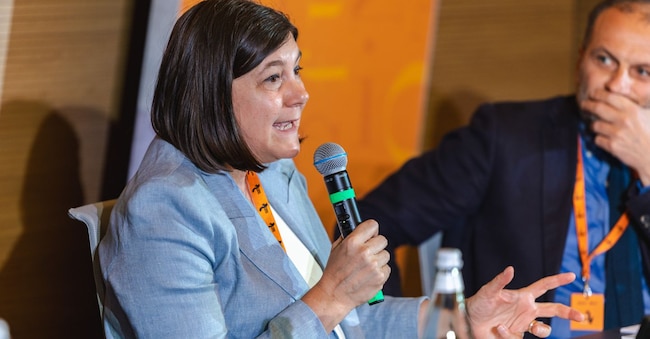
At the Trento Festival of Economics, one of the central themes was the one indicated in the second part of the title of the 2026 edition: 'the hopes of young people'. And one of the last appointments, on Sunday, was precisely dedicated to the university, the main place for young people, as a "laboratory of hope", not only a place of education but a space capable of generating meaning and community in times of wars, polarisations and rapid technological revolutions. This is the thread of the meeting dedicated to the book University laboratory of hope (Vita e pensiero), with the Rector of the Università Cattolica del Sacro Cuore, Elena Beccalli, the writer and UniCatt lecturer, Giuseppe Lupo, and Professor Andrea Santini, dean of the Faculty of Political and Social Sciences at the Catholic University, with Daniele Bellasio moderating the debate and taking questions from the audience.
Beccalli insisted on the idea of the university as an 'educating community', called upon not to reduce itself to a 'factory of graduates', but to cultivate dialogue between generations and responsibility towards the common good. Education is always an act of hope that looks to the future, he recalled, quoting Pope Francis and explaining that knowledge today must help young people not only to acquire skills, but above all to formulate "the right questions". In his reflections, the rector emphasised the value of an interdisciplinary approach capable of "drawing new maps of the educational world", countering individualism and inequality.
Santini, too, emphasised the need for truly interdisciplinary knowledge: disciplines, he explained, must contaminate each other and dialogue in order to address the complexity of the present, overcoming academic fences that are now inadequate for reading contemporary changes. In this regard, Beccalli announced the creation of the Schools of Knowledge, parallel courses for students and teachers with a fundamental theme each year to be explored with a multi and interdisciplinary approach.
Wolf chose a metaphor to talk about identity and technological transformation. He said that it is no coincidence that when we write, we eventually give the command "save as". We retain something of ourselves, but we are forced to redefine ourselves again and again. In this scenario, marked by the acceleration of Artificial Intelligence and digital innovations, the humanities remain even more decisive because language, he noted, serves 'to bring order to a world in disarray'.
The debate took its cue from the book, a choral work resulting from the work of all 12 faculties of the Catholic University, but it also turned into a discussion that intertwined economics, education, culture and above all hope.

