
Urban planning enquiry, the re-examination court releases the Rusconi project in via Anfiteatro
For the Unico Brera project, involving the construction of an 11-storey tower, there are 27 suspects
by Sara Monaci
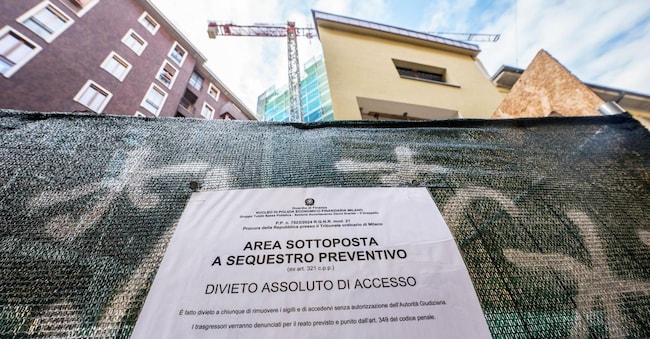
A new chapter in the maxi-investigation into Milan's urban planning: the Milan Court of Re-examination, accepting the defence's appeal, has cancelled the preventive seizure order of the 'Unico-Brera' residential tower, under construction in the historic centre of the Brera area, in via Anfiteatro. The building site had been seized last December in an investigation with 27 suspects for building abuse, illegal subdivision and forgery.
It was a seizure that had raised many questions from the outset, having already been cleared by the Tar. Thus, in their appeal, the defence - including lawyers Federico Papa, Fabio Todarello, Lodovico Mangiarotti and Michele Bencini - pointed out that the gip Mattia Fiorentini, who had accepted the request of the public prosecutors Petruzzella, Filippini and Clerici, did not "in the least" bother "to analyse" the sentences of the "administrative justice", the Tar and the Council of State, which had declared the building permit for that project "legitimate". The Galli-Nosenzo-Amicone judges, upholding the appeal, therefore annulled the decree.
The real estate project of builders Carlo and Stefano Rusconi with Rs Srl aims to transform two eighteenth-century ruins of five and three storeys, demolished in 2006, into an 11-storey tower over 34 metres high, 27 flats and 45 potential inhabitants. The work should be completed in 2026 and has been authorised, as in dozens of other cases that have come under the judiciary's lens, with an Scia, Certified Declaration of Start of Activity, being considered "building renovation" in 2019 and, subsequently, with another Certified Declaration of Start of Activity, as a variant in 2023. The 'starting price' of the flats seized at the construction site is 'set at 660,000 euro' with 'increments according to size, overlook and floor, services and amenities included', reads the real estate initiative's website.
This umpteenth episode is a demonstration of how not only complex but also difficult to interpret is the law on town planning: in essence, the public prosecutor's office believes that the law on town planning of the 1940s should apply; the builders believe that the Consolidated Building Law of the 2000s can be taken as a reference. However, it must be said that two recent rulings, one by the Supreme Court of Cassation (in July, on Residenze Le Lac) and one by the Council of State (in November, on Via Fauché), support the investigators' thesis, emphasising respectively that the tool of the Implementation Plan should be preferred and that a work can only be defined as renovation if it is contextual to the demolition, respecting the outline.
Meanwhile, as mentioned, 27 people are under investigation for the Unico Brera project, including names already present in other similar investigations, such as Marco Cerri, Giovanni Oggioni and Alessandro Scandurra. Prosecutors were also analysing the transfer of ownership of the areas: they were public between 2007 and 2008, then they were included in the Municipality's Alienation and Development Plans (the two funds called Milano 1 and Milano 2) and awarded to Bnp Paribas, which in turn sold them to private individuals after obtaining positive opinions from the Landscape Commission. Originally, the lot was only 400 square metres in Via Anfiteatro (which connects Corso Garibaldi to Milan's Civic Arena and Sempione Park on which the building now stands with a building index of over 9 cubic metres per square metre). However, the release from seizure could now call into question the indictment for this affair.


