
Us, unidentified female objects
'Cassandra at point-blank range' is a macabre, surprising, ironic and feminist elegy, dedicated to all the women who could not be, whom no one understood, not even themselves
by Lara Ricci
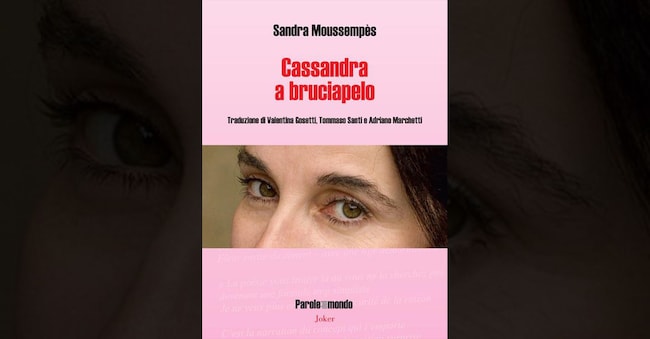
Abandoned houses become shells to contain all that we have never been, could have been, or what we are forced to impersonate, us, "unidentified female objects", in the surprising, ironic, unscrupulous collection Cassandra at point-blank range. Elegia macabra by Basque-born French and Italian poet and artist Sandra Moussempès, carefully translated by Valentina Gosetti, Tommaso Santi and Adriano Marchetti.
Alter egos or sisters, they crowd with their bodies or their voiceovers poems that are like clouds in which to guess shapes. They sing "film princesses who escaped from a convent", hippie divas who sleep curled up against each other in their jumpers, schoolgirls stripped of their pom-pom outfits, Venuses in miniskirts and crop tops that reveal flat bellies, big almond eyes and full lips.
They are "creatures forged in concrete/dolls or padlocks" that inhabit rooms with the dusty languor of decaying Victorian mansions, with their stripped wallpapers, their tattered floral drapes. Which transmute into nightmares a la Mullholland drive and become the scene of the millenary slaughter of stuffed women. The "dictatorship of the Happy End" as the ultimate disfigurement.
Cassandra at point-blank range, the 2022 winner of the Théophile Gautier Prize of the Académie française, is a collection so compact that it seems like one long poem that returns and returns to the same harrowing quête, an endless enumeration of "ectoplasms in search/ of their history, bodies trying to infiltrate other bodies", of "women who meet for the thousandth time without meeting", dolls "saturated with hope" who "search for their reflection in vain" while "the blonde interlocutor [le] waits/ writhing on the violet floor". Punk heroines in "ghostly pink dressing gowns" in the middle of the forest intent on cutting themselves, wrist bandaged, chewing "wild strawberry chewing gum". Maidens who "are unwilling either to sparkle in the void or to move in a bikini, to walk metres of thought, between scalpel memories and prefabricated psychic habitation", who attend workshops for the "reappropriation of mirrors" wanting "to be able to choose [their] language without being disturbed by the reassembly of repaired words".
A poetic-esoteric quest guided by those women who nevertheless tried to be: 'Lilith, Ifigenia, Emily, Cindy, full of grace you are in the heavens/ They offer their faces to their four stand-ins with fictitious names/ (recoded here by subtle voices)'. Emily one and two, Dickinson and Brontë. Or rather, 'the twelve suspicious brunette Emilys' who 'wore the same third eye in the middle of their foreheads but with different looks'. Cindy who stands for Cinderella, Cinderella, 'Cindy who groans to translate another/ Cindy with a softer voice (Cindy bis cloned during a marathon of/ ectoplasms where her paranormal friends met)'.


