
Duel between US vice presidential candidates: Immigration, the Middle East and the economy at the centre of the debate
In the debate between the US vice presidential candidates, issues such as immigration, the Middle East and the economy were discussed, with calm tones but opposing views. Could the performance influence voters' preferences? Vance calmer and more controlled

6' min read
6' min read
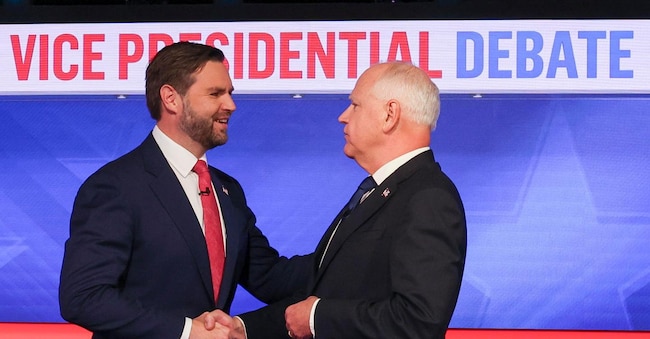
New York. Immigration and the Middle East, climate and abortion, inflation and the economy. And then the future of democracy. The debate in New York between the two candidates for the US vice-presidency, the Democrat Tim Walz and the Republican J.D. Vance, addressed all or most of the burning issues before the American voters. A clash in more sedate tones than the duel in the spotlight between Kamala Harris and Donald Trump in recent weeks, even if it emphasised opposing views.
Vance, especially in the early stages, seemed more in control of the issues and more comfortable than his podium rival; Walz seemed nervous and confused at times - evidence of his own staff's warnings that he was at a disadvantage in the debate format while excelling in retail politics. The performance could help Vance and Trump by projecting an image of 'normalcy' that has often eluded Republicans amid extreme rhetoric. Walz improved as the duel went on, and early CNN polls show that very few voters would change their minds about their preferences.
At the opening, foreign policy and the Middle East immediately dominated, amidst the spectre of war escalation. Walz reiterated Israel's defence against Iranian attacks and claimed the effectiveness of Harris and Joe Biden's leadership in strengthening American alliances to defend international stability. He called Harris "calm and determined", while Trump is "erratic" and prone to please dictators. Walza, however, confused the names of Iran and Israel in his response. Instead, Vance retorted by claiming that under the first Trump administration, America was stronger and more credible and commanded more respect, so much so that new conflicts were averted. And he criticised the Democrats for being too soft on Tehran.
On democracy, Vance downplayed Trump's efforts to overturn the 2020 election and claimed to be 'focused on the future'. Rather, he accused the Democrats of having long censored conservative voices in the media. Walz called it 'unacceptable' to deny what happened four years ago: he recalled the assault on Congress on 6 January, encouraged by Trump. "A president's words matter" and called Vance's claim that Trump would peacefully relinquish power then "historical revisionism". It was, he said, 'the first time a president has tried to subvert an election'.
However, there was no shortage of rare points of contact in the harsh climate of the campaign. Both Vance and Walz admitted past missteps. Walz acknowledged ('I misspoke') that he had exaggerated his presence in China during the democracy movement that culminated in the Tiananmen drama. Vance said he was wrong when he had called Trump unpresentable, adding, however, that he had given credence to prejudiced stories in the media.


