
Ski World Cup driving force of innovation and sustainability for Alpine tourism
The Alpine skiing stages in South Tyrol and the Dolomites represent a model of technological and organisational excellence, driving the qualitative growth and resilience of mountain tourism towards future major events

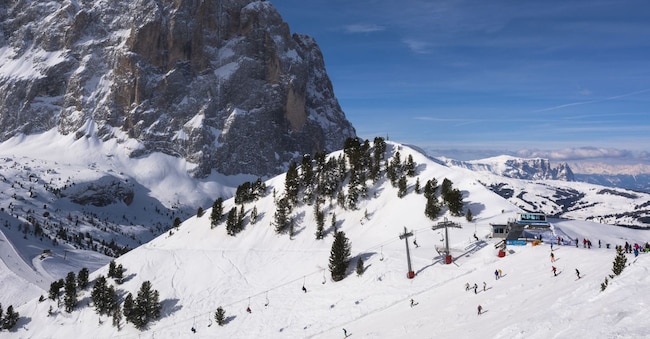
The white circus of the Audi Fis Ski World Cup, the Alpine Ski World Cup, has once again crossed the Italian borders this year in a winter that is not just a sequence of competitive events, but the prologue to a new era for the mountain tourism industry. Saslong (exceptionally) from 18 to 20 December, Gran Risa from 21 to 22 December. An important test occasion, because this is not just a sporting competition, but an industrial ecosystem regulated by strict standards, which must come to terms with the criticality of a winter season that began with great snowfalls in November but was characterised by a warmer-than-usual middle December. And, not of secondary importance, it is also the dawn of a season that will culminate in the Milan-Cortina 2026 Games. But observing the dynamism that animates Val Gardena and Alta Badia, it is clear that what is at stake exceeds even the perimeter of the Olympic dream.
Between the folds of the Saslong, the temple of speed, and the slopes of the Gran Risa, the university of the Giant, the manual for the survival and revival of an entire economic sector is being written, capable of transforming the climatic challenge into an opportunity for technological supremacy. If Val Gardena is already aiming straight at the World Cup in 2031, Alta Badia is celebrating an anniversary this year that is a political and commercial manifesto: the 40th anniversary of the test run of the Gran Risa, the slope that has redefined the concept of excellence in the heart of the Dolomites.
Alta Badia, 40 years of Gran Risa: when sport becomes economic infrastructure
Andy Varallo, at the head of the Alta Badia organising committee, observes this milestone with the coolness of an entrepreneur and the awareness of one who belongs to a family history that has helped to build the valley's modern tourism model. The most risky decision that, in his opinion, has ensured the continuity of the Gran Risa in its four decades of history was to make a significant part of the complex operational machine dependent on local volunteers. It was not a choice of savings, but of identity: motivating the population means transforming a professional race into a shared project, in which the territory becomes an active part of the event and the quality of hospitality is transformed into a true competitive asset. It is the same logic that Varallo also recognises in the collaboration with the Maratona dles Dolomites, 'an event that is different in nature, but with which there is a concrete collaboration and an exchange of resources,' because, as he emphasises, 'when a great event works, it brings benefits to the whole territory.
The long-time manager of Corvara, who is also a key figure in Ski Carosello and Dolomiti Superski, is convinced that a major resort without a major event cannot aspire to star brand status, that condition of global recognition that allows it to dominate the market. The World Cup in Alta Badia does not aim at the indistinct masses: the strategy is clear and aims at absolute quality in the parterre. Unlike other international stages, here the choice has been made to invest in a finishing structure that does not seek the exasperated number of spectators, but the high profile of the experience.
From the point of view of sustainability, a topic often used as a weapon of criticism against skiing, Varallo reverses the narrative with economic pragmatism. According to internal estimates, 'the World Cup race generates no more carbon dioxide emissions than a normal tourist day in high season. The convergence of people towards the arrival area is compensated by a distribution of flows that does not multiply the occupied beds or cars in circulation, which remain superimposable to those of any peak weekend'.


