
Valdés has died and Raúl is 95; what remains today of revolutionary Cuba?
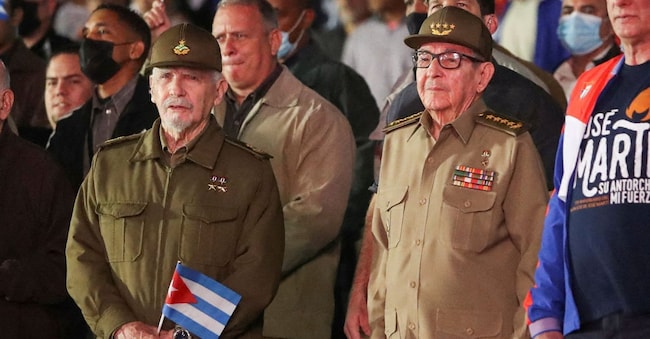
Ramiro Valdés Menéndez, a military officer and revolutionary politician who was one of Fidel Castro’s earliest collaborators, died on Sunday at the age of 94. Raúl Castro, Fidel’s brother and president until 2018, is 95 years old. Let us take a look at who remains today from the revolutionary Cuba that overthrew the dictator Fulgencio Batista between 26 July 1953 and 1 January 1959.

Key points
‘The party is just a front. Diaz-Canel, Cuba’s president, has no power whatsoever; the power lies in the hands of Raúl and the armed forces, who, as well as having the guns, have the bank accounts,” said Sebastián Arcos, director of the Cuban Research Institute at Florida International University, in an interview with CNN in May.
Raúl Castro, Fidel’s brother and the face of the Cuban revolution that brought the Communist Party to the island, is 95 years old and now retired. However, despite his advanced age and his retirement from official office, on 20 May he was accused by the United States of having killed US citizens in 1996.
The US’s interest in imprisoning Raúl, rather than Cuba’s current president, Díaz-Canel, is seen by many critics as further proof that ‘the person truly in charge of the island is Raúl Castro’, as researcher Janette Habel told *Le Monde*. She went on to add, however, that ‘he is not alone; he is surrounded by other figures linked to the armed forces, and particularly to GAESA’. GAESA is a Cuban economic mega-conglomerate owned by the Revolutionary Armed Forces (FAR) and founded by Raúl. It is estimated that GAESA controls around 40 per cent of the Cuban economy, making the 95-year-old one of – if not the – key figures at the helm of the island.
Guillermo García Frías: “Hero of the Republic of Cuba”
Garcia Frias was the first peasant to join the revolution. On 2 December 1956, he landed at Los Cayuelos alongside 81 other revolutionaries aboard the yacht Granma. The guerrillas of the 26th of July Movement had returned to Cuba after being exiled to Mexico. Frias, aged 98, holds the title of ‘Hero of the Republic of Cuba’. Following the consolidation of Fidel Castro’s government on 1 January 1959, he held various posts within the Revolutionary Armed Forces; he served as Vice-President of the Council of State and Ministers, Minister of Transport, and a member of the Central Committee of the Communist Party of Cuba. A historical and political figure, he continues to appear in public at events such as inaugurations or in interviews on the history of the party.
Dr José Ramón Machado Ventura
Dr José Ramón Machado Ventura joined what would become the 26 July Movement immediately after Fulgencio Batista’s coup d’état on 10 March 1952. He fought in the battles in the Sierra Maestra, the mountain range where the revolutionaries took refuge after returning to Cuba from Mexico. He held various political posts, including roles at the Ministry of National Health. It was only in 2021, at the age of 90, that he retired from the Communist Party’s Politburo, making way for the new generation to take on new responsibilities.

