Interview

Valerio Lundini: 'The demented is everywhere. Even Trump has realised this'

First European tour for Italia's most surreal comedian. Between mansplaining, the power of memes and the project for a film (with a piece of Sanremo in it)

by Francesco Prisco

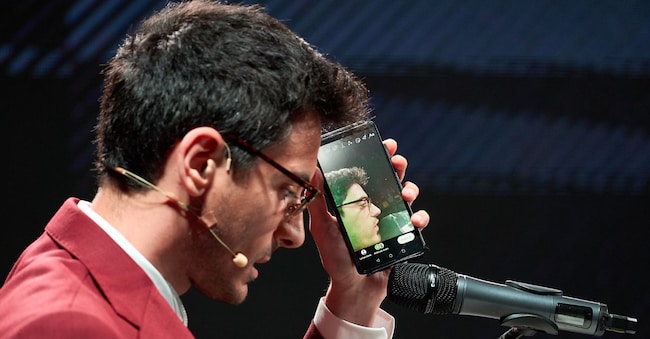
Valerio Lundini porta in tour europeo lo spettacolo «Il mansplaining spiegato a mia figlia»

10' min read

Translated by AI
Versione italiana

10' min read

Translated by AI
Versione italiana

Warning: this is the most surreal article you will read today in Il Sole 24 Ore. Judge for yourself, there really is something for all tastes: "mansplaining" and Mike Bongiorno, Depeche Mode and the Roman pinsa that never really existed, Oasis doing corporate concerts, Trump memes and the demential winning over everything. Valerio Lundini, Italia's most surreal comedian, is about to embark on the first European tour of his career: the first two dates at Milan's Arcimboldi (14 and 15 May), then Rome's Auditorium (30, 31 May and 1 June), Madrid, Barcelona, Brussels, Amsterdam, Paris and London, 'even though London is not in Europe', the claim mockingly reads. As he was packing his suitcase for Milan, we got an explanation of where he wants to go. Our chat lasted an hour (then, for Lundini, it was train time and we didn't want to take the responsibility of making him miss the first Milan date). What we said to each other, between the serious and the facetious, you will find below.

The title of the show is The mansplaining explained to my daughter. The title of the first question in this interview, however, is: How would you explain The mansplaining explained to my daughter to the readers of Il Sole 24 Ore?

Loading...

The truth is that I did a bit like you do with records, where you give the album a title that you like and it doesn't necessarily have anything to do with the songs in it. Specifically, in the show I never talk about mansplaining. And, to be honest, I don't even have a daughter, but... this title made me laugh. The Mansplaining Explained to My Daughter is an anthology of situations and sketches centred around trying to do a monologue while all around there are things happening that might seem random. There is no fil rouge, as they would say in Lyon. The show starts as a noir, then it becomes a news report, the central part is about a love story, you perceive different characters without me doing voices or imitations of characters. Now that I think about it, this is the first time I have ever tried to explain The Mansplaining Explained to My Daughter: I usually go round and round in order not to explain it also because, in doing so, I have never seen this show and, to explain it well, I would rather call someone who has seen it. From my point of view, I would say that it is a set of surreal situations with musicals, monologue at the lectern... different things. In my opinion, it's funny. Put it this way, as a tradesman. I would go and see it.

You are touring Europe. Usually Italia, when it produces art and/or entertainment, is accused of being provincial. How did the idea of trespassing come about?

I should point out that even in the rest of Italia the show will be all in Italian: the tickets were bought by Italians who live there, with the exception of the Paris date where, I am told, there will be some French people who understand Italian. And thank goodness, because it is an untranslatable show. The only foreign language I know is English, despite my five-day Erasmus in Spain (for an episode of Faccende complicate edr), but for a matter of comic timing I am convinced that Il mansplaining explained to my daughter in other languages would not work. It would be like asking a pianist to play on the guitar a piece he wrote for the piano. Then maybe translated it would still work, who knows? As for Italia entertainment, the problem is not so much the provincialism itself, but the complacency of this provincialism: we boast that we understand nothing.

The gaffes of Adriano Celentano come to mind when, in Frankly I don't care, he hosted David Bowie.

It may be that with Celentano I have always been complacent, but in that case I think the gaffes are more attributable to the fact that he was trying to show himself to be intimate with Bowie and evidently was not. More anxiety not to prove himself provincial than provincialism. My real enemy has always been another: Mike Bongiorno. I never liked him and, now that he is gone, I can say so. Even though he was American, he perfectly embodied a certain desire of Italians to show themselves superior to others in their inferiority.

And here the reference, then, goes back to when Bongiorno hosted Depeche Mode at Superflash.

And treated them like a gang of...

You did three seasons of Una pezza di Lundini, a RAI programme that was very well received, then there was Faccende complicate: a bit of a documentary, a bit of a social experiment, a bit of fiction. How has your comedy evolved from one format to another?

The Pezza was full of writing. There was a bit of improvisation, but it remained basically a written format. With Emanuela Fanelli we had a lot of fun making it and, when we meet, we renew our wish to one day return to that purity. Complicated Faces was born from the desire to do something completely different. Something more difficult: it was a format focused on reality, but I was not reality. The contradiction amused me a lot. And I was fascinated by the fact that, at a time when everything is clipped, there to understand the programme you had to watch the whole episode. The Facende were more extemporaneous.

Some might have interpreted them as a surrealistic evolution of Pif's formats.

I have always had great envy for Pif, who goes on a place practically alone and makes great television. With Complicated Faces, to make a twenty-minute episode, I sometimes had to work for weeks. There is a basic difficulty: it would have been much easier if such a format had been carried out by an unknown person. Someone like Stefano De Martino could never do Complicated affairs, because dozens of girls would chase him down the street to get an autograph. In my case there were no girls, but every now and then some guy with glasses and an unkempt beard would pop up asking for a selfie.

What, instead, will Valerio Lundini's next step be?

In the meantime, I'm taking this show to Europe and we'll see what happens. Then, with three hands, I am writing a new show, TV stuff that I still don't know if we will do in the studio or will be touring, and something for the cinema. I hope that at least one of the three will turn out well.

Lundini's comedy takes on clichés. How do the proponents of these clichés react?

Rather than picking on clichés, I pick on those who celebrate their clichés.

Often, for example, you have been ironic about Naples and Neapolitans, as in the case of The Adventures of Pwollenecienièlle.

Speaking of Neapolitans: a cliché has it that they are a tough audience in the theatre and touchy in life. On the contrary: I have to say that when I have performed in Naples I have always had a great time. I come from Rome, which is another city subjugated by clichés: the same criticism I make of Naples I also make of my city, which is morbidly attached to its own clichés. This story of Romans having big hearts is, for example, unbearable. No, I say: are there Roman bastards or not? Of course there are: as there are in every city, but we must carry on this story of the Romans having big hearts, as well as the fact that every Roman restaurant today must claim to make carbonara the way your grandmother used to make it. And shall we talk about the rediscovery of the pinsa romana? The pinsa romana never existed.... The truth is that I am not so amused by clichés but by those who boast about them. I would never make a joke about the Genoese being stingy. And I won't speak ill of Milanese taxi drivers. Also because I'm about to perform in Milan.

In the meantime, your career as keyboard player in I Vazzanikki continues. How important is music in the kind of comedy you perform?

Much more than one thinks. From music I get ideas for stories, sketches, films. It often suggests an atmosphere that I like to bring back into another container. Because my English is not perfect, I have, for example, happened to write songs inspired by English songs that I had misinterpreted. It happened with It wasn't me by Chuck Berry. I was convinced that the refrain said: 'I'm so glad It wasn't me' and so I wrote a song with almost the same title in Italian, Meno mane che non è capitato a me. Actually, in that song, Chuck Berry was saying something else entirely. The ending of the film I'm writing, then, came to me while listening to a song from Sanremo a few years ago: I won't say which one, so as not to make spoilers. There is a little-known song by Sergio Caputo, Maccheroni Amari, that made me think of a scene from a film and one day I would like to make another film, just to put that scene in it.

Is there a mainstream explosion of the demented at the moment? 

We only use the term demential, applied to comedy, here in Italia. We define as demented Mel Brooks, Leslie Nielsen... that world there. I think back to my adolescence, when the exploits of detective Frank Drebin represented an escape from so much bad television. We are a country where, on TV, when there is a comedian, you always need the host on duty next to him who says: 'You're dumb'. Even if you are Nino Frassica. I recognise that, also considering social media, there is a lot of stuff around today and I don't even know if there is all this need to laugh. I'm not just talking about professional content.... Maybe I find reels of suit shopkeepers doing skits to promote what they sell funny. But then I'm disappointed when I find out that that gag is copied from a previous reel from another suit shop, which is copied from a TikTok that picked up on a trend that started in South America a month earlier... When I see all this, I think of a great like Daniele Luttazzi who paid the price for copying. Today everyone copies and no one gives a damn. The demented is everywhere. Even Trump has realised this, who "memes" like there's no tomorrow.

Five years ago there was a glimpse of something new in Italian comedy and you were part of that something. Do you feel today that that generation of comedians has definitively emerged?

Before, things were more definitively institutionalised, today they are not. First there was Ezio Greggio and Enzo Iachetti, then the niche ones you had to meet in underground clubs. Today I have no idea what I am: whether I am niche or mainstream. They consider a Stefano Rapone who did the Arcimboldi to be niche.... boh. Before there was TV and radio: Fiorello and Celentano everyone knew them. Today a division between bubbles prevails. Maybe we have a twitcher followed by six million followers and you and I don't even know who he is. I don't necessarily see that as a bad thing.

How much are streaming platforms counting in the affirmation of the new generation of comedians?

They are certainly helping the popularity of those in our profession. I don't see any great investment by authors. Absurdly, the much reviled RAI with all its limitations, politics and various issues, every now and then allows you to come up with strange things. Maybe it is because I was lucky, I had the support of Giovanni Benincasa who believed in the things I was proposing... on platforms everything tends to resemble something foreign. In this way you lose that purity that makes the difference. There is not so much a question of new and old comedians: I would distinguish between lazy and not lazy humour. Sometimes Maestro Frassica, from the height of his 75 years, looking at things going around on social media, says to me: this is really old stuff.

Of your colleagues, who makes you laugh the most?

Although we don't always understand each other, I would say first of all Alessandro Gori, l0 Sgargabonzi, one of the most original voices we have. A bit of a badass, but very good. Then Zerocalcare: he's not a comedian, but he's someone who always has something to tell and that makes all the difference. I also say Emanuela Fanelli. Simply great.

The parody of the Oasis reunion made by you and Edoardo Ferrario at In & Out was very much on point. How consciously were you making fun of the entertainment world in Italia?

I trust that Oasis are the only characters towards whom I retain some form of healthy mythomania. Like, if Liam is in Rome, I'm capable of going under the hotel to see him pop up. That In & Out wasn't so much a sketch for people who knew Oasis, but for people who work in entertainment in Italy. Years ago I wrote a booklet of short stories and there was one about U2 soundchecking in Mexico City. The dynamics between Bono and The Edge, in my text, were what I experienced in the pubs of Civitavecchia: the difficulties in getting paid, friends to let in for free, the girl whose number you gave and who you're afraid will show up because, at the same concert, in the audience there might be another girl you're seeing... I didn't know anything about U2, but I'm not a philologist. Edoardo and I did the same thing with Oasis. It all started from Whatsapp messages we sent each other, as soon as they announced the reunion, in which I was Nel and he was Liam.

Memorable gag about Oasis being 'corporatists', concerts at company meetings...

And sure: everyone does them today. Also because, out there, there are no longer the militant fans who charge you with such choices and accuse you of being a sellout, as was the case until the late 1990s. Paul McCartney, another absolute myth of mine, did the Apple corporate... You do four songs, maybe the best known, you get paid well, what more do you want? By the way: considering that we're on Sole 24 Ore and we're read by a certain kind of audience, I'll take the opportunity to say that with I Vazzanikki we're willing to do events of this kind. Then, on the money, we'll agree, thank you.

Copyright reserved ©
Loading...

Brand connect

Loading...

Newsletter

Notizie e approfondimenti sugli avvenimenti politici, economici e finanziari.

Iscriviti