
Valtellina PDO cheeses: Casera on the rise, good prospects for the Bitto season
The Consortium presents a Guide to spread knowledge about the two cheeses and three recipes created by (Valtellina and starred) chef Alessandro Negrini. First (not easy) steps towards export growth
4' min read
4' min read
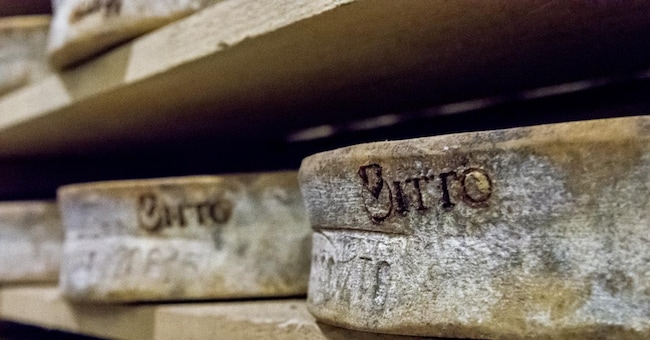
After the appreciable results of 2023, the production of Valtellina Casera Dop also started growing in 2024. And the production season of Bitto, a raw milk cheese with an ancient tradition, exclusively produced in alpine pastures and coming from two milkings processed practically in real time (up to 10% goat's milk is also allowed), has just started. And it seems to have got off to a good start, with the rains favouring the growth of grass (and therefore hay) for the dairy cows, and the snow that, although it remained at altitude for a long time, melted in time to make room for the pastures.
There was therefore a fair amount of optimism at the presentation of the new season. "There would be much more demand for Bitto, but it is not easy to find those who are still willing to carry on the tradition of the alpine pastures and the willingness of cheesemakers outside the family tradition," says Consortium President Marco Deghi. The objective is therefore to continue working to increase quality and create marginality, also by communicating how laborious the production of this cheese is (which not by chance costs practically twice as much as Casera made at the bottom of the valley).
"There are 45 mountain pastures operating this year: they will host about 3,000 dairy cows and 300 goats on more than 11,000 hectares of pastures and meadows," says Deghi, "to renew the ancient summer rite of transhumance and create one of Italy's oldest raw-milk cheeses, produced from the end of June to September in small dairies in the provinces of Sondrio and Lecco (and in some neighbouring municipalities in the Brembana Valley) on peaks between 1,400 and 2,300 metres.
Alongside Bitto there is Casera Dop, the semi-fat dairy cheese (in dialect 'caséra, the dairyman's house') produced mainly in winter when the herds remain at the bottom of the valley. But now attempts are being made to lengthen the production period as much as possible, to give continuity and also different types of maturing, with the '300 days' cheese taking on very different organoleptic characteristics from the more classic '70 days' and '180 days'.
The promotion of longer maturing also has the aim of enlargingthe market, which for the two PDOs is basically confined to Northern Italy. Abroad is still worth a few percentage points and is growing slowly. 'However, we are trying and some results are starting to arrive,' says the president. 'It is satisfying to establish ourselves in a 'cheese expert' country such as neighbouring Switzerland, but we are now reaching other mature markets such as Germany and France.


