Regional elections

Veneto, Campania and Apulia: here are the candidates and challenges in the coalitions

On Sunday 23 (7 a.m. to 11 p.m.) and Monday 24 (7 a.m. to 3 p.m.) November, regional elections will be held in Veneto, Campania and Apulia to elect a new president and new regional councillors.

by Andrea Gagliardi

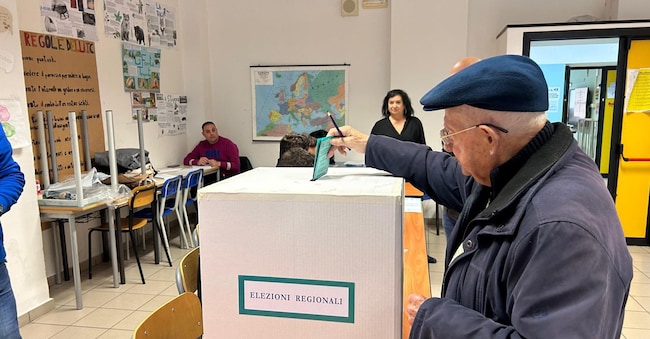
Operazioni di voto in un seggio, 21 aprile 2024. ANSA/FRANCESCO CUTRO

5' min read

Translated by AI
Versione italiana

5' min read

Translated by AI
Versione italiana

On Sunday 23 (7 a.m. to 11 p.m.) and Monday 24 (7 a.m. to 3 p.m.) November, regional elections will be held in Veneto, Campania and Puglia to elect a new president and new regional councillors. Some 13 million voters are called to the polls (5 million in Campania, 4.3 million in Veneto and 3.5 million in Puglia). According to publishable polls, the game is already decided in Veneto and Puglia, where Alberto Stefani (centre-right) and Antonio Decaro (centre-left) are clearly ahead of their competitors. The game in Campania is more open, where Antonio Cirielli (centre-right) faces Roberto Fico (centre-left).

Candidates in Veneto

In Veneto, five people are fighting to take up the legacy of Luca Zaia, no longer eligible for office after three terms: Alberto Stefani (centre-right); Giovanni Manildo (centre-left); Marco Rizzo of Democrazia Sovrana e Popolare; Fabio Bui (Popolari per il Veneto) and Riccardo Szumski (Resistere Veneto). The last polls before the legally required stop give Stefani a wide lead, with a range between 62% and 65%, while Manildo is between 26% and 32%. Stefani, deputy secretary of the Lega, is supported by the entire centre-right: Lega, Forza Italia, Fratelli d'Italia, Noi Moderati per Stefani, Unione di Centro and Liga Veneta. Manildo, is supported by all the centre-left forces, including Azione: (Movimento 5 Stelle, Pd, Avs, Volt Europa, Pace Salute Lavoro (Rifondazione Comunista) and the lists Uniti per Manildo Presidente, Civiche Venete.

Loading...

The match in the centre-right

The game in the centre-right is over who between the League and Fdi will come out on top as a list vote. The Melonians have hardly agreed to give up expressing the presidential candidate in the region, giving up their place to the League in exchange for an option on Lombardy in 2028. And now they are aiming to confirm their supremacy in the 2022 political elections and the 2024 European elections. While the League, counting on the'Zaia effect, leader in all provinces, to snatch the sceptre from Fdi. One of the latest polls published, that of the Demos institute places the League between 22 and 26% and Fratelli d'Italia very close, between 21 and 25%. A head-to-head match is therefore looming in a game destined to certainly condition the balance in the future junta. The centre-left would be content to reach 30%. A result that would allow it to lay the foundations to be competitive again in a region where it has always struggled to take root (in 2020 the centre-left candidate Arturo Lorenzoni). At the last elections in September 2020, centre-left candidate Arturo Lorenzoni took only 15.7 per cent while Luca Zaia was elected president for the third time with 76.8 per cent.

The challenge between Fico and Cirielli in Campania

In Campania, the centre-left and the 5 Star Movement are fielding the former President of the Chamber of Deputies Roberto Fico. His candidature is also supported by the Pd, AVS, Casa Riformista (a list linked to Italia Viva), 'Noi di Centro' (the party of Benevento mayor Clemente Mastella), the civic lists 'Roberto Fico Presidente', 'Avanti Campania' and 'A Testa Alta' (the civic list of outgoing governor Vincenzo De Luca, no longer eligible for re-election after two terms). The centre-left coalition does not include Action.

Fico's candidacy was the focus of a long confrontation with De Luca himself. The outgoing president, who has always been critical of the 5 Star Movement, accepted Fico's name only after an internal agreement within the PD on the leadership of the party secretariat in Campania, attributed to his son Piero De Luca.

The name chosen by the centre-right is that of Edmondo Cirielli, current Deputy Minister of Foreign Affairs and International Cooperation. Cirielli is a historical exponent of Fratelli d'Italia and is supported not only by the majority parties, but also by the Unione di Centro, Gianfranco Rotondi's Christian Democrats and the civic lists 'Cirielli presidente' and 'Pensioners-Consumers'.

In addition to Cirielli and Fico, there are four other presidential candidates in the Campania elections: the mayor of Terni Stefano Bandecchi with 'Dimensione Bandecchi'; Nicola Campanile with 'Per le Persone e la Comunità'; Giuliano Granato with 'Campania Popolare', a list with candidates from Potere al Popolo and the Italian Communist Party; and Carlo Arnese for 'Forza del Popolo'.

The match in the coalitions

Roberto Fico is given as the winner by the latest publishable polls with a 7-10 point lead. But surely 'Cirielli will not lose badly', are convinced the Fratelli d'Italia, who are not giving up on some last-minute electoral promises, such as the one launched by the candidate governor of '100 euro a month to those who receive minimum pensions in Campania' and the possible reopening of the terms of the building amnesty that was passed in 2003 by the Berlusconi government (in the form of amendments reported to the manoeuvre by Fdi)

The vote, on the other hand, will also serve to measure the weights within the coalitions, with Fi, the second largest party on the centre-right, not hiding its ambition to overtake Fdi, decisively improving on its 2020 result (which had already passed double figures at the political elections). In the centre-left, it will be important to understand when the polls close how much the list of 'sheriff' De Luca ('A testa alta') will weigh: whether it will take more votes than the M5s and how many councillors it will elect. Because it is no mystery that the outgoing governor, after the go-ahead given to Fico with difficulty, aims to condition the balance in the new regional council.

In Puglia downhill road for Decaro

In Apulia, the candidate of the centre-left coalition is Antonio Decaro, former mayor of Bari and currently MEP for the Democratic Party. Decaro is also supported by the 5 Star Movement, Alleanza Verdi-Sinistra and three civic lists ('Decaro Presidente', 'Per la Puglia' and 'Avanti Popolari con Decaro'), while among the centrist forces he is supported by Azione, Italia Viva and Più Europa, with some exponents present in the civic lists linked to them. The centre-right, instead, after months of internal discussion, has decided to converge on entrepreneur Luigi Lobuono, former president of the Fiera del Levante, supported by Fratelli d'Italia, Lega, Forza Italia, Noi Moderati and the civic La Puglia con noi. In addition to the candidates of the two main coalitions, there are two further political proposals. Ada Donno, supported by the 'Puglia Pacifista Popolare' list, which brings together Potere al Popolo and Partito Comunista Italiano. And Sabino Mangano, former councillor of the 5 Star Movement in Bari, supported by the civic list 'Alleanza Civica per la Puglia'.

In the last consultations in September 2020, the centre-left stood separate from the 5-Star Movement. The centre-left has led the region for 20 years (two terms of Nichi Vendola and two of Emiliano)

Disjunctive voting possible

In both Apulia and Campania, the electoral law in Veneto allows disjointed voting, i.e. the possibility of voting for a certain presidential candidate and for a list other than those supporting him or her. It is possible to express a preference for the presidential candidate or only for a list, in which case the vote is also in favour of the presidential candidate linked to the list. Up to two preferences may be expressed for councillor candidates, but the votes must go to candidates belonging to the same list and of different gender (one man and one woman or vice versa).

Thresholds for seat distribution

In Apulia, in order to compete for the distribution of seats, individual lists must exceed the threshold of 4 per cent if they are in a coalition, and 8 per cent if they stand alone. In Campania, in order to win seats, a list must exceed 2.5 per cent of the valid votes at the regional level In Veneto, seats are distributed at the regional level among coalitions that have obtained at least 5 per cent of the valid votes or are composed of at least one group of lists that have obtained at least 3 per cent of the valid votes.

Copyright reserved ©
Loading...

Brand connect

Loading...

Newsletter

Notizie e approfondimenti sugli avvenimenti politici, economici e finanziari.

Iscriviti