
NATO Summit: it’s not just about defence funding – Italia is also playing its part on the southern flank
The summit sherpas claimed to have succeeded in having a new reference to the southern flank included in the conclusions of the Ankara summit, with the recognition that the threats emanating from that area require the same level of attention as those facing the eastern front

Key points
It is not just the issue of defence spending is not the only thorny issue on the agenda at the NATO summit in Ankara, which opens today, Tuesday 7 July. NATO’s target of 5 per cent by 2035 is a long way off – and not just in terms of time. Italia will be called upon to play its cards right to steer the attention of the 32 NATO member states towards the southern front – namely the Mediterranean, which is of extreme strategic importance to us. It is from there, in fact, that the migratory flow from Africa towards Europe originates, via uncontrolled routes managed by criminal networks that exploit political instability. And there is a country there – Libya – which continues to suffer from a power vacuum. NATO’s Southern Front, often associated with the geopolitical concept of the ‘Wider Mediterranean’, is therefore an absolute priority for Italia’s defence policy and national security. For historical, geographical and strategic reasons, Rome has always taken on the role of the main driving force behind this region within the North Atlantic Alliance.
The summit sherpas claimed to have succeeded in having a new reference to the southern flank included in the conclusions of the Ankara summit, with the recognition that the threats emanating from that area require the same level of attention as those facing the eastern front.
Italia: a natural bridge between Africa and the Atlantic Alliance
Now more than ever, in a context where NATO has for years prioritised its eastern flank, partly due to the threat posed by Russia. Since the start of the conflict in Ukraine, attention has inevitably shifted decisively eastwards. Italia is taking steps to remind its allies of the need to maintain a comprehensive approach. This is also because Russia and China are expanding their economic and military influence in Africa and the Mediterranean, effectively encircling Europe from the south. The Southern Front thus becomes, in Italia’s view, the point of convergence where national security coincides directly with the collective mission of the Atlantic Alliance, transforming the country into a natural bridge between NATO and the African continent. The Mattei Plan for Africa, presented by the Meloni government in early 2024, is a further piece of the jigsaw.
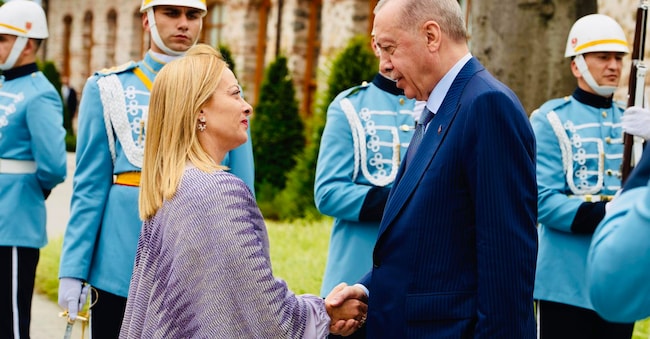
The dialogue between Meloni and Erdogan
The southern flank is one of the priorities that Prime Minister Giorgia Meloni shares with Turkish President Recep Tayyip Erdoğan, with whom she held a preparatory telephone conversation on the eve of the summit. Palazzo Chigi reported that the two leaders reaffirmed their shared commitment to strengthening transatlantic relations and collective defence within NATO, emphasising the importance of the southern flank. The conversation also provided an opportunity to discuss Libya, including cooperation in combating irregular migration flows and human trafficking. Libya is precisely one of the issues on which Rome and Ankara are stepping up their coordination. However, the government rejects the idea that there has been a change in Italia’s position following recent US initiatives: the objective remains the one supported jointly with the United Nations, namely to facilitate a process of national unification involving all relevant regional actors.
The central role of the Wider Mediterranean
The recent “new distribution” of responsibilities within the North Atlantic Treaty Organisation’s command structure has assigned Italy command of the Joint Force Command in Naples (JFC). The NATO command in Naples, based in Lago Patria (Naples), is one of the Atlantic Alliance’s two strategic-level operational commands in Europe. It is the linchpin of the Atlantic Alliance’s strategy for the Mediterranean, the Middle East and North Africa, but also has responsibility for the Balkans, an area of strategic importance for Italia. It coordinates key missions, including KFOR in Kosovo and assistance operations in Iraq. Historically, command of the JFC in Naples has always been entrusted to a US four-star admiral (who simultaneously held the post of Commander of US Naval Forces in Europe and Africa). The handover of command to a senior Italian officer represents a formal recognition of Italia’s geopolitical role and the operational capabilities of the Italian Armed Forces, in particular the Italian Navy. By entrusting Naples to Italy, the North Atlantic Alliance has indirectly recognised Italia’s position, which is to regard the stability of the southern theatre (comprising the Mediterranean, North Africa and the Sahel) as crucial. Within NATO, Italia finds itself playing a pivotal role in crisis management in the South, ranging from countering hybrid threats to monitoring energy and trade routes.


