
Robotaxis, open challenge: Volkswagen anticipates, Amazon starts production
By 2027, the first 1,000 VW vehicles will be on the road, starting in Hamburg and Los Angeles. The Seattle-based giant has just announced the start of production by its subsidiary Zoox

3' min read
3' min read
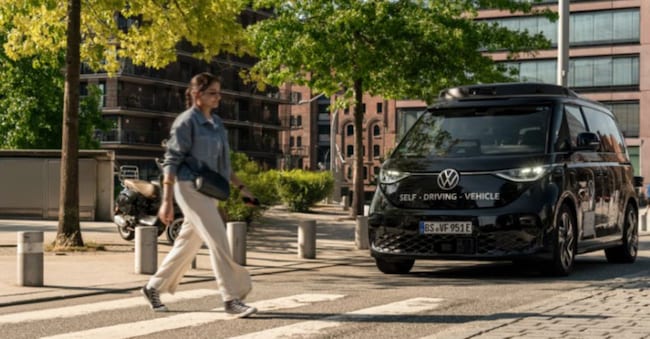
With the debut of the ID.Buzz in Hamburg yesterday, the Volkswagen Group officially enters the robotaxi market, challenging the Silicon Valley giants. The Level 4 electric minivan with autonomous driving (i.e. without a human driver) - mass-produced in the Hanover plant - will be operational from 2026, with the first fleets in Europe and the United States. The goal? To offer a large-scale commercial service from 2027.
The timetable is set: by the end of 2026 European and American homologation is expected, while by 2027 the first 1,000 vehicles will be on the road, starting in Hamburg and Los Angeles. The project foresees a gradual expansion: in Hamburg the fleet, managed by Moia (VW subsidiary), aims to reach 500 units in 2027. In the US, thanks to the partnership with Uber, a potential order of up to 10,000 vehicles in the next ten years is estimated.
Competition, meanwhile, is becoming increasingly fierce. Amazon announced just Wednesday the start of production by its subsidiary Zoox: up to 10,000 robotaxis per year in its Hayward, California plant. The e-commerce giant, which acquired the startup for $1.2 billion in 2020, aims to launch the commercial service in Las Vegas by the end of the year, before expanding to San Francisco in 2025. A strategy that mirrors the acceleration of the industry: while Waymo (Alphabet) has already delivered over 10 million paid rides by 2020, Tesla promises a limited service in Austin from Sunday.
The Volkswagen vehicle - an advanced version of the electric Bulli - is equipped with 13 cameras, nine lidars and five radars, with autonomous driving capabilities up to 120 km/h. On board are four passengers, with access via app and digital systems. The minibus will not be available for private customers, but exclusively for fleet operators or public transport. Zoox has opted for an even more radical design: gondola-like vehicles without a steering wheel, with four seats and compact dimensions for urban mobility.
Volkswagen emphasises that this is no longer an experimental project: 'Cities do not need new prototypes, but ready-to-use solutions,' explained Sascha Meyer, CEO of Moia. Behind this launch is a multi-billion dollar investment and years of testing in cities such as Munich, Oslo and Austin. Amazon shares the same industrial philosophy: the 20,440 square metre Californian plant - the equivalent of three and a half football pitches - currently produces one vehicle per day, but aims for three units per hour by 2025.


