Broken-down locomotive

Volkswagen: more strikes against cuts. Scholz: 'Wrong to close factories'

New round of negotiations between trade unions and the company, while workers are again blocking production in Germany. German Chancellor: 'Closing plants would not be the right way, bad management decisions have contributed to the difficult situation'

by Gianluca Di Donfrancesco

Dipendenti della Volkswagen partecipano a una manifestazione del sindacato IG Metall davanti al quartier generale di Wolfsburg (REUTERS)

4' min read

4' min read

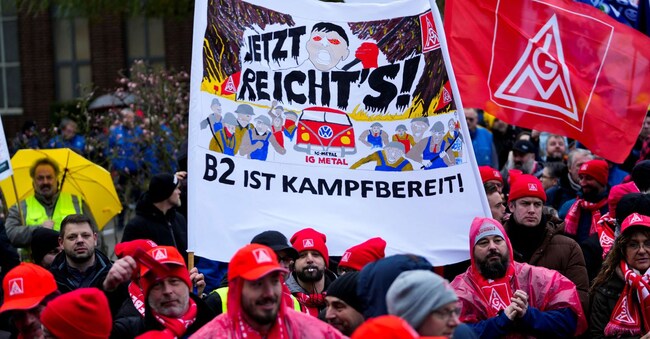
Second Monday strike in a fortnight for Volkswagen workers: on Monday, 9 December, thousands gathered in front of the gates of the Wolfsburg headquarters, as the fourth round of negotiations between the company and the unions was being staged. The four-hour production stoppage affected plants across the country in rotation. And here comes the support of the outgoing chancellor, Olaf Scholz: 'Wrong to close factories'.

"Trust destroyed"

.

The company insists on cutting production costs to regain efficiency and profitability and has threatened the closure of plants in Germany (up to three). In order to avoid thousands of redundancies, Ig Metall put forward an alternative plan, which includes reducing working hours and waiving bonuses and which would save the company EUR 1.5 billion, according to its calculations. However, the union's counterproposal was rejected by the managers.

Loading...

Even before the talks began, union leaders threatened more strikes if the company did not take steps in their direction. 'Trust has been destroyed, the workers are very angry. The VW brand risks being damaged by the board's behaviour,' said Thorsten Groeger, chief negotiator of Ig Metall.

The group, led by CEO Oliver Blume, is trying to plug a €4 billion hole in its €17 billion cost-cutting programme for the VW brand and related units. The stock is among the worst-performing among European carmakers, down almost 25 per cent this year.

Scholz rejects managers: 'Wrong to close factories'

The outgoing chancellor and leader of the SPD, Olaf Scholz, spoke out against the closures and against management: 'My opinion is clear: closing the factories would not be the right way. It would not be right because bad management decisions have contributed to the difficult situation,' he said on Sunday, 7 December. The state of Lower Saxony, which is Volkswagen's second largest shareholder and is led by the Spd, also urged against closures.

The Volkswagen crisis helped fragilise the Traffic Light coalition, which then imploded due to the impossibility of finding shared solutions to the more general crisis of the German economy. The dispute weighs heavily in the election campaign, ahead of the early vote in February.

Scholz certainly does not want to go down in history as the chancellor who witnessed the first Volkswagen plant closure in Germany in its 87-year history. Nobody would want that.

60 per cent installations

.

The capacity utilisation of the group's German factory network has fallen to less than 60 per cent over the past two decades, Bernstein analysts wrote in a November note, with spare capacity estimated at 800,000 units.

Volkswagen is suffering, like other car manufacturers, from declining sales in Europe, a mature market destined at best to grow very moderately, due to structural factors such as demographics and the changing consumption patterns of younger generations. The type of engine, electric or petrol, has little to do with it.

Above all, Volkswagen is paying for the wrong choices in China, which has turned heavily to electric (and that's where the engine comes in) and where the German group is being outclassed by its competitors, aided by more than $230 billion in state subsidies over the past 15 years. In 2024, electric models will account for 50 per cent of the domestic market with the prospect of rising to 75 per cent in the next few years.

In China the party is over

.

In the words of an industry analyst, for Volkswagen, as for Gm, Ford or Toyota, 'the party in China is over'. The lag is not only manifested in the engine, but also and above all in on-board electronics, advanced assistance and infotainment systems. In 2023, Volkswagen's market share in the world's largest car market was 14.5 per cent, up from 19.3 per cent in 2020. In the first 11 months of 2024, it stood at 11%.

In November, sales of new-fuel vehicles (Nev: electric, hybrid and fuel cell) in China jumped 51% year-on-year and 6% year-on-year in October, according to the China Passenger Car Association. A third of these vehicles are Byd-branded.

Back in 2018, Chinese manufacturers had the capacity to produce around one million Nevs, while foreign companies were stuck at 150,000, according to AutoForecast Solutions. This year, Chinese groups have risen to a production capacity of almost 10 million electric vehicles, while foreign competitors are at just 1.9 million.

Faithful to dividends

.

However, Volkswagen has no plans to change its dividend policy and is sticking to a payout ratio (the share of after-tax profits paid out to shareholders) of at least 30%.

Instead, IG Metall demands that shareholders and management do their part by waiving part of their bonuses and reducing profit redistribution.

The Porsche-Piech family, which controls Porsche SE and through it holds 31.9% of Volkswagen, looks at the affair with concern. Volkswagen's dividend is one of the most important sources of liquidity for the holding company and amounted to EUR 1.4 billion last year. Porsche SE is burdened with a debt of EUR 5.1 billion.


Copyright reserved ©
Loading...

Brand connect

Loading...

Newsletter

Notizie e approfondimenti sugli avvenimenti politici, economici e finanziari.

Iscriviti