
Norway: voters divided at polling stations on a quiet Election Day
Economy and geopolitical uncertainties are at the centre of people's concerns. Labour PM Støre votes and reassures: 'Inflation and interest rates are coming down'
from our correspondent Michele Pignatelli
2' min read
2' min read
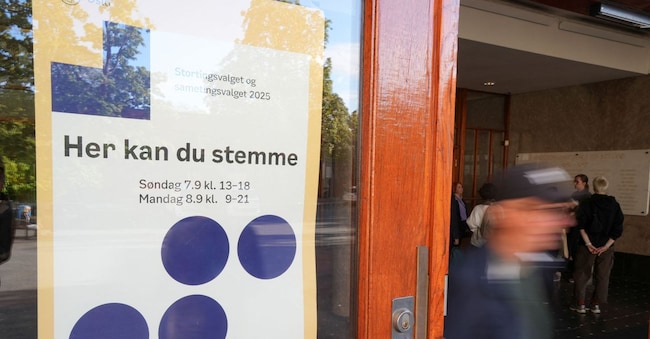
OSLO - In the polling station at Parkveien 65, a stone's throw from the Royal Palace in Oslo, the voters follow one another at a steady pace. Several arrive on electric scooters, some still with a cappuccino in hand. It is a quiet Election Day in the Norwegian capital, and even though about half of the four million eligible voters have voted early (some even at some polling stations yesterday), the turnout is steady, probably in line with the traditional 75-80% turnout for elections to renew parliament.
Also voting in the morning was the Prime Minister, Jonas Gahr Støre, who assured reporters pressing him that inflation and interest rates are coming down. Reassuring voters is crucial for Labour, at the head of a minority government, since - paradoxical as it may seem in a rich country like Norway - economic issues have been central in the election campaign. Not just the cost of living and the problems of the poorer classes, of course, as much as public spending and, above all, the abolition of a controversial tax that affects assets above 1.76 million Norwegian kroner (about 150,000 euros) and is disliked by the business world.
"Domestic issues and the economy are undoubtedly the most important issues," confirms Knut, 24, who works in Norway's leading sector, energy, after voting: inflation, tax policies. He then clarifies that he gave his preference 'to the Christian Democrats and therefore to the centre-right coalition'.
On the economic issues, the right wing has, moreover, focused decisively, in particular the populists of the Progress Party, even second behind Labour in the eve polls. If, however, the polls are respected, the four parties of a hypothetical coalition (Progress, Conservatives, Christian Democrats and Liberals) will have 81 seats, thus not a majority of the 169 in Parliament, although the battle is evidentlytoo close to call, too close to call.
To the advantage of the centre-left, particularly Labour, plays instead the credibility of its leading figures - Prime Minister Støre, Finance Minister and former NATO Secretary, Jens Stoltenberg - in an uncertain geopolitical context full of challenges.


