

Waiting lists: 2 million more treatments completed on time, but 4 million consultations and tests ‘out of turn’
Performance has improved in 19 out of 21 regions, but issues remain regarding costs exceeding the guaranteed ceiling and the appropriateness of prescriptions

Key points
Over 2 million more bookings (+10%) were recorded in the first nine months of the year compared with the same period in 2025, and compliance with guaranteed waiting times improved by a few percentage points for both initial consultations and diagnostic tests, with the number of first appointments rising by 935,000 – from 8.7 to 9.6 million – whilst diagnostic tests saw an increase of 1.1 million – from 7 to 8.1 million – which citizens were able to receive in accordance with the priority criteria indicated on the prescription.
The report as at 30 September, compiled by Agenas, the National Agency for Regional Health Services, based on data sent to the National Waiting Lists Platform, which monitors, month by month and in every region, the main issue facing citizens: the difficulty in accessing National Health Service care within an appropriate timeframe.
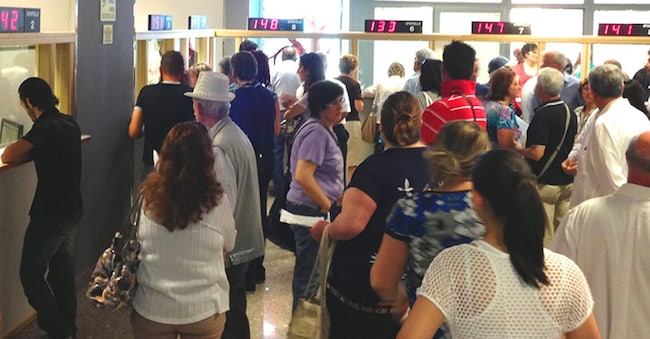
Over 4 million late bookings
Evidence of this improvement can be seen in the (slight) fall in bookings made after the deadline: for first appointments, the figure has fallen from 2.14 to 2.11 million (from 18.9 per cent to 17.2 per cent of the total), whilst diagnostic tests booked ‘after the deadline’ fell from 1,089 to 1,084 (from 12.9 per cent to 11.4 per cent). But it is precisely here that the issue of waiting lists emerges in all its clarity: even today, the National Health Service is unable to guarantee that over 4 million services are provided within the stipulated timeframes, even when taking into account appointments that ‘exceed’ the deadline by as little as a single day. Even excluding these, the figure still stands at a substantial 3.2 million services not provided within the statutory time limits. This gap is evident in the details of the Agenas analysis, which provides a detailed breakdown of trends by type of consultation and by region. As many as six regions – Campania, Lazio, Tuscany, Calabria, Sicily and Molise – are showing a deterioration in performance (for some, such as Lazio and Tuscany, this is despite a compliance rate that still exceeds 90 per cent) for both consultations and diagnostic tests.
Appropriateness under the microscope
Whilst this survey – the last one being in July – once again confirms the issue of prescribing appropriateness: in fact, almost 35 per cent of prescriptions for initial consultations fall into ‘class P’, i.e. ‘Scheduled’ and therefore dispensable within 120 days: in seven regions, the use of this classification on prescriptions exceeds 51 per cent, and in Campania and Basilicata it exceeds 75 per cent. Only in Tuscany, Piedmont, Emilia-Romagna and Umbria does the use of class P remain below 25 per cent, a range considered optimal by Agenas.
Precisely to improve the appropriateness of the priority class indications specified on prescriptions by prescribing doctors, as well as to optimise the ability to plan the provision of care, the Agency has established a permanent working group with the Ministry of Health, the National Institute of Health and the Regions. Meanwhile, Agenas Director-General Angelo Tanese emphasises that this is a ‘work in progress’ – ‘All regions have room for improvement’ – and highlights the importance of the platform commissioned by Health Minister Orazio Schillaci: ‘The Bulletin confirms a widespread structural trend of improvement, a sign of the entire National Health Service’s commitment to tackling waiting lists; it is no coincidence that in every month of 2026, the percentage of cases meeting guaranteed waiting times was higher than in the corresponding month of 2025. This is thanks to the resources made available, which have boosted productivity, but also to efficiency measures in appointment scheduling and improved governance,” summarises Tanese. He adds: “The Platform is proving to be an indispensable tool for identifying where action is needed and assessing the impact of the measures adopted. Today, we are no longer operating in the dark. We are identifying significant room for improvement that requires targeted action. But knowing the figures, whilst necessary, is not enough. That is why we are engaged in ongoing dialogue with each region regarding critical issues and the actions to be taken. Although regional differences remain, all regions are working to improve, methodically and with determination, and the results are beginning to show,’ he assures us. Then came the announcement: ‘From January 2027, in line with the new National Waiting Lists Plan, the number of consultations and tests under scrutiny will rise from 55 to 114.’
The data
In the first nine months of 2026, total bookings rose from 19.7 million in 2025 to 21.8 million, an increase of over 10 per cent. There has been growth in both initial specialist consultations, from 11.3 to 12.3 million (+8.3 per cent), and diagnostic tests, from 8.4 to 9.5 million (+13.3 per cent). This rise in bookings has been accompanied by an improvement in compliance with guaranteed waiting times: for first consultations, the percentage rose from 76.9% to 78.6%, whilst for diagnostic tests it increased from 83.3% to 85%.
Urgent and short-notice appointments have seen the greatest improvement: for initial consultations classified as Urgent (U), which must be guaranteed within three days, compliance rose from 78.8% to 81.7%, whilst for those in the Short (B) category, to be carried out within ten days, it rose from 78.2% to 80.6%. There has also been an improvement in examinations: compliance for urgent services guaranteed within three days rose from 74.2% to 77.3%, whilst for those in the ‘Short’ category it increased from 76.5% to 78.2%. As for non-urgent services, the rate rose from 70.7% to 73.4% for initial consultations and from 83.4% to 85.5% for diagnostic tests. Scheduled services (within 120 days, as specified) remain broadly stable for initial consultations at 84.2 per cent, whilst for diagnostic tests they improved from 85.8 per cent to 87.1 per cent.
An analysis of individual services “confirms a widespread improvement – as Agenas points out – albeit with differences between the various types. These are encouraging signs, particularly for certain services that have historically faced greater difficulties in terms of waiting times”. However, “there is still room for improvement, particularly for endoscopic examinations and certain specialist consultations”, the report notes.
Among initial consultations, oncology consultations continue to record the highest percentage of compliance with guaranteed waiting times, rising from 93.8 per cent to 95.3 per cent. There have also been significant improvements in physiatry consultations, from 79.3% to 83%; gastroenterology consultations, from 71.2% to 73.8%; and pulmonology consultations, from 79.7% to 82.1%. The most substantial improvement was seen in dermatology appointments, which rose from 65.8 per cent to 69.9 per cent, whilst still remaining among the services with the greatest challenges.
Among diagnostic tests, the most significant improvement was seen in colonoscopies, which rose from 62.8% to 69.3%. Progress has also been recorded for gastroscopy, rising from 68.6% to 72.6%, for breast ultrasound, from 78.3% to 82%, and for abdominal ultrasound, from 84.7% to 87%.

