
Margins and innovation

The war hasn’t stopped the Tel Aviv Stock Exchange: up 100 per cent from its lows and a new record for 2026

Whilst Israel continues to grapple with conflicts that began following the massacre of 7 October 2023, the stock markets are taking investors by surprise. The TA-125 and TA-35 indices are gaining ground again in 2026, buoyed by the technology, defence and financial sectors. The Israeli market has become one of the most surprising stories in global finance

by Vito Lops

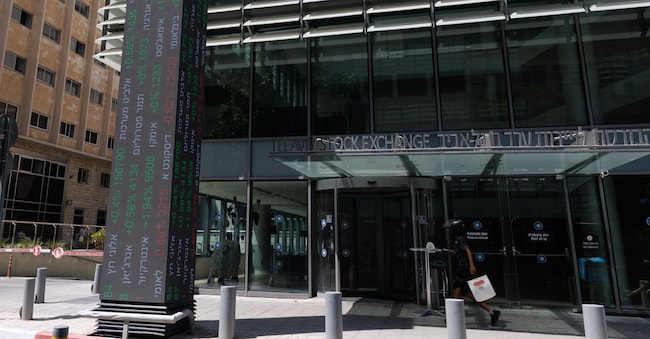
Uno schermo con le quotazioni di borsa alla Borsa di Tel Aviv  (Fotografo: Kobi Wolf/Bloomberg)

4' min read

Translated by AI
Versione italiana

4' min read

Translated by AI
Versione italiana

Whilst global investors’ attention remains focused on Wall Street, artificial intelligence and the next moves by central banks, there is one market that has surprised almost everyone over the past two years with its resilience. That market is Israel’s. Despite a war that has been raging since the Hamas attack on 7 October 2023 – and which has drawn Israel first into the Gaza Strip and subsequently into an increasingly widespread conflict with Hezbollah in Lebanon, the Houthis in Yemen and, more recently, Iran – the Tel Aviv Stock Exchange continues to demonstrate a relative strength that few would have imagined in the aftermath of that day.

The war situation

Since the start of 2026, the TA-125 index – the main benchmark for the Israeli market, comprising the 125 companies with the highest market capitalisation – has risen by around 11%. The performance of the TA-35, the blue-chip index, has been even better, gaining around 15% in the first six months of the year.

Loading...

These figures take on particular significance when viewed in the context of recent years. In 2025, the TA-125 had recorded a rise of more than 50 per cent, whilst the TA-35 had gained over 53 per cent, placing it amongst the world’s best-performing stock markets.

Last year

What sets the Israeli case apart is that this rise occurred whilst the country was embroiled in a military conflict which, over the course of several months, has gradually escalated. The war against Hamas in the Gaza Strip has given way to a direct confrontation with the so-called ‘axis of resistance’ backed by Tehran. Investors therefore found themselves assessing not only the economic costs of the war, but also the risk of Iran’s direct involvement – a possibility which, in recent months, has repeatedly fuelled tensions in the energy markets and driven up oil prices. In the first five months of 2026, the Tel Aviv Stock Exchange repeatedly set new all-time highs. The TA-125 index surpassed the 4,400-point mark, whilst the TA-35 index reached 4,628. The rally was driven primarily by corporate results, which remained robust despite an international environment characterised by persistently high inflation, restrictive interest rates and a slowdown in global growth.

The resilience shown in the first quarter was particularly significant. During the military operation known as ‘Lion’s Roar’, which lasted almost forty days, investors did not abandon the market. On the contrary, the TA-35 closed the quarter with a gain of nearly 13 per cent, whilst the TA-125 gained almost 10 per cent, outperforming numerous Western stock markets.

A break

June, however, is seeing a pause. Following the rally of recent months, profit-taking has set in, bringing the TA-125 back down to around 4,061 points. The monthly correction has exceeded 8 per cent, erasing some of the gains accumulated in previous months but without undermining the underlying trend. For many fund managers, this is a natural phase following one of the fastest rallies ever recorded amongst developed markets.

Behind the strength of the Israeli stock market lie a number of structural characteristics that set the country apart from most advanced economies. The first is the presence of a highly developed technology ecosystem. Israel continues to be regarded as one of the world’s leading ‘start-up nations’, with one of the highest concentrations of innovative companies globally. This sector now accounts for almost 40% of the TA-125 and continues to attract international capital. Alongside technology are the financial and property sectors, which together account for over 60% of the index. Israel’s major banks have benefited from domestic economic growth and an environment of still relatively high interest rates. Key players include Leumi, Poalim, Mizrahi Tefahot and Discount, as well as insurance companies such as Phoenix. Another factor supporting the market has been the defence sector. Regional tensions have, in fact, bolstered the prospects of companies active in security and military systems. Against this backdrop, firms such as Elbit Systems have continued to attract investor interest, benefiting from increased military spending not only in Israel but also in numerous Western countries. Investor participation remained high. In the first quarter, the average daily trading volume on the Israeli stock market reached around 5.6 billion shekels, a record level and almost double that of the same period the previous year. A significant contribution also came from the reform of the trading calendar, which, from the start of 2026, brought the Tel Aviv Stock Exchange into line with international standards by introducing a trading week running from Monday to Friday.

Innovation

The real surprise is that the market has continued to rise whilst most international observers have focused almost exclusively on geopolitical risks. Investors have gradually begun to view the conflict as a factor already priced in, shifting their focus to earnings growth, technological innovation and the ability of Israeli companies to maintain their high level of global competitiveness. The picture for the first half of 2026 therefore paints a market that continues to defy expectations. Having doubled in value from the lows following the attack on 7 October 2023, the Tel Aviv Stock Exchange remains one of the most interesting stories on the global financial scene. Technology, defence, the financial sector and the ability to attract international capital continue to be the pillars of growth which, at least so far, has managed to coexist with one of the most complex and protracted geopolitical crises of recent years.

Copyright reserved ©
Loading...

Brand connect

Loading...

Newsletter

Notizie e approfondimenti sugli avvenimenti politici, economici e finanziari.

Iscriviti