The crisis in the Middle East

Camp Derby, Sigonella and other US bases in Italia: where are they and who decides when to use them?

The fundamental agreement governing the status of American bases in Italia is the Bilateral Agreement on Infrastructure (Bia), signed between Italia and the United States on 20 October 1954. Known as the 'Umbrella Agreement', it has never been published. Outlining the procedure is the Memorandum of 2 February 1995, which can be consulted instead

by Andrea Carli

aggiornato ore 10:35

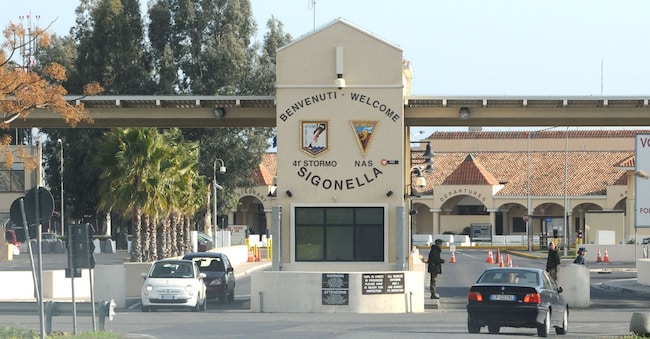
L'ingresso della base aerea di Sigonella.   (ANSA/Orietta Scardino)

7' min read

Translated by AI
Versione italiana

7' min read

Translated by AI
Versione italiana

In the background is the war between the US and Israel on the one hand, and Iran on the other. And, going into more detail, Tehran's recent threats that 'defensive actions by European countries would be considered an act of war'.

The particularly sensitive issue is that of the possibility for the United States to use the bases they have on Italia territory for operations against the ayatollahs' regime. The Five Star asked the Meloni government to give the line on this issue.

Loading...

Result: Defence Minister Guido Crosetto in a tweet replying to the M5s profile, regarding the use of bases in Italia by US military forces, clarified: "On Muos and Sigonella and other things I am ready to answer you but I would like to remind you what I have already told you in Parliament: the use of military bases on national territory, especially those of the USA, takes place in accordance with agreements such as the Nato Sofa of 1951, the Bilateral Infrastructure Agreement of 1954 updated in 1973 and updated with the Memorandum of Understanding Italia-Usa of 1995. As can easily be seen, therefore, these legal frameworks have been regulating these activities for decades and no government has felt the need to change them'. There is no record of any agreements after 1995.

Meanwhile the traffic of American drones and planes taking off from the US base at Sigonella in Sicily is intensifying. But only for refuelling, logistics and aerial surveillance.

At least for the time being, the United States does not intend to use the post as a springboard for attacks on Tehran and to do so it needs the OK of the Italian government: so far "there has been no request", clarified Undersecretary Alfredo Mantovano.

What the latest US-Italy Memorandum envisages

But what do the agreements say? This question is difficult to answer, as most of the texts have not been made public. Let us start with the Memorandum of 2 February 1995, known as the Shell agreement. Let us start with this because, the only exception, the contents of this understanding have been made public.

It happened three years after it was signed, in 1998, following the tragedy of Cermis, by decision of the then Prime Minister Massimo D'Alema.

Here, it is first clarified that 'the designation of "exclusive use" for facilities and/or infrastructure used by the US armed forces does not in any way limit the exercise of Italian national sovereignty, as enshrined in Article VII of NATO's SOFA (the reference is to the Agreement between the Member States of the North Atlantic Treaty on the Status of Forces, signed in London on 19 June 1951, ed.)

Infrastructure', on the other hand, 'means all the fixed or permanent structures, both horizontal and vertical, and equipment present within the installation and established there for the performance of the main and supporting activities of the Forces'.

Finally, 'installation' is defined as 'the complex of land and fixed structures on it, located within defined and clearly identified boundaries'. This being clarified, 'the installation is placed under Italia command.

The functions of this command, which will be exercised by an Italia officer, will vary depending on whether the installation is used jointly or exclusively by US forces.

The jurisdiction of the Italia commander extends to the entire installation, all Italian personnel, military and civilian, assigned for any reason to the installation, as well as Italian territory, infrastructure, equipment and materials'.

As for the responsibilities assigned to the US, 'the US commander has full military command over US personnel, equipment and operations. He will inform the Italia commander in advance of all significant US activities, with particular reference to operational and training activities, movements of material, weapons and civilian/military personnel, as well as any events/incidents that may occur.

Likewise, the Italia commander will keep the US commander informed of all significant national activities.

The Italian commander will notify the US commander if he considers that the US activities do not comply with applicable Italian law and will immediately seek advice from the higher authorities in Italy.

Differences of opinion between commanders as to whether a specific activity should be undertaken, which cannot be resolved locally, will be promptly referred to their respective chains of command for resolution.

The commencement of a controversial activity,' the Memorandum further clarifies, 'is subject to the resolution of the dispute'. Again: 'permanent increases in the operational component and related support will be authorised by the Italian national authorities.

Temporary increases in military and civilian personnel (for training, exercises, logistical activities, transit, etc.) will be approved by the Italia commander. Temporary increases in personnel associated with operations already approved by the Italia government will be coordinated with the Italia commander'.

The main treaty (whose contents were never disclosed)

However, the fundamental treaty governing the status of American bases in Italia is the Bilateral Infrastructure Agreement (Bia), concluded between Italia and the United States on 20 October 1954.

This treaty, known as the'Umbrella Agreement', has never been published. The reason? They have a high secrecy ranking and cannot be declassified unilaterally. This agreement sets theceiling of US forces that can be stationed in Italia. In accordance with the BIA, various technical and local memoranda of understanding have been approved over the years to regulate various aspects related to the use of the individual bases.

The bases where the US operates

As Professor Emeritus of International Law at the Luiss University (Rome) Natalino Ronzitti recalls in an in-depth study for Iai, the International Affairs Institute, Defence Minister Arturo Parisi had declared before the Chamber of Deputies on 19 September 2006 that there are eight US bases in Italia (at present there are seven) governed on the basis of Italy-US bilateral agreements.

According to a clarification published by the authors of the Italian practice of international law in the Italian Yearbook of International Law, the eight bases (or rather bases and infrastructure) of the United States in Italia are:
1) Capodichino Airport (naval support activities);
2) Aviano Airport, Pordenone (31st Wing and 61st Regional Support Group);
3) Camp Derby (Livorno);
4) the base in Gaeta, Latina;
5) the Base on La Maddalena Island (which was later dismantled, ed.);
6) the Naval Station in Sigonella (the one remembered in the history books for the serious diplomatic and military incident that took place between 11 and 12 October 1985 between Italy and the United States, triggered by the hijacking of the cruise ship Achille Lauro);
7) the solar activity observatory in San Vito dei Normanni Brindisi);
8) a presence in Vicenza and Longare, in the same province.
The military base is established on someone else's territory through an agreement, which contains the regime of the base itself and details the rights and obligations of the state or organisation owning the base and the territorial state (i.e. the state hosting the base).

As far as Italia is concerned, the agreement is the source of the rights and obligations of both NATO and US bases.

The most recent precedent

The question of whether the American allies can use Italian bases is not a new one.

It came to light last year, after the US had bombed three nuclear sites in Iran.

On the occasion of the announcements to the Chamber of Deputies ahead of the European Council in June, Prime Minister Giorgia Meloni had decided to provide some clarifications at the request of the PD and the Five Star Party. The two opposition parties had asked the government not to authorise the use of Italian bases for a possible attack on Iran. "They can only be used with an authorisation from the Italia government," Meloni had explained on that occasion, adding that it is "unrealistic to speculate on scenarios that have not occurred at the moment, especially in a rapidly changing context.

"I don't think it will happen, but in any case I can guarantee thata decision of this kind would have to go through a parliamentary passage," the Prime Minister had stressed, clarifying that, in her opinion, permission to use the bases should not be granted "on an ideological basis", but "by assessing the context, weighing the pros, cons and reasons".

How does one reconcile the secrecy of agreements with the provisions of the Constitution

?

Months later, the question has come up again. "How can the secrecy of agreements be reconciled with the provisions of the Constitution?" asked Ronzitti. Answer: 'Some rightly say that the values guaranteed by our Constitution include defence and security, to which Articles 11 and 52 explicitly and implicitly refer. These are fundamental values that, however, cannot nullify the democratic principle of parliamentary control of the government's foreign policy. Therefore,' the international law expert concludes, 'the strictly confidential clauses of the agreement may be kept secret, but its framework will have to undergo normal parliamentary procedures and be published in the Official Gazette'.

The political clash

Once again, therefore, the issue of the use of US bases in Italy has sparked political debate.

Sigonella (Syracuse) is a port of call increasingly crowded with refuelling cargo aircraft and drones, such as the Global hawk, used for patrolling, while in Niscemi (Caltanissetta) the Muos (Mobile user objective system) system remains active - as per routine - that also monitors the situation in the Middle East through radar and satellite.

For the Five Star parliamentarians, those positions 'are already involved in the war against Iran', so much so that - they point out - 'a P-8A Poseidon of the US Navy had already taken off towards the eastern Mediterranean in the early hours of last Saturday's attack' and 'the Muos satellite communication centre, one of the four global ground nodes that guarantees the connection between all American planes, drones, ships and submarines, is by definition involved in US military operations'.

Further clarification will come with the communications of Ministers Crosetto and Tajani on Thursday 5 March, from which the first indications on aid to the Gulf countries may also emerge.

Another side of the same coin: the Iranian reaction, six days after the attack launched by Washington and Tel Aviv against Tehran .

Copyright reserved ©
Loading...

Brand connect

Loading...

Newsletter

Notizie e approfondimenti sugli avvenimenti politici, economici e finanziari.

Iscriviti