Scenarios

Sicily, the island under observation in the crisis with Iran

Analysts rule out a direct Iranian attack for now, but the escalation in the Middle East brings Sicily back to the centre of Europe's strategic security

by Nino Amadore

aggiornato ore 10:30

4' min read

Translated by AI
Versione italiana

4' min read

Translated by AI
Versione italiana

Sicily returns to the centre of Mediterranean geopolitics. With the crisis between Iran and the West widening and the drone and missile attacks that have already hit military targets in the region, the island - a strategic NATO hub and home to crucial military and energy infrastructure - inevitably comes under scrutiny.

Sicily remains the point where geopolitics stops being theory and becomes daily news: it is the southern outpost of Europe, a crossroads where energy routes, military infrastructure and strategic interests pass. The question circulating in military analyses and the international media is simple: how exposed is Sicily really to possible Iranian retaliation? 

Loading...

Analysts' assessments are more cautious than media alarms: a direct attack seems implausible today. But the concentration of military bases and strategic infrastructure makes the island one of the most sensitive European territories to the effects of a possible escalation.

It is not just a question of geographical distances. If the crisis between Iran and the West, observed on a map, looks like a distant fire, Sicily feels its heat more than any other European territory.

Because of its barycentric position in the Mediterranean, the island has once again become that 'natural aircraft carrier' that history has sewn onto it. Today it is the sensitive terminal of a tension that runs along the submarine cables, crosses the drone skies and is reflected in strategic infrastructure.
La base di Sigonella

in provincia di Siracusa

fonte: Google Maps

The Military Front: Sigonella, Muos and Birgi

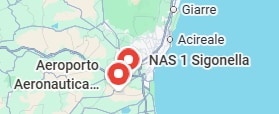
The heart of Sicilian criticality beats at Sigonella. The base is one of the most important logistical hubs for the US Navy and NATO surveillance in the Mediterranean. RQ-4 Global Hawk drones, used for reconnaissance and intelligence missions over the Middle East and Persian Gulf, regularly take off from here.

La base di Niscemi

in provincia di Caltanissetta

fonte: Google Maps

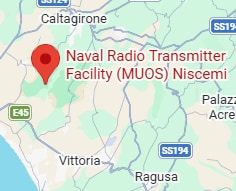
Together with Sigonella there is another key infrastructure: the Muos in Niscemi (Caltanissetta), the satellite system that manages global military communications. The Sicilian terminal enables the coordination of naval operations, drone missions and command systems on a planetary scale. But in the island's military network there is also a third, often lesser-mentioned piece: the Trapani-Birgi base.

La base di Trapani-Birgi

in provincia di Trapani

fonte: Google Maps

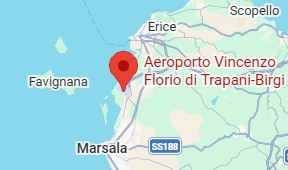
The airport, home to the 37th Air Force Wing, is one of NATO's main operational bases in the Mediterranean and plays a crucial role in the air defence of southern Europe.

Birgi is in fact one of the support bases for NATO's AWACS radar aircraft, the surveillance aircraft that monitor the airspace and coordinate long-distance military operations.

The facility is also set to grow in the coming years: the Ministry of Defence has initiated a project to turn it into a major international training centre for F-35 fighter pilots, the first outside the United States.

That is why, every time tension increases in the Mediterranean, Birgi automatically enters the perimeter of sensitive infrastructure along with Sigonella and Muos.

To protect the installations, according to various military sources, the air defence system has been reinforced with anti-missile systems SAMP/T, creating a sort of protective umbrella over the island.

Missiles and drones: what analysts really say

Iran's missile capabilities have grown in recent years.

Some of Tehran's ballistic missile launchers have a range of between 1,500 and 2,000 kilometres, with some variants going up to around 2,500 kilometres.

The distance between Iran and Sicily, however, exceeds 3,000 kilometres. This means that the island is at the extreme limit - or beyond - the real operational range of much of Iran's arsenal. Rather, the most plausible threat concerns long-range drones.

However, to get to Sicily they would have to cross highly controlled airspace in the eastern Mediterranean and NATO countries, making such an operation extremely complex.

Added to this is the presence in the Mediterranean of US ships equipped with the Aegis anti-missile system and a defence network comprising advanced radar and Patriot and SAMP/T batteries.

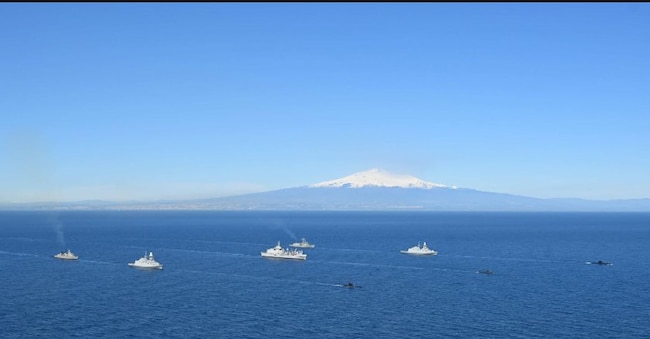
These days in the Mediterranean Sea, the exercise Dynamic Manta, NATO's main anti-submarine activity in the region, is underway.

The training, whichtakes place every year between late February and mid-March in the waters off Sicily, involves ships, submarines and aircraft from different allied countries with the aim of strengthening the capacity to counter submarine threats.

The true risk scenario

For strategic analysts, a scenario in which Sicily becomes a direct target exists, but it is linked to only one case: an open war between Iran and the United States or between Iran and NATO.

In that case, Western military bases would become strategic targets. In Italia, infrastructures such as Sigonella, the Muos in Niscemi and the Trapani-Birgi base, which plays a key role in the surveillance and air defence of the Mediterranean, would be mentioned. But this would be a global conflict scenario, very different from the current phase of regional tension.

The energy and logistics front: Priolo, Augusta and the oil routes

If the direct military risk appears limited, the vulnerability of the island emerges more strongly in the energy field. Sicily hosts some of the most important petrochemical poles in Europe: Priolo-Augusta (Syracuse) and Milazzo (Messina).

TheIsab complex in Priolo Gargallo and the Sonatrach refinery in Augusta represent crucial nodes for refining and fuel distribution in the Mediterranean.

The port of Augusta also falls within the geography of sensitive infrastructure on the island. The Syracuse port of call is not only one of the main oil ports in the Mediterranean but also hosts an Italian Navy base and logistical support facilities used by NATO fleets.

In the roadstead, units of the US Sixth Fleet can dock for refuelling and technical assistance operations, while on land infrastructures closely linked to the large Priolo energy hub operate.

In an international crisis scenario, the port is not so much an operational base as a strategic logistical hub: fuels, military vessels and energy routes connecting the Mediterranean to the rest of Europe pass through here.

For this reason, rather than a direct target, Augsburg is regarded by analysts as a critical infrastructure to be protected.

In recent years, the refineries' sources of supply have been diversified. After the handover of Isab from the Russian Lukoil group to the Cypriot fund Goi Energy, the logistics system was reorganised with supplies from Kazakhstan, Libya, Iraq and the United States.

Tourism and the perception of instability

International tension is not only measured by radars and anti-missile systems. It also has effects on collective perception. Tourism, one of the pillars of the Sicilian economy, had recorded positive signs: in 2025, presences grew by almost 12%. But the Middle East crisis risks fuelling a climate of uncertainty in the Mediterranean.

Copyright reserved ©
Loading...

Brand connect

Loading...

Newsletter

Notizie e approfondimenti sugli avvenimenti politici, economici e finanziari.

Iscriviti