
Warehouses become a source of liquidity: First transaction by CDP and Cherry Bank
Ten million to the Vicenza-based food company Brazzale. A pioneering initiative, a model for other sectors and players

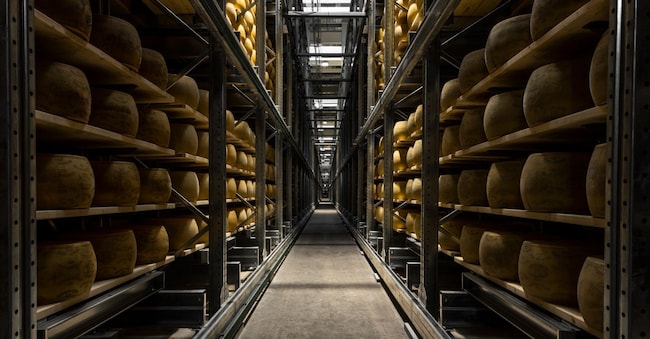
“A cheese warehouse yields a higher return than government bonds and gold”: Roberto Brazzale, owner of the Vicenza-based cheese company of the same name (Italy’s oldest dairy business, which in 2025 achieved a turnover of 340 million euros, with 12 factories and 1,200 employees in Italy and around the world), is at the forefront of Italia’s first ‘destocking’ operation – that is, the securitisation of stock – made possible by the new SME law passed last April. ‘In Italia, there is a stock of products intended for maturing worth tens of billions of euros,’ adds the entrepreneur. ‘Yet, when calculating the net financial position (NFP), these were worth nothing before this legislation came into force. It was an anomaly in the system that has finally been resolved.’
Pioneering initiative
The transaction, involving financing of 10 million euros divided equally between the parties, was carried out by Cassa Depositi e Prestiti (CDP) and Cherry Bank, with the collaboration and advice of Pirola Corporate Finance, Accounting Partners, Cerved Master Services and Studio Cappelli Riolo Calderaro Crisostomo Del Din & Partners (acting as legal advisers).
A pioneering initiative that has made it possible to create value from an asset which, until now, has all too often been seen as a hindrance, generating immediate liquidity for businesses and thereby enabling new investment. This model is set to be replicated in other production sectors, as explained by Andrea Nuzzi, CDP’s business director, who also highlighted the institution’s commitment to adopting innovative financial instruments, with the aim of standardising them and making them replicable across all sectors of strategic importance to our country.
Sectors potentially affected
According to Nuzzi, in addition to sectors linked to the wider food supply chain, the industrial sectors most interested in the new scheme are all those that produce goods with a future price that is as predictable as possible. “At an institutional level, the initiative forms part of the agreement signed with the Ministry of Agriculture, Food Sovereignty and Forests, which aims to support access to credit for agri-food businesses,” Nuzzi explained.
Destocking, as provided for under the new law, certainly has room for improvement: the rules need to be simplified in practice, said Giovanni Bossi, chief executive of Cherry Bank. But it is a tool that has the potential to trigger a ‘financial paradigm shift’ – he added – ‘comparable to the introduction of factoring for trade receivables in the 1990s’. Globalisation had pushed companies towards the ‘just-in-time’ model, reducing stock levels to a minimum. Today, Bossi observes, the breakdown of that system requires companies to return to holding larger stocks, and this calls for financial instruments to create value from these inventories.

