
Wars and instability, how defence training is changing
One piece of the jigsaw is the development of skills capable of managing and enhancing Defence cultural, historical and real estate assets, developing innovative public-private partnership models, promoting Defence culture as an identity and strategic lever and integrating managerial, legal, communication and institutional skills

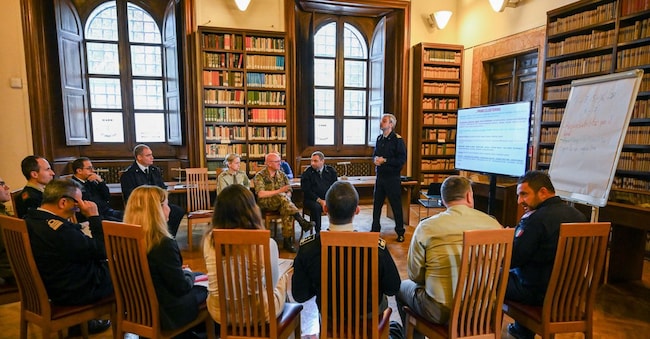
More training, more security. The challenge facing the Armed Forces, as Guido Crosetto made clear, presupposes a new approach, primarily mental. The picture can change abruptly, as for example happened in recent days with the US and Israeli attack on Iran. We must be prepared, and we must do so as quickly as possible. "After decades of relative stability,' the Defence Minister emphasised, 'simple' crisis management is no longer sufficient: we must also be able to cope, if necessary, with a prolonged, high-intensity conflict against possible enemies/adversaries possessing capabilities similar to our own. International instability is no longer an exception but a permanent condition. In this perspective, training has a far from secondary role. For Crosetto, it is strategic for the modernisation and effectiveness of Defence, to such an extent that he has included it in the context of the overall reorganisation of the 'military instrument', a bill that will land on the table of the Prime Minister's Office by March and will then be submitted to parliament for examination.
The Master Card
The focus on training is manifested in parallel in the decision to field the first second-level master's degree course in 'Enhancement of Defence Heritage and Culture' from March. Promoted by the ministry, organised by the Casd, Difesa Servizi S.p.A. and the Committee for the Development and Enhancement of Defence Culture, it will be presented on 10 March at the Centro Alti Studi Difesa, in the presence of Crosetto. The formula includes lectures, workshops and seminars, curricular training, and a final paper. According to the minister, "it is a concrete opportunity to deepen knowledge of the cultural and historical heritage of Defence and develop professional skills that Italia needs, especially at this time. It will help train professionals capable of enhancing an extraordinary heritage and promoting the culture of Defence as a fundamental element of our national identity'.
The objective is therefore to develop skills capable of managing and enhancing Defence cultural, historical and property assets, developing innovative public-private partnership models, promoting Defence culture as an identity and strategic lever, and integrating managerial, legal, communication and institutional skills. The proposal is aimed at graduates interested in working in the public administration, in investee companies, in the cultural and heritage enhancement sector, in the consultancy and managerial field related to complex public systems. The course lasts 1,500 hours, 60 CFU, from March to November. Also envisaged is an operational internship at Difesa Servizi, which will allow participants to directly confront themselves with business models applied to the public administration. The programme enhances the experience gained in strategic projects such as the Vespucci World Tour and Villaggio Italia, the International Flight Training School in Decimomannu and the National Underwater Dimension Pole, all examples of public-private partnerships applied to the Defence system.
Staff training to be made modern
The line is drawn. As clarified by Crosetto, personnel training must be reviewed and made modern, defining the necessary skills and creating pathways to acquire them. Space, in this respect, plays a major role: the Defence Ministry, as clarified in the guidelines that initiate the strategic and financial planning process for the sector, aims to 'support investment in advanced training programmes, to develop highly qualified, motivated professionals capable of exploiting new technological trends'. Then there is the cyber threat. In this case, the strategy is to 'develop, attract and retain skills through innovative and flexible solutions for the recruitment, supply, employment, continuous training and retaining of civilian and military personnel, or to adopt measures to reduce the exodus of highly specialised personnel, also through measures to recognise intellectual co-ownership'.
Specialist reserve
The road also passes through the deployment of 'a "specialised reserve" with professionals from the private world also in the specific cybernetic domain (to complete the capabilities that can be expressed by the Defence), aimed at identifying a "pool" of experts in the various fields, whose economic treatment can be adapted to the specific sector'. As for scientific and academic research, the aim is to make Defence a reference centre for geopolitical studies and technological innovation. At the forefront is the Casd, the newly established university high school with special regulations. In the academic year 2024/2025, the Defence Higher Studies Centre trained 925 students (including 153 foreigners from 56 countries). This Centre trains and updates Italian and international military and civilian leaders, developing skills in leadership, soft skills, innovation, strategy, security, cybersecurity and emerging technologies. It has created specialised poles such as the Leadership & Soft Skills Academy, the Defence Cyber Pole and the Wargaming Laboratory; it also actively participates in the European Security and Defence College courses, organises courses for over 1,000 students a year, including 200 foreigners from more than 50 countries. It offers PhD, Masters and higher education courses in Defence and Security Sciences. It also coordinates strategic research and analysis activities on political, social, technological and military issues, with a focus on new technologies such as artificial intelligence. It is a link, a reference and technical-educational, inter-force, university-level pole for the Armed Forces. The Casd has the task of developing and disseminating the 'Culture of Security and Defence', in cooperation with all the souls of the Armed Forces. The watchword is, now more than ever, 'teamwork', also in training.


