
Not just Hormuz

Wars in the 21st century are fought over ports, refineries and logistics networks

Raw materials are not merely an industrial issue. They have become a strategic pillar of national security. A central coordinating body is needed to bring the ministries together
by Gianclaudio Torlizzi

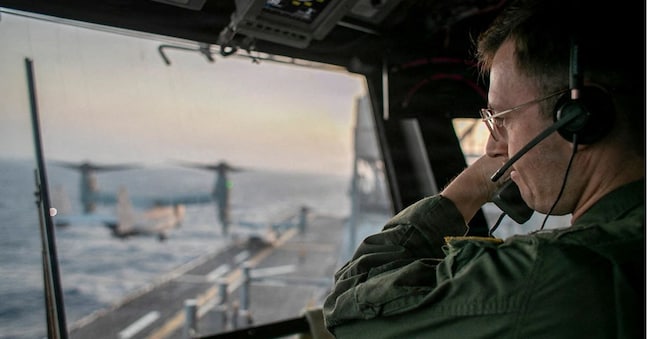
Un ufficiale, a bordo della USS Tripoli, supervisiona operazioni di volo     REUTERS

4' min read

Translated by AI
Versione italiana

Key points

4' min read

Translated by AI
Versione italiana

For years, Europe has viewed security as a predominantly military function, leaving the strategic protection of the continent to the United States and taking it for granted that the global market would guarantee access to the raw materials needed to sustain industrial growth. Today, both of these certainties have been shattered.

The war in Ukraine, tensions in the Red Sea and the Mediterranean, the strategic rivalry between the United States and China, and the growing instability in the Middle East have brought an often-overlooked issue back into the spotlight: no defence system can exist without a secure supply chain for the raw materials and industrial components that form its foundation.

Loading...

Europe’s ambition to build a stronger continental pillar within NATO will not depend solely on increased military spending or the production of new weapons systems. It will depend above all on the ability to ensure a secure supply of metals, critical minerals, energy, electronic components and advanced materials.

The lessons learned from the conflict in Ukraine are also calling into question some of the long-held assumptions of recent decades. The wars of the future will not be won by technological superiority alone. Technology and manpower must go hand in hand. Drones, artificial intelligence and advanced systems certainly act as force multipliers, but they do not eliminate the need for industrial capacity, resilient supply chains, adequate stocks and trained personnel.

Sustainability of industrial machinery

As the current conflicts demonstrate, wars continue to be long, hard and gruelling. Many are not lost on the battlefield, but due to an inability to sustain, over time, the production and logistical effort required to sustain them. The sustainability of the industrial and supply chain infrastructure is once again becoming a strategic factor as important as the effectiveness of weapon systems.

The problem is that Europe, including Italia, is facing this challenge from a position of great vulnerability. Dependence on China affects numerous strategic sectors: rare earths, permanent magnets, graphite, gallium, germanium, tungsten, antimony and many other raw materials essential for radar, missiles, munitions, satellite systems, military electronics and dual-use technologies. In recent years, Beijing has shown that it regards these resources as a tool of foreign policy and strategic competition. Restrictions on the export of critical materials have highlighted how control of supply chains now represents a geopolitical lever no less important than military force. Making the picture even more complex is an often underestimated phenomenon: the progressive militarisation and privatisation of bottlenecks in global supply chains.

In this scenario, the ability to diversify supply channels, build alternative trade relationships and secure a share of production capacity becomes a key element of national resilience. It is true that the European Union has finally grasped the strategic importance of the issue and is stepping up its efforts regarding security reserves. The initiatives set out in the Critical Raw Materials Act and the stockpiling programme represent a step in the right direction. However, building up stocks merely buys time; it does not eliminate structural vulnerability. If Europe continues to depend on other countries for the extraction, refining and processing of critical materials, the strategic risk will remain largely unchanged.

Washington has understood this so well that it has arrived at a very simple conclusion: the gap with China can only be narrowed by overriding market forces. The Pentagon’s creation of a price floor for raw materials—set at double the market price—when entering into supply agreements with national mining companies is proof of this.

Whilst we wait for Brussels to decide to invest seriously in the European supply chain, we cannot sit on the sidelines. It is absolutely essential that the country adopts a national strategy that identifies the priorities to be pursued. With this in mind, mining policy – which forms the cornerstone of a national strategy – cannot be left to individual ministries. The issue of strategic raw materials cuts across areas of responsibility that simultaneously involve Defence, Business and Made in Italy, Economy and Finance, Foreign Affairs, Environment and Energy. No single administration possesses the comprehensive vision required to manage an issue that intertwines geopolitics, international trade, national security, finance and industrial policy.

Reforms

We therefore need a permanent steering group within the Prime Minister’s Office, equipped with the capacity for inter-ministerial coordination and a clear mandate: to ensure the resilience of strategic Italian and European supply chains. The aim must not be self-sufficiency – a concept incompatible with Italy’s economic structure – but rather the reduction of vulnerabilities through a comprehensive strategy encompassing the geographical diversification of supplies, long-term agreements, strategic stockpiles, support for industrial investment and the development of recycling capabilities, also involving other European and non-European partners with whom certain objectives are shared.

Global competition

The global competition that is taking shape is not merely about the availability of weapons. It is about control over the resources needed to produce them. Indeed, the wars of the 21st century are fought long before they reach the battlefield – in mines, ports, refineries, metallurgical plants and logistics networks.

If Europe intends to take greater responsibility for its own security, and if Italia wishes to maintain the competitiveness of its industrial base, the resilience of supply chains must become a national priority. Raw materials are no longer merely an industrial issue; they have become a strategic component of national security.

Gianclaudio Torlizzi is the founder of T-Commodity and an adviser to the Minister of Defence

Copyright reserved ©
Loading...

Brand connect

Loading...

Newsletter

Notizie e approfondimenti sugli avvenimenti politici, economici e finanziari.

Iscriviti