

'We are doctors and not sheriffs': Italy's doctors defend the right to health (also of migrants)
Unanimous outcry from the National Federation of Associations after the inclusion of 8 colleagues in the register of those under investigation for the assessment of unsuitability for the detention of foreigners in detention centres for repatriation

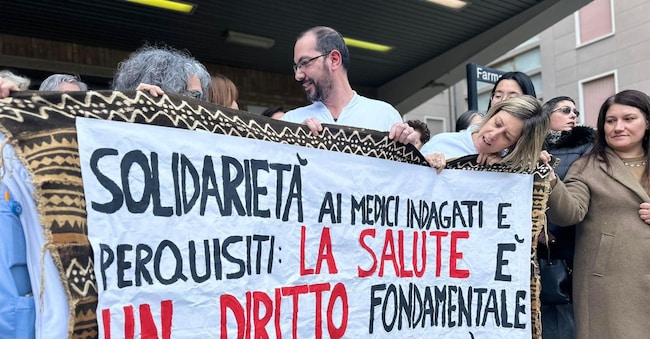
The doctors of Italia are squaring off over what has now become the 'Ravenna case'. That is, the facts that on 12 February led to a night sweeping search of the city hospital and to the inclusion of eight colleagues in the register of those under investigation for certification activities connected to the assessment of health suitability for the detention of immigrants in the Centres for Stay for Repatriation. Basically, the 'accusation' is that with false unsuitability certificates the white coats wanted to keep some of the people visited out of the CPRs.
The Federation's choice
The decision taken by the Federation of the Orders of Doctors and Dentists (Fnomceo) is a unanimous one, which arrived in Rome at the end of the solemn celebrations of the National Day of Health, Social and Healthcare Workers and Volunteers, established six years ago to commemorate the sacrifice of hundreds of lives lost during the Covid. And there could be no better seal to reaffirm the essence of those whose compass is the Hippocratic Oath and Article 32 of the Constitution. Which defines health as 'a fundamental right of the individual and an interest of the community'.
The four props
All the 106 presidents of as many territorial orders of the Federation, representing thousands of doctors throughout Italia, have therefore decided to put down on paper in an Agenda approved unanimously a quartet of concepts that sound like a 'hands off' from autonomy and the duty of care, always and in any case. Under the banner of the principle according to which 'the clinical evaluation must concern the state of health and not constitute an act of authorisation'. Doctors, in short, are doctors and public safety is certainly not their responsibility, they emphasise, which is instead the prerogative of the police. Hence the request to 'revise the entire procedure concerning the transfer to the CPRs and in particular the clinical evaluation of the doctor that 'must concern exclusively the state of health of the individual and not constitute an act of authorisation'.
The Constitution as a compass
The first point is that the medical act is a constitutional safeguard and therefore - the presidents write - the doctor 'in the exercise of diagnosis, prognosis and certification does not perform an accessory or administrative function but directly implements the fundamental right of health protection'. Moreover, they point out, it is the Constitutional Court and the Supreme Court in two sentences that have recalled how the autonomy of clinical judgement represents a guarantee for the citizen and society.
The second and consequent point is that the medical certification is an integral part of the medical act, and the certification of medical unfitness for detention in the CPRs must also be referred to the latter. Which is 'a medical act to all intents and purposes,' explain the national leadership of the Federation, and is based on 'objective clinical findings, prognostic evaluations and includes the direct personal responsibility of the doctor. The doctor does not authorise administrative measures and does not exercise public order functions. The doctor certifies the state of health and any conditions of health incompatibility. Attributing to the medical act a function of legitimising or guaranteeing safety means altering its nature and compromising the separation of functions on which the rule of law is based'.

