World Day

What happened to bubble tea? Chain shops closed, some aim at large-scale retail shelves

30 April is the world day dedicated to a drink that was successful in Italy for only a few years. But now Italy's Bobble Bobble is trying its hand at supermarket sales

by Maria Teresa Manuelli

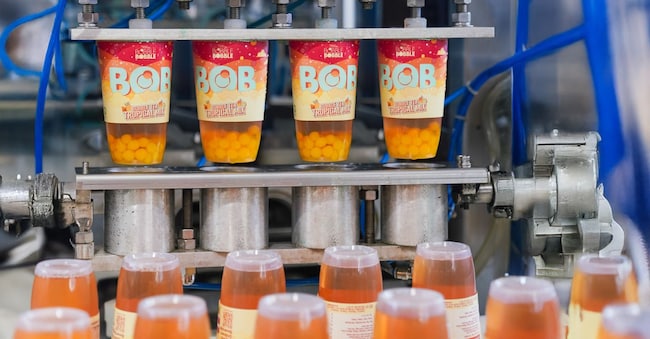
Linea di produzione del bubble tea Bobble Bobble

4' min read

Translated by AI
Versione italiana

4' min read

Translated by AI
Versione italiana

30 April is World Bubble Tea Day, the drink made of tea and tapioca pearls or fruit, which originated in Taiwan in the 1980s but has only been successful in Italia in recent years. And perhaps it is a fire that has already gone out, at least as a mass phenomenon that generated queues in the street in front of the signs that imported it.

Globally, according to Growth Capital's Bubble Tea Market Report 2023, the beverage was worth $2.75 billion in 2022, with a compound annual growth rate of 9% expected until 2030. Europe accounted for $300 million or 11% of the world total.

Loading...

Italy's boom and change of course

In Italia, bubble tea experienced its golden season between 2017 and 2019, with franchises, queues outside the shops and an Asian aesthetic that had conquered millennials in particular. According to Growth Capital's estimates, by 2022 the Italia market had reached EUR 42 million - over 15% of the European market - with forecasts of compound growth at 18% to 98 million in 2027. Specialised outlets had grown from 156 in December 2021 to 236 in March 2023, an increase of 51% in less than two years, according to the same report.

However, the wind has changed. And fast. The first Italian chain, Frankly Bubble Tea & Coffee, founded in 2016 and grown to more than ten shops between Milan, Turin, Bologna and Bergamo, with a turnover of 7.5 million in 2023, closed all its shops on 23 November 2025, going into liquidation and leaving around forty employees. An epilogue that symbolically marked the end of a model: the single-product store, designed for large flows of passers-by, proved unsustainable outside of a few high traffic streets. Among the other structured chains surveyed by Growth Capital's report in 2023, only Mistertea maintains a stable presence, with three locations in Milan and Monza. 87% of the stores are independent or very small.

But consumption has not disappeared: it has shifted. Deliveries and generalist bars have acted as a transitional channel, while major retailers have begun to carve out an increasingly significant space.

Bobble Bobble: from tapioca to shelf

Those who have ridden this evolution - and partly anticipated it - is Bobble Bobble, a Lucchese company founded in 2017 by Simone Simonelli and Nicolò Ossino. Founded as a franchisor with almost thirty outlets before Covid, it gradually closed its shops during the pandemic, when imports from Taiwan and China had stopped. The answer was to build their own production, starting from scratch: molecular spherification, density, specific weights... a chemistry that the two partners, born in 1990, learnt in the field, having started at 27 years of age without any industrial experience.

Out of that need was born the first European production reality of bubble tea ready-to-drink. Today, Bobble Bobble produces the Bob brand - an acronym for Beyond Ordinary Beverage - in a plant in Lucca operating around the clock, seven days a week during peak months, with a capacity of around 60 thousand pieces per day and an annual production of around 8 million glasses, according to Simonelli. The product - infused tea, fruit juice and popping boba inserted in the glass thanks to a patented recipe that solves the problem of osmosis - is Vegan OK and Halal certified, gluten and lactose free, with an entirely Italian supply chain.

Numbers and the price challenge

Bobble Bobble ended 2025 with a turnover of 5 million euro and an Ebitda of 610 thousand euro, growing at a rate of 20-25% per year, according to the company. 55% of sales come from the Italia market, 45% from abroad: Bob is present in more than 25 countries, with references in chains such as Tesco, Aldi and Lidl, and has been a private label supplier for Eurospin since 2025. The stated goal for 2026 is 7.5 million euro turnover. "The result achieved in 2025 is the fruit of a path built over time, made up of precise industrial choices," comments Ossino.

The open knot, however, is the price. Bob's is worth around 3 euro on the supermarket shelf, up to 5 euro in the refrigerated column in bars: figures that place it in the artisanal segment, far from the competitiveness of the big brands. 'We are alongside huge names, but we don't make huge numbers,' says Simonelli. The aim is to lower the price by increasing production volumes, but growing means finding sheds much larger than the current one thousand square metres of production. A fund or a financial partner? 'We are listening, we are not closed to anything, but for now it is not on the horizon,' says Simonelli.

Bob's audience is between 7 and 13 years old, peaking at 8-12. They find him at the pool bar, they see him in manga and Netflix series, they choose him instead of an ice cream. Bobble Bobble has been an official sponsor of Lucca Comics & Games for six years.

Bubble tea is not finished: it has transformed. "What has disappeared is the store with the queues outside. The product in the world is growing significantly,' says Simonelli. With Ferrero as a reference model and a list of products still absent from Italian and European shelves in the drawer, the two Lucchese founders aim to build what in the world of bubble tea does not yet exist: a recognisable corporate name on a global scale.

Copyright reserved ©
Loading...

Brand connect

Loading...

Newsletter

Notizie e approfondimenti sugli avvenimenti politici, economici e finanziari.

Iscriviti