

What happens if you’re struck by lightning: from paralysis to a heart attack. Here are the risks and how to avoid them
Burns resulting from electric shocks can also cause death or serious injury. Here is the guide from the Italian National Institute of Health

Key points
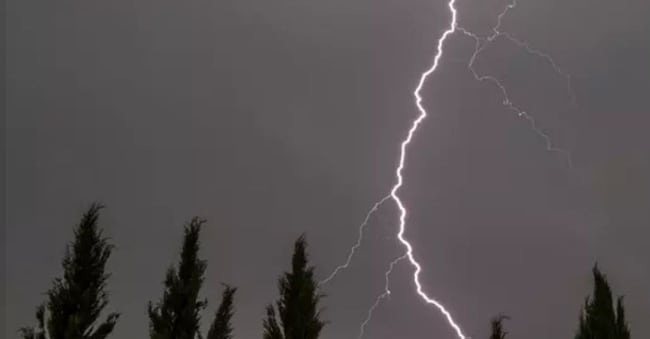
From paralysis to amnesia and loss of consciousness lasting from a few minutes to several hours. However, if the lightning current passes through the heart, it can cause cardiac arrest, whilst if it passes through the nervous or respiratory centres, it can lead to death from respiratory arrest. Burns resulting from a lightning strike can also cause death or serious injury. This is what happens if you are struck by lightning. The Italian National Institute of Health (ISS) explains this on a dedicated web page, published at a time when a number of incidents have been recorded two fatal incidents caused by lightning. On Mount Etna, a 30-year-old tourist died after being struck by lightning, and a hiker in South Tyrol met the same fate. A few days ago, a scout was struck on Mount Livata, in Lazio, and remains in hospital at the Policlinico Gemelli but is on the mend.
The glare from a lightning bolt (the flash) can also cause visual disturbances, and the shockwave can cause hearing damage. Other indirect effects of lightning strikes can include fires and falling trees. “In Italia, an average of around 1.6 million lightning strikes occur each year, mainly in July and August, but the phenomenon can also occur, albeit more rarely, in winter. The areas most affected are Friuli, the Lombardy lake district, the Rome area and, generally speaking, the Pre-Alpine and Apennine mountain ranges. However, more generally speaking, there are no areas in Italia that are free from the risk of lightning. However, there are no studies on the number of casualties or injuries caused by lightning,” warns the Istituto Superiore di Sanità.
Guidance on how to avoid being affected
“There are numerous safety guidelines to follow during a thunderstorm to minimise the risk of being struck by lightning. In the mountains or outdoors: you should avoid seeking shelter under a tree or in a wood, as trees are particularly vulnerable to lightning strikes. If the tree is standing alone, the risk of being struck is even greater,” emphasises the ISS. “As well as trees, it is advisable to stay away from poles (including those at bus stops) and walls: a lightning strike can cause them to collapse, either completely or partially. The best thing to do, if you cannot take shelter indoors, is to stay in an open space, away from sharp or metal objects (including umbrellas, walking sticks and ice axes). The best position to adopt is to crouch down, whilst lying down or standing is more dangerous. Do not engage in activities involving the use of sharp objects, such as fishing or golf. It is best to avoid talking on a mobile phone, especially if the handset has an aerial.
The risks when you’re atthe seaside or a lake
“It’s dangerous to swim in the sea during a storm: water is a good conductor of electricity. The best thing to do is to leave the beach and seek shelter. If that’s not possible, it’s best to crouch down outdoors, without an umbrella and away from sharp or metal objects”. Your home “is a safe place during thunderstorms, but you need to be careful about certain behaviours: as water is a good conductor, it’s best to avoid having a bath or shower and doing the washing. It is also best to unplug electrical appliances, as they may be damaged if the house is struck by lightning. Avoid using a landline telephone: the charge could travel through the wires.”
What happens if you stay in your car or on a boat
“It’s a safe place: it’s a metal cage that diverts any lightning strikes to the tyres (this is the effect known as a Faraday cage). However, you must avoid touching the car radio and any metal parts inside the passenger compartment.” On a boat: “If you are near a harbour, it is advisable to try to moor. Otherwise, it may be better to try to move away: thunderstorms are often confined to relatively small areas. Generally speaking, a boat’s mast is exposed to lightning, so it is best to keep well clear of it. To ensure any lightning strike is discharged into the water, it is advisable to connect the mast to the sea, for example by dropping the anchor into the water after twisting the rope around the mast.”

