
What really happens on humanitarian ships
In *Mediterraneo. A bordo delle navi umanitarie* (Mediterranean: On board the humanitarian ships), Caterina Bonvicini begins with the details – the bite marks left on the legs of the shipwrecked by those who drowned at the bottom of the rubber dinghy – to bring into sharp relief the intolerable situation for which we are responsible

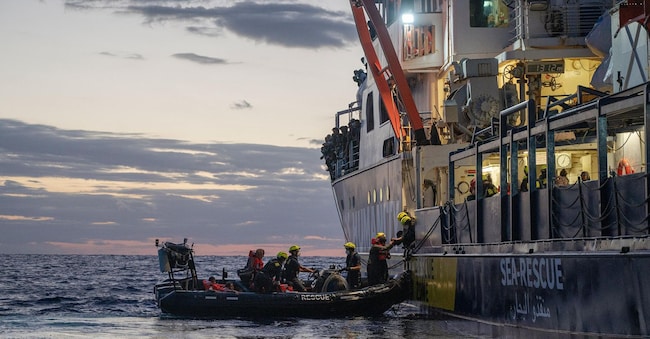
‘We’d take people on board and see bite marks on their legs; at first we didn’t understand. Do you know what they were? The marks left by people who had drowned at the bottom of the dinghy.’ People smugglers can pack the boats so full that people have to be pulled out by force. People travel standing up, crammed together. Those who can no longer stay upright slip to the bottom and have no room to get back up. They die with their faces crushed in ten centimetres of liquid.
To illustrate what happens to refugees attempting to cross the sea, in The Mediterranean: On board humanitarian ships, Caterina Bonvicini begins with the details. From the smell of the sludge that pools at the bottom of the hull, to the chemical burns caused by the fuel often dissolved in it, to the chronic pain of those who have been tortured, to the telephone number on the shorts of a child’s corpse: written by the parents so they could be notified in the event of death. Or the unhealable wounds of the rescuers who had to choose whom to save first and whom to leave to drown. Volunteers ‘who, at the age of twenty, were not afraid to take responsibility for the lives and deaths of others. Burning like candles, fully aware, utterly serious, committed to something greater than any of us. And simply because it had to be done, and that was that’.
As both a writer and a journalist, Bonvicini understands the importance of details and their ability to help us grasp what would otherwise be beyond our grasp. ‘Our imagination is trivial because we do not know the details. (...) It is dangerous because it is trivial. Our imagination, both trivial and dangerous, is easily manipulated and is used against us.’
In the pages of the book, he reflects on the difficulty and the necessity of conveying what he witnessed on board some of the ships searching for shipwrecked people whom Italia and the European Union have decided no longer to rescue. Indeed, they have decided to pay the Libyans to take them back to the prisons where they are tortured, enslaved, raped and killed. Empty words, to which public opinion has once again become accustomed, following the outcry in 2013 caused by the shipwreck of 540 people off Lampedusa, and after the photograph of the body of Alan Kurdi, a three-year-old Syrian refugee lying face-up on a beach, his little head still being lapped by the waves.
Leaving rhetoric aside, Bonvicini focuses on helping the reader to empathise, as well as on providing comprehensive information and exploring various points of view. The result is a book that everyone should read. ‘The writer has a duty to recount a terrible truth, and the reader has a civic duty to know that truth. Anyone who turns their back, closes their eyes or looks the other way offends the memory of the fallen,’ states Vasily Grossman in The Hell of Treblinka (1944). And what we are allowing to happen in the Mediterranean is truly ‘a surrender in the face of the lives of hundreds of thousands of people. A surrender in the face of history’.


