Books

What skills are needed to work with artificial intelligence?

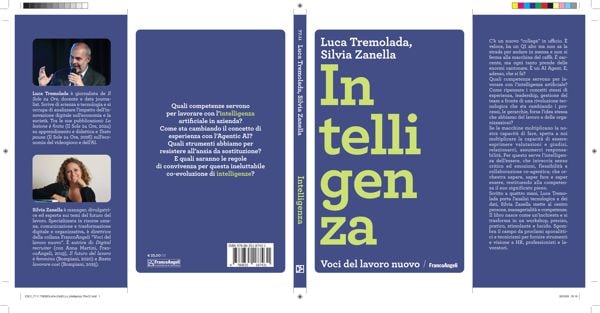
In the book 'Intelligence', authors Luca Tremolada and Silvia Zanella describe the impact of Ai on the labour market.


4' min read

Translated by AI
Versione italiana

4' min read

Translated by AI
Versione italiana

We publish an excerpt from the introduction of the book 'Intelligence' (Franco Angeli)

The first time I worked with a machine was in November 2022, when ChatGPT came out. To be honest, it was not my first time with software that responds in natural language. I had already measured myself with Natural Language Processing. Conceptually, NLP is the ancestor of ChatGPT, but not its direct descendants.

Loading...

Let's say it is like classical mechanics is to relativity. (..) From the beginning, ChatGPT did not seem like an evolution of existing technology but something qualitatively different: it understood the questions, the context and answered them in tone.

Despite the fact that my twenty years of science journalism have made me cynical towards life in general - and especially towards new technologies - the first time I entered a prompt in ChatGPT version 3.5 I felt 'like a disturbance in the Force' (Star Wars quote).

On instinct I typed:'Write a science and technology article as if I were Luca Tremolada from Il Sole 24 Ore'. And she (he) instantly performed the task. I read the whole thing. I got up from my chair and hugged my wife in silence, thinking: 'I still have a job, that thing is invented, it's not accurate and then it's so boring to read'.
Today, three years later, I no longer have that much confidence, but I remain optimistic. Not least because in the meantime I have also empowered myself, gaining awareness in the use of this technology. And as is often the case, when you learn to use a tool well, it stops seeming magical and intentional. It reveals itself for what it is and starts to seem dangerous just because we are the ones using it. It is a question of 'intellectual posture', of understanding our boundaries, of establishing who we are and who they are. The real challenge posed to us by these large-scale language models (that is the correct definition) is that we must not put ourselves in competition with them.

Copertina

“Intelligenza” di Luca Tremolada e Silvia Zanella

It is not a race, we stop running the same race. (...) Why thendo we insist on considering it our substitute? Partly because it is. Not on the level of human relations, but on the level of work. And this is the bitter starting point of this book, which began as an investigation and soon turned into a working paper.

Today, our attitude towards the 'machine' has never been so divided and frightened, simply because in human history we have never really been faced with the possibility of having a 'synthetic colleague' at our side. Today, futurologists appear more uncertain than ever. (....) Many scientists claim that we are currently experiencing a sixth mass extinction (the Holocene or Anthropocene Extinction), caused this time not by geological phenomena, but by human activity. The AI is the highest expression of human activity. And it is also the most symbolic. Our reflection begins here.

In this book we set out to talk as little as possible about technology, because what we are witnessing is not just a technical revolution. It is a profound change in the productive arrangements of humanity. That is why we have forced ourselves to start with those who are driving this change, to start with their words, with the oldest unit of measurement we have: human thought.

Like ChatGPT, we focused on what they say. Not to amplify slogans and prophecies, but to ground some of the mantras, clichés and slogans that are accompanying the arrival and impact of AI on the labour market. (...)

(...) AI is not a meteorite. It does not fall from the sky, it is not blind, it is not external to the system. It is a technology designed, adopted, regulated and above all used by human beings. To speak of extinction presupposes an inevitable natural event; here instead we are faced with an economic and organisational transformation, painful for some professions, liberating for others, chaotic like all previous technological transitions.

The loom did not exterminate humanity, the internal combustion engine did not wipe out work, the internet did not make brains useless: it just forced them to do different, often more complicated things.

The fear stems from a typical error of perspective: confusing tasks with jobs, and jobs with people. AI is very good at eating up specific, repetitive, standardisable tasks. Humans, on the other hand, have lived for millennia precisely by changing roles when the environment changes. This is our evolutionary superpower, much more than artificial intelligence: reconversion. History suggests that we will not become extinct. We will adapt. Badly at first, with anxiety and catastrophist articles. Then, as always, by inventing new professions and telling the younger generation that once upon a time, just think, certain texts were only written by humans.

Copyright reserved ©
Loading...

Brand connect

Loading...

Newsletter

Notizie e approfondimenti sugli avvenimenti politici, economici e finanziari.

Iscriviti