The analysis

What the historic free trade agreement between the EU and Mercosur provides for

The cartel creates a market of 700 million people, but the European Parliament could slow down the entry into force with motions for postponement and legal challenges

by Beda Romano

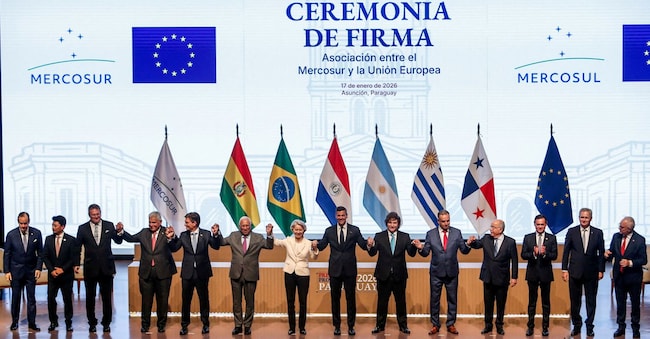
Le autorità dell'Unione Europea e del blocco sudamericano Mercosur posano durante la cerimonia di firma di un accordo di libero scambio, che conclude oltre 25 anni di negoziati, ad Asunción, Paraguay, il 17 gennaio 2026. REUTERS/Cesar Olmedo

3' min read

Translated by AI
Versione italiana

3' min read

Translated by AI
Versione italiana

FROM OUR CORRESPONDENT

BRUSSELS - The historic partnership agreement between the European Union and the Mercosur has finally been signed in Assumption, the capital of Paraguay, after years of bilateral negotiations and weeks of European tug-of-war. Beyond the desire to promote relations between the two blocs, the agreement that in fact creates a new market of more than 700 million people is meant to be a response to the unilateral and protectionist US foreign policy. The gaze now runs to Strasbourg where the European Parliament will have to give its long-awaited approval.

Loading...

"This is much more than a trade agreement," said European Commission President Ursula von der Leyen on Saturday 17 January. "Today we show the world that we are in favour of dialogue, of cooperation, of mutual benefit. In the economic, environmental, and geopolitical fields'. European Council President António Costa added from Assumption yesterday: 'Our agreement does not create spheres of influence, but spheres of shared prosperity'.

In the same spirit, the representatives of Mercosur (Brazil, Paraguay, Uruguay and Argentina) spoke. Brazilian Foreign Minister Mauro Vieira criticised 'unpredictability', 'protectionism' and 'coercion', in a clear reference to the Trump administration. The only one to break away somewhat was Argentine President Javier Milei, who hailed the recent downfall at American hands of Venezuelan President Nicolás Maduro - as well as thanking Italian Prime Minister Giorgia Meloni for her mediating role in the final phase of the negotiations.

The signing came after final uncertainties on the part of the Twenty-Seven (six countries preferred not to approve the agreement). Guarantees were adopted in particular in the agricultural sector (see Il Sole/24 Ore of 8 January). The treaty should stimulate relations between the two blocs. Today, Mercosur countries tend to trade with Brazil, the region's superpower. With the near-abolition of tariffs with the European Union, the member countries will become new privileged partners.

On the parliamentary front, Strasbourg will vote on Wednesday on two motions, both in favour of referring the agreement to the European Court of Justice to assess its legal validity. The first motion was signed by the Greens, Left and Liberals; the second by the more nationalist right-wing parties. In all, there were about 250 signatories (out of a total of 720 MEPs). It must be assumed that the signatories will vote exclusively in favour of their motion. Consequently, given the numbers, many in parliamentary circles are betting (hoping) on a double rejection.

The partnership agreement signed with Mercosur has two major chapters. The first is purely commercial and requires the consent of the European Parliament alone; the second has broader perspectives and also requires national ratifications. In giving the green light for the signing, the Council authorised the provisional application of the trade treaty (see Il Sole/24 Ore of 10 January). Barring any backtracking, this will be triggered as soon as one of the four Mercosur countries has also approved the treaty (possibly Uruguay).

A possible referral to the Court by Parliament would result in a postponement of parliamentary ratification, but would not hinder provisional application (this has happened in the past with the trade agreement with Canada). The choice as to what to do, if any, would be political. Brussels has little room for manoeuvre as to the timing of the start of provisional application, also taking into account the need for at least one of the Mercosur countries to complete its ratification process.

More problematic would be a tout court rejection of the text. Ezio Perillo, a former judge of the European Court of Justice, explains: 'In the presence of a decision of the European Parliament refusing to approve the agreement in its entirety, that agreement must be considered legally unconcluded and its provisional application immediately discontinued'. It happened in 2010 when Strasbourg rejected the SWIFT treaty with the United States, which had already been in provisional application for three months. The parties were forced to renegotiate the agreement dedicated to the fight against financial terrorism.

Copyright reserved ©
Loading...

Brand connect

Loading...

Newsletter

Notizie e approfondimenti sugli avvenimenti politici, economici e finanziari.

Iscriviti