
When a majority is not enough: republican freedom and the contestability of power
Political freedom requires institutions that allow citizens to challenge power, ensuring that no authority can exercise arbitrary rule, even if supported by the majority

Key points
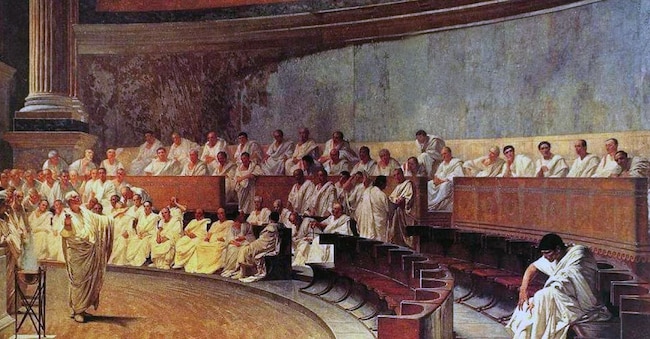
Republics are born out of fear. Not from fear of disorder, of the war of all against all, but from fear of its antidote. From fear of power when it loses control. 509 BC, the date of the ousting of Tarquinius the Proud, coincides with the birth of the republic and the appointment of the first two consuls. Two, precisely, so that each could be controller and constraint for the other with his right of intercessio, the power of veto. The republic was created to limit the powers of government and did so by relying on collegial institutions, very short terms of office and the presence of the tribunes, a permanent countervailing power to balance that of the consuls. The same fear, that of power growing and overstepping limits, that worried Machiavelli and Montesquieu and, basically, all the constituents of modern democracies. All of them, in fact, albeit with different solutions, sought to respond to the same anxiety generated by the risk of unrestrained government. In chapter four of the first book of the Discorsi sopra la prima deca di Tito Livio, Machiavelli writes "I say that those who condemn the tumults between the Nobles and the People seem to me to blame those things that were the first cause of keeping Rome free; and that they consider more the noise and shouts that arise from such tumults than the good effects that they produce". Good government, therefore, is not born from silence nor from the absence of conflict. Rather, it is born from the 'tumults between the Nobles and the Plebs' and from the 'rumblings' and 'shouts'. It is born when conflict finds institutional forms and shared rules capable of regulating it. It arises when dissent can manifest itself openly and peacefully and when different powers limit and control each other.
It is precisely from this insight, as old as the republican tradition itself, that the contemporary reflection of Irish philosopher Philip Pettit begins. In last week's Mind the Economy we saw how freedom, in the republican tradition, does not coincide with the simple absence of coercion, but with a more demanding condition that Pettit defines as 'non-domination', as the state of one who is not exposed to the arbitrary will of others. If this is the definition of freedom, the next question can only concern its political implications. What institutions are capable of making 'non-domination' truly operational?
The Paradox of the State
A complex society cannot do without a public authority capable of enforcing rules. Without a state, there is no protection against private domination, economic monopolies, opaque oligarchies and other forms of asymmetrical exercise of power. But here a paradox emerges because the state that, on the one hand, protects us from private domination, does so, itself, through the exercise of that same coercive power from which it is supposed to protect us. How, then, can we prevent this power from turning into a new form of domination? 'There is no public protection against domination,' writes Pettit, 'without a coercive state; but coercion itself seems to undermine freedom'. This is why, he continues, 'republican theory regards the procedural rights that citizens must enjoy - together, as we shall see, with other less formal rights - as powers that each must exercise fully and equally in order not to be subjected to the subjugation and domination of an uncontrolled state. It places heavy responsibilities on the state in the area of social justice (...) But it emphasises that, nonetheless, the coercive state poses a real danger - a danger to the very freedom that social justice is meant to promote - and that citizens must share equally in the control of political coercion if they are to enjoy the status of free persons. The spectre of the despotic and illegitimate state - even the benevolent-despotic state - haunts this approach as much as the spectre of the socially unjust regime. And it inevitably foregrounds the demand for a regime of shared popular control' (On the People's Terms: A Republican Theory and Model of Democracy, Cambridge University Press, 2012, p. 185). Republican democracy was born out of this very dilemma. How to make the exercise of public power compatible with the freedom of citizens?
Majority is not enough
A popular response to this question is to identify the legitimacy of the exercise of political power with the will of the majority of voters. If power derives from the people, it is assumed, this cannot be considered arbitrary. The republican perspective is more cautious. A government can be perfectly legitimate from an electoral perspective and yet, in the absence of institutional limits and controls, exercise a power of domination. Domination depends not only on who wields the power itself, it depends on how they wield it. "What matters is not so much that the government follows the will of the people at all times," writes Pettit again, "but that the citizens can challenge what the government does (...) The only way in which a republican regime can ensure that such an exercise of discretion is not hostile to the interests and ideas of the population as a whole, or of a part of the community, is to introduce systematic possibilities for ordinary citizens to challenge the actions of the government. This points us towards the ideal of a democracy based not on the presumed consent of the people, but rather on the contestability by the people of everything the government does: the important thing is to ensure that government actions survive popular contestation, not that they are the product of the will of the people' (Republicanism, Oxford University Press, 1997, p. 277-8). A 'contestative' democracy, Pettit explains, will by its very nature be deliberative, inclusive and responsive. That is, it will require decisions to be based on considerations of common interest and leave room for people from all walks of life to challenge legislative, executive or judicial decisions. It will also need to be sensitive to challenges raised against government decisions. Political freedom does not require that the people decide everything directly. It requires that no public decision be removed from the possibility of challenge.
The institutions of non-domination
Separation of powers, rigid constitutions, independent courts, freedom of the press, rights of parliamentary opposition, are all devices that converge towards a common and necessary goal: to make power contestable. The republican tradition expressed this intuition with the idea of a mixed constitution, a system of balances between different powers capable of preventing the arbitrary concentration of authority. Pettit takes this intuition and reformulates it in the language of contemporary democratic theory. According to his model, a functioning democracy combines two fundamental dimensions: on the one hand, popular influence, exercised through elections and representation; on the other hand, popular control, achieved through institutions that allow citizens to challenge arbitrary decisions. Only the combination of these two dimensions prevents public power from turning into domination.


