
Why the ECB will hold rates steady
Inflation does not seem to be a problem even though it is above target, while growth indications do not point to rapid price reductions

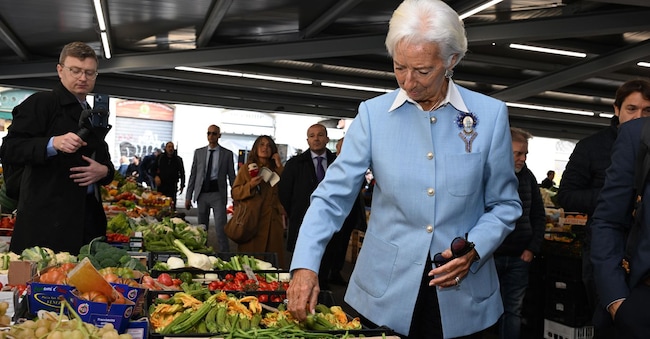
Firm rates. Leaving the door open for December. The October meeting of the European Central Bank, to be held in Florence, is expected to confirm the official cost of very short-term credit at 2% for banks' deposits with the ECB and 2.15% for refinancing operations: a very low level, taking into account the inflation trend and the presumably neutral rate (not immediately observable, but certainly not far off). The risk of a demand shock linked to the Trump administration's recent tariffs policy advises keeping monetary policy in a position to move nimbly in any direction.
Still price tensions
Inflation is not yet back on target: it was 2.2 % at the end of September, with the core index rising by 2.4 %. For the end of the year, however, projections expect an average inflation of 2.1 %, which would require indices rising by an average of 1.9 % p.a. in October, November and December. Similarly, an average inflation of 2 % p.a. would be needed for each of the three months to reach the target level of 2.4 % for core inflation. The target - which is actually a statistical simulation - does not seem within reach for the EU economy and cutting rates further could prove to be a mistake.
The rise of the euro
It is a consideration, this one, that suggests that the latest rate cuts have been decided with a view to risk management. The ECB's latest risk assessment points to strong uncertainty precisely on prices, and in both directions. There is a possibility, President Christine Lagarde explained in September, that the euro will create downward pressure on inflation, and if the exchange rate cannot be an instrument or target of monetary policy - too elusive - its effects cannot be ignored. The effective exchange rate has risen very rapidly, from February to today - and it is precisely the movements and their speed that are relevant - to the point of moving above the long-term average, after a rather long phase below that threshold, which can be considered a simplistic indication of equilibrium value. Today it seems to be stationary in a relatively narrow corridor, but nothing excludes that it could move again quickly.
High long-term returns
It is also interesting how the yield curve has changed compared to the beginning of the year - just before Trump's arrival in the White House and his trade policies - and compared to the previous phase with deposit rates at 2%. In 2022, shorter-term yields were lower, but that was a clear anomaly with respect to monetary policy rates. Today, longer- and very long-term yields are instead decidedly higher, and it is not easy to understand - in a purely exploratory analysis - how much is the effect of higher inflation risks and how much of higher growth expectations, for example through defence investments (which must, however, be innovation-oriented to have an attractive multiplier).
Lending lively amid falling rates
On the other hand, growth does not seem to signal any worries. Not in the immediate future, at least. Lending to non-financial companies, which is the primary source of financing, continues to accelerate, with loans still falling towards the historical average (reached in Italy, for example). Unemployment also remains close to its lows. There are therefore no signs of a possible rapid disinflation (nor would a price slowdown really require immediate action, if the lessons of the long expansionary phase of the past few years are to be learnt).


