Digital Economy

Why the intelligent agent revolution is changing the world of work more than chatbots

Marco Bragadin, CEO of Datlas – a company specialising in the digitalisation of processes that already utilises human agents, knowledge and skills – speaks

3' min read

Translated by AI
Versione italiana

3' min read

Translated by AI
Versione italiana

For two years, we’ve been talking about models. More powerful, faster, cheaper. The competition between OpenAI, Anthropic, Google and Meta has seemed, above all, like a race to see who could build the best artificial brain. But now the focus is shifting elsewhere. The real issue is no longer the model. It’s the system.

We have entered the era of intelligent agents.

Loading...

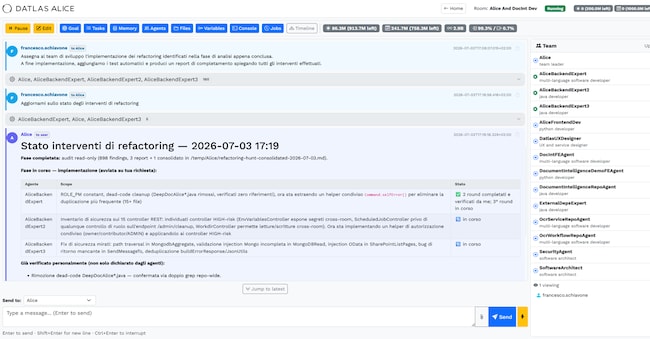
This is no trivial step. It means that value is no longer generated solely by an artificial intelligence’s ability to answer a question correctly. It is generated by its ability to collaborate with people, software, databases and business processes. In other words: the future is not a smarter chatbot. It is an ecosystem of AI agents working within the organisation.

Marco Bragadin, CEO of Datlas, an Italian company specialising in the digitalisation of business processes (Business Process Outsourcing), sums up this point as follows: ‘The most significant change is that we are no longer just discussing models, but the way in which people and artificial intelligence collaborate.’

And this is where the story gets interesting.

Because, up until now, automation has been relatively straightforward to explain. A machine replaces a task. Software eliminates a manual step. Greater efficiency, lower costs. But the economics of agents are more complex. They do not simply replace work; they change its structure.

Let’s take a sector with a high volume of information, such as insurance or finance. Every case file is a mosaic of documents: photographs, contracts, emails, reports, forms and expert assessments. For years, the bottleneck has been human labour: reading, checking and comparing.

These days, AI can read everything in a matter of seconds.

Datlas operates precisely in this field: transforming large volumes of unstructured data into actionable insights. In the insurance sector, for example, this involves using Document Intelligence, generative AI and computer vision to automatically read, classify and correlate claims documentation.

Bragadin explains the point clearly: ‘Artificial intelligence does not make decisions on people’s behalf. Its role is to eliminate work that does not contribute to our understanding of the process.’ This is a fundamental distinction.

Loading...

AI does not decide whether to approve or reject a claim. It lays the groundwork for decision-making. It highlights anomalies. It links data. It flags inconsistencies. It reduces information noise.

And this is where the most interesting economic paradox emerges: the more you automate, the more the value of highly cognitive human skills increases. It seems counterintuitive, but it isn’t. If a machine is tasked with reading 500 documents, the value of the human lies no longer in the act of reading. It lies in the ability to interpret exceptions, understand context, assess risk and make complex decisions. This is why the agent economy also represents a redefinition of human capital.

Bragadin puts it this way: ‘The most interesting question is not what artificial intelligence will do, but what people will do once artificial intelligence has automated part of their work.’ It is the question on every company’s mind today. And it particularly affects junior staff. Because there is a risk here that is rarely discussed: if AI automates entry-level operational work, where will tomorrow’s professionals be trained?

Historically, learning within a company has involved seemingly routine tasks. Checking files. Carrying out checks. Reading documentation. That is where tacit knowledge is built up. That is where a junior employee becomes a senior one.

If we skip that step, we risk a short circuit: companies that are more efficient in the short term, but more fragile in the long term. ‘If we automate a process without giving this aspect any thought,’ explains the manager, ‘we risk gaining efficiency but losing the opportunity to learn.’ That is why the true cost of automation is not technological. It is organisational.

Datlas explored this tension by having junior and senior staff work alongside AI agents. The result was interesting and, in some ways, counterintuitive. The junior staff used artificial intelligence primarily as a learning tool. The senior staff, on the other hand, used it as a tool for delegating operational tasks. Two contrasting approaches. Both useful.

Younger people are asking for explanations, examples and guidance. Their more experienced counterparts are looking for speed whilst maintaining architectural control. This tells us something important: there is no single ‘correct’ way to use AI. ‘We are moving away from viewing AI as a tool that simply carries out orders and are starting to use it as a design partner,’ Bragadin concludes. If there is to be a new economy of collaboration, this is a start.

Copyright reserved ©
  • Luca Tremolada

    Luca TremoladaGiornalista

    Luogo: Milano via Monte Rosa 91

    Lingue parlate: Inglese, Francese

    Argomenti: Tecnologia, scienza, finanza, startup, dati

    Premi: Premio Gabriele Lanfredini sull’informazione; Premio giornalistico State Street, categoria "Innovation"; DStars 2019, categoria journalism

Loading...

Brand connect

Loading...

Newsletter

Notizie e approfondimenti sugli avvenimenti politici, economici e finanziari.

Iscriviti