
Wildfires: the number of high-risk days in Southern Europe has doubled over the past 45 years
According to a study published in the journal *Scientific Reports*, the number of days with extreme fire conditions has more than doubled across large parts of southern Europe

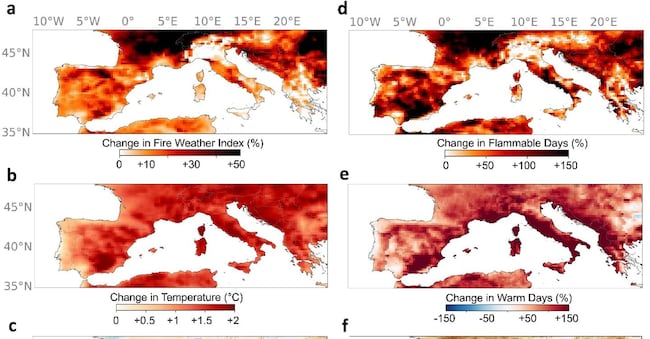
In southern Europe, the number of fires is falling, but the period of weather favourable to fires is increasing. This is the paradox described in a study published in Scientific Reports: between 1981 and 2025, across large areas of Portugal, Spain, France, Italia and Greece, the number of summer days with extreme weather conditions conducive to the spread of fire has more than doubled.
In some areas, there were fewer than ten per summer between 1981 and 2010. Over the last decade, this figure has risen to around 25. Meanwhile, thanks to prevention measures and more efficient fire-fighting systems, the annual number of fires has fallen.
The point is that nowadays, when a spark manages to turn into a fire, it more often than not finds a motorway lying ahead of it.
To measure this ‘weather motorway’, the researchers used the Fire Weather Index (FWI), an indicator developed in Canada and adopted by many monitoring systems. It does not predict where a fire will break out, nor does it directly take into account arson, lightning or power lines. It measures the extent to which the weather makes the area prone to burning.
The index is based on four daily measurements: temperature, air humidity, wind and rainfall over the previous 24 hours. These values are used to estimate the moisture content of various plant-based fuels.


