
With MIRA, the Strait of Messina is becoming a cultural hub for the Mediterranean. Giuli: ‘It is not just a museum but a project for growth’
MiC, the City Council and the University have unveiled the new centre dedicated to research, education and contemporary artistic production
Key points
There is an idea that runs through the MIRA project – the Mediterranean Institute for Research and Arts – presented at Palazzo Zanca in Messina. The Strait, transformed from a dividing line into a platform for crossing: a shift in perspective that is even more significant than the architectural restoration or the programme of events that accompanies it. ‘MIRA is not just a museum; it is a project for the growth and development of international relations, particularly with Africa and the wider Mediterranean, in the spirit of dialogue, peace and exchange between peoples. It speaks the universal language of peace, which is art,’ summarises the Minister for Culture Alessandro Giuli. ‘Right now, one need only look at what is happening not only in the Mediterranean but also in Kyiv: there is a need for art, for culture, for connection. We are building our cultural bridge across the Strait of Messina.”
Double opening ceremony
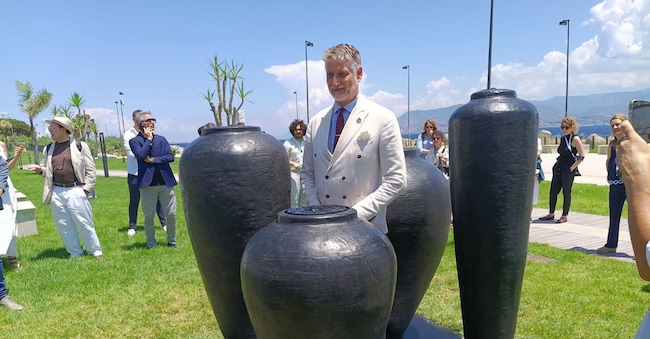
The launch of the new cultural centre dedicated to research, education and contemporary artistic production in the Mediterranean – created by the Ministry of Culture, the City Council and the University – forms part of a ‘broad process of urban regeneration and cultural revitalisation of the Messina and Sicilian regions and, more generally, of Southern Italy’, say the organisers. To mark the launch of the institute, a dual opening ceremony was held – in Messina and Reggio Calabria – dedicated to the monumental installation of the sculptural groups entitled *La Fontana Ferma* by Piero Pizzi Cannella. The works have been installed on either side of the Strait: in the area of the former Messina Exhibition Centre, within a regenerated urban park, and in Piazza De Nava, in Reggio Calabria. These two mirror-image installations enrich the ongoing dialogue between the cities, evoking a shared cultural geography and a new Mediterranean centrality forged through interventions in the local area with the involvement of the local community.
The symbolic significance of the Towers
For a century, the Strait has been criss-crossed by infrastructure designed to link the two shores as discreetly and invisibly as possible. Power cables, sea currents, shipping routes. The Morandi Towers, one of the two sites of the new institute, are the most eloquent monument to this silent vocation; built in 1957 to support the cables that carried electricity to Sicily, decommissioned in 1994 when the connections were routed under the sea, and left for thirty years as a foreign element in the landscape of Torre Faro. That this relic of industrial archaeology should now become the beating heart of an institute dedicated to research and contemporary artistic production is not so much – or not merely – a project of urban regeneration, but rather a choice to transform a symbol of hidden infrastructure into a means of visibility and connection.
The link with the Mattei Plan
MIRA was established within a specific institutional framework, namely that of the Mattei Plan and the newly established MiC Mission Unit for cooperation with Africa and the wider Mediterranean, and takes up the baton from MAXXI Med, which was launched in 2023. But its broader significance lies in the attempt to redefine what a cultural institution might be at this juncture in history: not a repository of works, but — as the project’s own presentation states — a living ecosystem, capable of interpreting contemporary artistic practices as processes of relationship, hospitality and transformation, rather than as collections to be preserved. This language reflects a broader debate on the role of museums, which are increasingly seen not as repositories of memory but as active agents in the regeneration of the local areas in which they are situated.
It is no coincidence that the choice fell on Sicily, and specifically on Messina. The project identifies the island as a meeting point between Europe, Africa and the Middle East, and entrusts the new institute with the task of building international artistic networks and residency programmes capable of countering what the presentation document describes as ‘contemporary cultural homogenisation’.


