

Workflows and the rule of law in the Mediterranean: an ever-widening rift between Europe and the Middle East
In Otranto, the Mediterranean Journalists’ Festival tackles the new challenges facing the media: disinformation, conflicts, press freedom, the safety of journalists and the digital revolution. Among those awarded the Caravella del Mediterraneo prize were Lucio Caracciolo, Iacopo Luzi, Armando Franza, Lucia Esposito, Alhassan Selmi, Claudio Antonelli and Leonardo Zellino. A special prize for press freedom was awarded to Shelly Kittleson.
by 24Ore Nextmed
 Aggiungi Il Sole 24 Ore
ai preferiti su Google
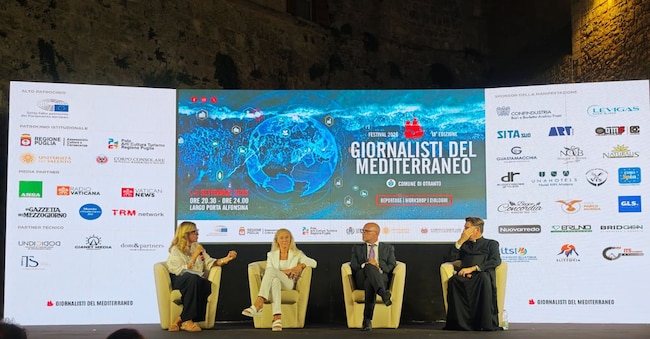
The first three evenings of the Mediterranean Journalists’ Festival have come to a close. This year’s edition marks its eighteenth anniversary. An important milestone, taking place in a year that has been more complicated than ever for those who have made the task of deciphering reality their profession: ‘The challenge, in fact, is to uphold the timeless principles of journalism – the pursuit of truth, even in often indecipherable circumstances – whilst remaining attuned to the times and current events,’ explains the Festival’s patron, Tommaso Forte. Without compromising the need to report unequivocal facts, nor the necessity of utilising modern means of communication, which enable us to reach unprecedented audiences of readers in real time. Thus, on the first evening, the topics of regional relations – in particular, relations with the Balkans – and the safety of journalists were addressed. The second evening, meanwhile, featured a lengthy panel discussion dedicated to the rule of law. Among the key figures on stage were Judge Maria Francesca Mariano, the Prefect of Lecce, Domenico Manno, who has long been committed to combating extortion, usury and abuse, and Father Antonio Coluccia, who is currently working in the suburbs of Rome. At the end of the meeting, the Father addressed the Vatican media, directing a special message to young people, quoting Don Bosco: ‘Today more than ever, we need to be part of our young people’s lives; we must enter into their way of thinking, as the Piedmontese saint used to say’, and it is essential ‘to instil values, to be in tune with their times, even if today there always seems to be too little of that’. But what is it that truly moves people towards lawfulness? Tougher penalties, listening, or setting an example? “I believe setting an example is the first priority. Jesus Christ was the first to set an example, and young people need this.” Hence a word of warning: “Even when there is a major law enforcement operation, we must still be careful, because repressive action tells us that prevention – that is, educational work – has been lacking in the community.”
The second evening then featured a panel discussion specifically on the future of the Mediterranean, a dialogue between Claudio Antonelli, deputy director of 24Ore NextMed, and the journalist Marianna Balfour. Many topics were covered, ranging from the importance of education and security to the new alliances taking shape in the Middle East, which will affect the balance of power in the Mare Nostrum in the coming months. From the military alliance between Greece and Israel to that between Pakistan, Turkey and Saudi Arabia. A discussion grounded in figures and data, designed to avoid falling into the trap of the polarised narrative that all too often pervades the mainstream media and, above all, the world of social media.
The festival, an event which over the past eighteen years has hosted more than 1,000 journalists, analysts, representatives of institutions and academics, has always provided a forum for discussion on current geopolitical developments in the Mediterranean basin and across Europe, as well as on the transformations taking place in the world of information, in light of the increasingly entrenched and pervasive presence of artificial intelligence in our lives, ‘a fact that exposes humanity to ever-changing challenges’, Forte goes on to explain.
On Wednesday 3 September, there were two notable panel discussions. The first featured Shelly Kittleson, a freelance journalist who was kidnapped in Iraq last March and released a week later. She took part in the panel on the theme ‘The crisis in international law: war, global justice and new power imbalances’ alongside Shervin Haravi, a lawyer specialising in Iran; and Stefano Polli, former deputy director of ANSA. This was followed by the panel ‘Catholic diplomacy and global scenarios: mediation, peace and international conflicts’. Among the other speakers was the Archbishop of Otranto, Francesco Neri.
Tonight marks the close of the event with the presentation of the Caravella del Mediterraneo awards. The awards are to be presented to Lucio Caracciolo, founder and editor of the magazine “Limes”; to Iacopo Luzi, White House correspondent; to General Armando Franza, commander of the Puglia Air and Naval Unit; to journalist Lucia Esposito, who is under police protection due to her investigations into the Camorra; to the Palestinian journalist Alhassan Selmi; to Claudio Antonelli, deputy editor of “24Ore NextMed”; and to Leonardo Zellino, a correspondent for Tg1.

