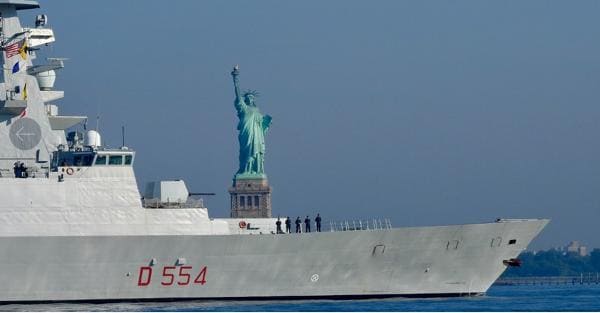
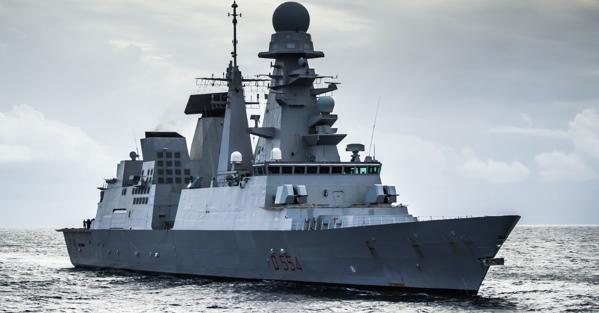
Duilio, what the destroyer that shot down the Houthi drone looks like
ServizioContenuto basato su fatti, osservati e verificati dal reporter in modo diretto o riportati da fonti verificate e attendibili.Scopri di più
The attack
Duilio, what the destroyer that shot down the Houthi drone looks like
Over 152 metres long and around 20 metres wide, a speed of 29 knots, 195 people on board. She is the basis of the nascent European operation Aspides under the leadership of Rear Admiral Stefano Costantino
A drone was launched yesterday from Yemen and directed towards the ship Carlo Duilio, the Navy destroyer that will be the base of the nascent European operation Aspides under the leadership of Rear Admiral Stefano Costantino.
The Houthis thus launch their first direct attack on Italy and risk precipitating the crisis in the Red Sea, which has been under attack for months now by Yemeni rebels who, until now, had only carried out raids on US and British boats.
Loading...
The drone was shot down by the Italian ship.
It had similar characteristics to those used in previous attacks and was about 6 kilometres from the Italian ship, flying in its direction.
"The Houthi terrorist attacks are a serious violation of international law and an attack on the security of the maritime traffic on which our economy depends," commented Defence Minister Guido Crosetto. "These attacks are part of a hybrid war, which uses every possibility, not only military, to damage some countries and facilitate others.
Loading...
The European operation in the Red Sea 'Aspides' aims to defend merchant ships from Houthi attacks, which began in November 2023. Supported by Iran, the Houthis are able to attack the ships from land, using drones, missiles, and barges.
At the beginning of February, the Italian Navy destroyer carried out the handover with the frigate 'Federico Martinengo', which is engaged in the Red Sea in ensuring maritime surveillance and protection of merchant vessels in transit to ensure the freedom of trade routes. In turn, from 11 February the Martinengo will take over as the flagship unit of 'Atalanta'.
Crosetto: dagli Houthi dei veri e propri attacchi di natura militare
Hangar and flight deck suitable for helicopter operations
Caio Duilio was launched at Riva Trigoso (GE)on 23 October 2007 and transported to the Muggiano (SP) shipyards before entering service, with delivery to the Navy, on 3 April 2009. Over 152 metres long and about 20 metres wide, a speed of 29 knots, 195 people on board, in terms of weapons she has 3 Oto Melara 76/62 SR; 2 Oto Melara Oerlikon KBA 25/80; Sist. Miss. PAAMS: 6 vertex launchers. (48 cells) for Aster 15 and Aster 30; Predisp. for 8 S/S Teseo Mk2/A; 2 SCLAR-H rocket launchers; 2 Eurotorp B515/1 MU90 torpedo launchers; EH101/SH90.
Its port of reference is Taranto and it is under the command of the First Naval Group, of which it is also a flagship unit. "Adopting state-of-the-art technology," reads the Ministry of Defence website, "it is particularly suited to carrying out command and control tasks, even in crisis and humanitarian emergency situations, being able to rely on numerous traditional and satellite communication devices, including the very recent Link22, and a modern command support system that can be reconfigured as required. All this can be implemented in full logistical self-sufficiency without depending on the territory on or near which it is required to interact or operate. The hangar and the flight deck," it is explained, "are suitable for operating the SH90 and EH101 helicopters for maritime patrol, transport, and medical evacuation requirements.
NATO exercise debut
The Caio Duilio made its international debut during the NATO Proud Manta exercise, held in the waters of the Ionian Sea in February 2011, operating alongside ships, submarines and aircraft from nine allied nations. This was even before the delivery of the combat flag, an event that took place in Gaeta (LT) on 22 September of the same year. She obtained the 'Combat Ready' characteristic after passing her naval training at the Navy's Aeronaval Training Centre during the first months of 2012, during which she also successfully carried out launch tests for the PAAMS missile system.
Loading...
Curiosity
.
The ship was named after the Roman consul Caius Duilius, who in 260 BC had an armada of 120 ships equipped with a movable bridge with hooks, known as a 'crow', built to counter the powerful Carthaginian enemy fleet. This invention allowed the Romans to transform the naval clash into hand-to-hand combat where they could express their superiority. In that same year, the Roman and Carthaginian fleets clashed at the Battle of Milazzo, where the Carthaginians were heavily defeated: with this victory, the Romans became the new masters of the western Mediterranean.
The first Roman to win at sea, Duilius was honoured with a triumph and the erection in the Forum of a column built from the rostrums of enemy ships, which still appears in the ship's Crest today. In fact, the destroyer Caio Duilio is the fourth unit of the Italian Navy to adopt this name.
The first was the battleship that served from 1880 to 1909; when it was built, with its 450 mm cannons, it was one of the most powerful warships of the time and, although it was never used in battle, it contributed to the international growth of the then newly unified Italian state.
The second unit was a battleship launched in 1913 and modernised in 1937, which participated in World War I and World War II and remained in service until 1956, becoming among other things the first flagship of the newly formed Republican Navy. Finally, the third was the missile launcher cruiser launched in 1960 and retired in 1990, the first vessel of this type to be built in post-war Italy. In her last years, this ship was also used as a training ship for the Cadets of the Naval Academy.