
The youngest planet in the cosmos has been discovered: Elias 2-24 b is being born right before our eyes
Elias 2-24 b is the youngest exoplanet – that is, one orbiting another star – confirmed to date, and it offers astronomers one of the rare opportunities to observe, almost in real time, the birth of a world orbiting another star

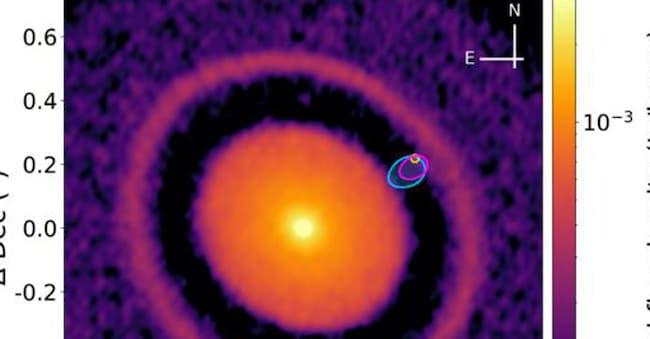
It is less than a million years old, as big as Jupiter and still growing, immersed in the disc of gas and dust from which it was born. Elias 2-24 b is the youngest exoplanet – that is, one orbiting another star – confirmed to date, and it offers astronomers one of the rare opportunities to observe, almost in real time, the birth of a world around another star.
The discovery was led by Andrea Bernardi, a PhD student at the Universidad Diego Portales in Santiago, Chile, who trained at the University of Padua, and was published in *The Astrophysical Journal Letters*. Among the authors is Alice Zurlo, now a lecturer at the same Chilean university and also a graduate of Padua, which has long been a centre of excellence in astrophysics.
Elias 2-24 b orbits a young star situated some 450 light-years from Earth. Its age, less than a million years, is minuscule in cosmic terms when compared with Earth’s approximately 4.5 billion years. The planet has a mass on a par with that of Jupiter – many hundreds of times that of Earth – and continues to draw in gas from the protoplanetary disc surrounding the star.
“What makes Elias 2-24b so extraordinary is its age,” explained Bernardi. “It is the youngest planet detected to date and, as it is still accreting material from its surroundings, we can observe a stage of planetary formation that we rarely see directly.”
Confirmation came by combining observations from different instruments. The Keck optical telescope in Hawaii and ALMA, the radio interferometer in the Atacama Desert in Chile, revealed the structure of the disc of gas and dust; the Very Large Telescope at the European Southern Observatory provided independent data.


