Space

A great collision between the Earth and Theia, a ghost planet: explaining the origin of the Moon

The impact seems to be the right hypothesis for understanding how our natural satellite formed and where the planet responsible for the collision came from

by Leopoldo Benacchio

4' min read

Translated by AI
Versione italiana

4' min read

Translated by AI
Versione italiana

Perhaps the mystery of the Moon's origin has been unravelled, thanks to a paper published in recent days in the leading scientific journal Science. The impact between the Earth and a large celestial body, from which the Moon was formed, now seems even more the right hypothesis for understanding how our natural satellite was formed and where the planet responsible for the impact, from which it emerged completely destroyed, came from.

It is a long-standing mystery that now, thanks to the patient work of the research team led by the University of Chicago, USA, and the Max-Planck-Institut für Sonnensystemforschung, Germany, is thought to have been solved.

Loading...

Let us proceed in order: the beautiful Moon, which illuminates our nights when it is full, is a somewhat peculiar satellite. In the meantime, it is lonely, it is the only one on Earth, and it is also very large compared to the planet it orbits: its diameter is about a quarter of that of the Earth, and its mass is about one-eightieth of that of the Earth. It seems little, but it is a lot relative to the planet it is orbiting. The fact that we always see the same face, with a few small periodic oscillations, seems very normal to us, but it is not at all. It is called spin-orbit coupling and, beyond words, it means that very old systems tune like the notes on a guitar and the Moon, therefore, orbits around us at the same time as it rotates around itself. And this is the datum that allows us to say that the Earth-Moon is an 'old' system, more than four billion years old.

We could go on for many pages, but we will stop and return to the scientific article that sheds light on the Moon's genesis, for alongside so many certainties, questions also remain. The main one is: how did this strange couple form?

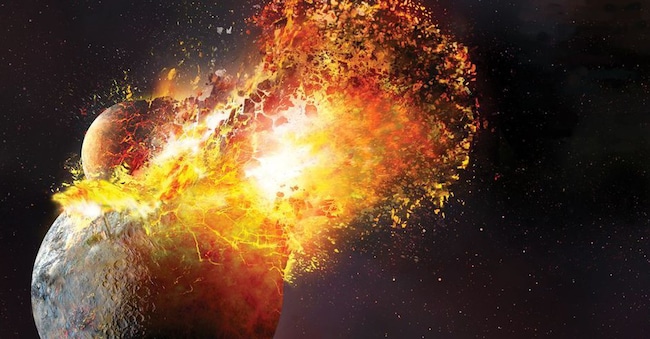
Many hypotheses have been put forward, the one on which the spotlight has been shining for some time is the cosmic collision: the Earth had just formed in a still young and very violent solar system, with frequent, even gigantic collisions, when it collided with a similar planet the size of Mars. A celestial body therefore smaller than the Earth, with a diameter half that of the Earth, and a mass nine times smaller. Smaller but comparable. One can understand that the collision must have been tremendous, but back then the solar system was full of stray bodies of all sizes, which today have thankfully been reduced to a minimum. Everything that was out of balance with the rest of the system was swept away by collisions, a kind of game of space billiards in which even the Earth got involved.

The offending planet was named Theia, the ancient Greek name for the mythical Titans. After the collision Theia dissolved and from its remnants, which went off in many directions and then regrouped, the Moon was formed over time.

This theory is not new and is supported by much evidence, but it remained to be clarified where Theia came from.

The Franco-German and American research team analysed the composition of 15 Earth rocks, meteorites and 6 Moon samples from the Apollo missions of the last century. The result was clear: Theia and the Earth must have formed in a very similar way, when the Sun was still at the beginning of its existence, from clouds of dust, gas and small meteorites that gradually came together. The collision between the two must have come very early, again in astronomical terms: around 100 million years.

The critical point is that the Moon was essentially formed from the material of Theia, but has much in common with the Earth's mantle.

The enigma was solved in the simplest of ways. As in the best detective stories they say 'follow the money', to find the murderer, here the scientists followed the iron. Given the amount of this metal in which the Earth's crust is rich, and given that the Earth's original iron had descended to the centre of our planet, this could only mean that the large fraction of the iron in the Earth's mantle must have come from an extraterrestrial source at some later time. In short, someone must have 'sprinkled' iron on the Earth's surface, like a nice spoonful of parmesan cheese on a plate of spaghetti.

Here's the kicker: the research team, we can say painstakingly, discovered that the iron present on the Moon and in the Earth's crust, and thus due to the collision, are virtually identical chemically and correspond to that present in meteorites known as non-carbonaceous chondrites. All these traces led to the solution.

These space rocks were formed near the Sun during the early days of the Solar System, suggesting that Earth and Theia first appeared in the same area of space near the Sun, but Theia probably formed closer to our star than Earth, which is why it was richer in iron than our planet.

The dynamics of what happened is therefore clear now: the two planets, Theia and Earth, originated practically together, with the former being closer to the sun. This caused the former to absorb more iron from the Sun, due to its greater proximity. During the collision between the two, the smaller one, Theia, got the worst of it and practically dissolved, forming a cloud of dust and debris from which, over millions of years, the Moon was formed. And this gives an account of why Earth and Moon, as components, are very similar: because so was Theia. And the enigma is solved.

Copyright reserved ©
Loading...

Brand connect

Loading...

Newsletter

Notizie e approfondimenti sugli avvenimenti politici, economici e finanziari.

Iscriviti