
The poet looks out to sea and sees only shipwrecked people and shipwrecks
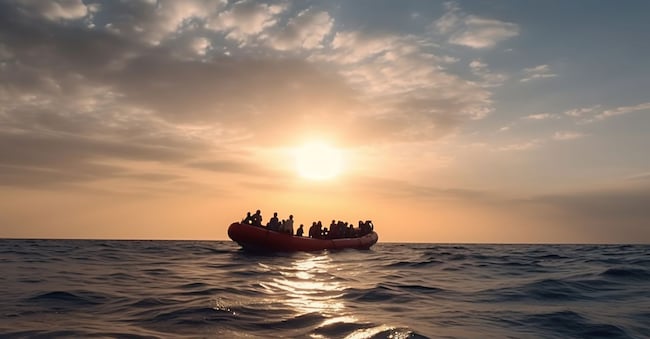
Two poets, Tommaso Giartosio and Gbenga Adesina, reflect on our ‘civilisation’ whilst observing the Great Migration and the preventable shipwrecks in the Mediterranean

Everything – the whole world, our entire being – is reflected in a piece of foil, ‘blinding us for a moment’. The foil is the thin emergency blanket used to retain the body heat of those who are still barely alive, to keep them alive. It is used in shipwrecks.
The epiphany takes place ‘on a windy morning / on the deck of a SAR patrol boat’, on the sea which is ‘non-land’. With death – we finally realise – as the ‘only true frontier’, writes Tommaso Giartosio in Il mare, quoting in this final sentence Caterina Bonvicini’s reportage: Mediterraneo. A bordo delle navi umanitarie (Einaudi 2022).
It is the blue ‘that calls you to itself’. It is the moment when ‘the sky turns upside down over the sea’, the sea becomes the centre of gravity, becomes a ‘funnel’; we must start from there to truly understand what our “civilisation” is. The great migrations of recent decades thus become a ‘terrible “opportunity”’ to reflect on the ‘real relationships between all of us’, explains the author in a note to his collection of poetry, which is ‘an account of a moral experience even before it is a political one’.
Civil poetry, the most difficult kind: managing not to slip into rhetoric and not giving in to the temptation of the epic – a path already masterfully trodden by voices more entitled to sing of that ‘dark patch that crosses the borders on maps and dissolves their shapes’ (such as Derek Walcott, here in Migrants), the author tackles the great unspoken truth upon which Western societies are built: the subjugation of the ‘other’ (and, even more so, of the ‘other woman’).
The shadow of colonisation, the shadow of exploitation, the shadow of discrimination: until we confront it, we shall remain in the dark, turning others into shadows. ‘It is possible, my love, to hate a shadow,/ indeed, it is easier than loving it. To hate it/ and become shadows ourselves’. A lengthy reflection in verse that begins with the most intimate experiences (‘It is obscene to speak in the name of others,/ and poetry is this obscenity /deliberate and calculated’) to reflect on our individual and collective responsibilities. The author recalls the sea of his childhood, where he would dive ‘along shimmering paths’, to reach ‘the very bottom of the valley where only/ microscopic, almost colourless algae/ tremble’ and then rise again, slowly, a little weary, whilst ‘my whole body’ became ‘a nest of foam’. Already aware, however: ‘Where the world ended / the sea began and / it never ended and / from the height / of my twelve years / I knew / it ended’. He then turns to the family, fathers so convinced of their own goodness that they refuse to see that it is their son who is the ‘paedophile’. Fathers with a ‘blind smile / that knows nothing of its own sadness’. And love – that for a man – which is inevitably political and fully aware of shipwrecks. Giartosio re-reads the third chapter of The Scent of India by Pier Paolo Pasolini: The Story of Revi – the child dressed in rags whom the poet from Casarsa met in Kochi, in Kerala, and whom he entrusted to a priest to look after – with that awareness of our limitations in observing, the limitations of white Westerners, which he had already explored in Everything We Have Not Seen (2023, Einaudi), an account of a journey to Eritrea.


