Engines

Antonelli dominates Suzuka: second consecutive F1 victory and world championship lead at only 19 years of age

The young Italian talent conquered Suzuka with authority, fending off competition from Piastri and Leclerc, and established himself as the new star of the season

by Alex D'Agosta

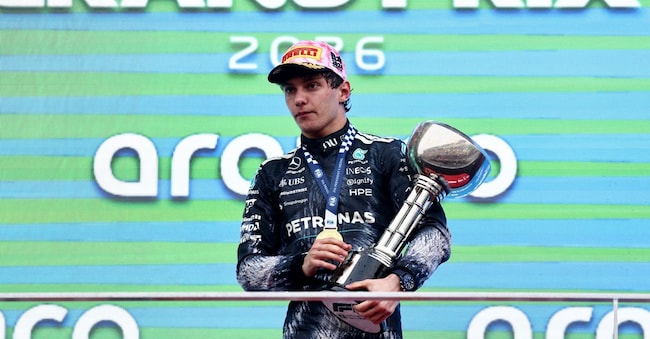
Formula 1 - Gran Premio del Giappone - Circuito di Suzuka, Suzuka, Giappone - 29 marzo 2026 Andrea Kimi Antonelli della Mercedes festeggia sul podio con il trofeo dopo aver vinto il Gran Premio del Giappone REUTERS/Jakub Porzycki REUTERS

8' min read

Translated by AI
Versione italiana

8' min read

Translated by AI
Versione italiana

Kimi, Oscar, Charles: super unprecedented for the Aramco Japanese Grand Prix number 51. Andrea Kimi Antonelli's second victory changes its specific weight within Formula 1. Suzuka returns tricolour for the first time since Riccardo Patrese in far-off 1992 with the Williams FW14B, Renault engine and design by Adrian Newey. The first two consecutive victories for an Italian since Ascari in 1953: the freshman is rewriting history! It is no longer just the precocious talent that surprises, but a driver who controls a complex race, overturns it and closes it with authority.

Behind him, Oscar Piastri built up a solid and fully second place race: having made a great start, he immediately took control of his race and, even after the safety car, he was never really put under pressure by the Ferrari of Leclerc, confirming the consistency of a McLaren that at Suzuka had less "peak" than Mercedes but enough pace to deserve the highest podium available. In the heart-stopping finale there was also the risk of seeing the position behind him change, as Leclerc, with very little to go, had to withstand a serious attack from Russell. Luckily for him, he was able to defend third place, despite Russell being able to get alongside him, overtake him and almost immediately be forced to give the position back.

Loading...

With this victory the former rookie, in whom Toto Wolff believed to the point of entrusting him with a top Mercedes, also becomes the youngest world championship leader. At this rate, Antonelli is on his way to lowering several youth records contested between Vettel, Hamilton and Verstappen. But beyond the age records, the important thing is the signal that Antonelli, in just three races, has already gone from promise to centre stage, with a rapidity that even inside Mercedes probably could not have imagined so clearly. Twelve months ago, on the eve of his first season in this series, in fact, few would have bet on such a rapid and solid impact. Today he is a real reference, and this victory at Suzuka, as it is constructed, has the flavour of a consecration.

It is just a pity that all this comes while Imola remains out of the 2026 calendar: right at the historic moment when Formula 1 has an Imola manager like Stefano Domenicali at the top and a boy from Bologna on the track, who has become the new face of Italia that wins. A pure talent that we hope is ready to approach the satisfaction that Jannik Sinner is giving in tennis. Also for this reason, inside a spring emptied by the absence of races for the whole of April, a grand prix in Emilia-Romagna would have had a very strong symbolic weight, while remaining industrially irrelevant in the 'new' (too?) global logic of the world championship.

Not without great apprehension and disappointment at the start, where Antonelli had actually thrown away a pole that also had special historical weight: it was the 50th first qualifying position for an Italian in Formula 1, as well as his second in a row, a result that brings an Italian to two poles in the same season for the first time since Jarno Trulli in 2004. The sprint, however, was bad: Oscar Piastri took the lead immediately, George Russell tried to stay on him ahead of Charles Leclerc and Lando Norris, while Antonelli sank into traffic, forced more to defend and rebuild than to attack.

In the first part of the race, Suzuka was stuck in its most severe nature, made of track position, dirty air and very little margin to invent something. On a track where it was usually difficult to overtake only changed its face on lap 22, when Bearman crashed (very hard but without serious consequences) into the barriers and the safety car overturned everything: Antonelli, until then penalised by the start, crossed the neutralisation at the right moment and restarted in the lead, while Russell paid the price for an early stop discovered by the timing of the race. At that point the grand prix entered another dimension, with Mercedes once again at the centre of the story and Antonelli suddenly put in a position to turn a historic Saturday into an even heavier showdown.

In the finale there is no more game: Antonelli's lead is very comfortable, managed without ever giving the feeling of really having to defend. Behind him Piastri remains second without having the pace to reopen the race, while Leclerc closes third after a central phase also conditioned by the internal confrontation with Lewis Hamilton. It is precisely there that one of the highest junctions (and risks) of Sunday can be glimpsed: the Ferrari management, with the two drivers close together and the internal battle, may have taken something away in terms of rhythm and continuity, leaving Piastri with a more linear race. But the real figure remains the final gap: too wide to be explained by traffic or internal dynamics alone.

Behind, Russell regained fourth position right on Hamilton, who was unable to keep up in the long final stint. A clear signal on the internal Mercedes balance as well.

If Mercedes is now back as a reference, it is equally clear that McLaren has lost its status as the first force of 2025: but after a disastrous debut due to reliability problems in the first races, it is clearly becoming competitive again, taking home a solid second place, but no longer in control of the race pace. It is a luxury third force, but still third. Before the April break, Formula 1 sends the drivers out to eat their eggs with a drivers' standings that sees the three distinct teams in the top six: Antonelli and Russell with 72 and 63 points, Leclerc and Hamilton with 49 and 41 points, Norris and Piastri with 25 and 21 points. In the constructors the proportions are even heavier: Mercedes with 135 points, Ferrari 90, McLaren 46.

The heaviest figure, however, comes from Red Bull Racing, sixth on 16 points behind Haas on 18 and Alpine tied on 16. Max Verstappen even finishes behind Pierre Gasly, in an anonymous race and without ever really getting into the game, while Hadjar's other car remains outside the points zone. Balancing problems, tyre management difficulties and an increasingly narrow operating window are emerging with continuity: Suzuka, a track that amplifies aerodynamic and stability limits, has exposed them unfiltered. It is no longer an episode, but a trend.

Fusaro, the 'no' to Senna and the ghost of Suzuka

Piero Fusaro died on Friday at the age of 88. A Fiat manager from Turin, he was president of Ferrari from 1988 to 1991, in the years of transition after Enzo Ferrari and before the arrival of Luca Cordero di Montezemolo, in a phase marked by internal tensions and heavy choices.

On the eve of Suzuka, the place where the rivalry between Ayrton Senna and Alain Prost became legend, his disappearance also brings this story back. Senna's failure to join Ferrari has remained like an open wound: for many an unforgivable mistake. But the picture is more complex than what has been told for years. Fusaro himself claimed to have pushed for the engagement, then stopped at the highest levels of the Fiat group. In the paddock, however, another interpretation has always circulated, linked to political balances and the weight of tobacco sponsors, then aligned on Prost. That is why that choice never became a shared truth, but a tale. And today, returning ideally to Suzuka, it remains suspended there, somewhere between history and myth.

Honda and its patient times to hope to return to the top of Formula 1

In the noise of a start to the season that has already ignited technical doubts and controversy over the new balance between electric and thermal, there is, however, also another, deeper and more industrial plane of interpretation. And it is the one that leads to Honda, which after four drivers' championships in this decade now finds itself at the bottom of the standings in this new phase. However, the Japanese manufacturer has chosen to return as a protagonist precisely in the most delicate regulatory transition, binding itself to Aston Martin as official partner from 2026 and presenting in January the new RA626H power unit, developed within the new era between electrification and sustainable fuels.

It is a project to be read with strategic patience, not with anxiety about the immediate result. At stages like this, the value lies not only in the engine's potential, but in the ability to hold together the heat engine, electrics, software, chassis and next-generation fuels. This is also where Aston Martin's internal reorganisation weighs in: Adrian Newey has taken a step back: necessary to be less absorbed by day-to-day operations, he will now be able to focus more on high-impact technical choices, from the architecture of the car to the integration between power unit and chassis.

Within this framework, Fernando Alonso counts more as a development accelerator than as a mere driver. Even if Aston Martin is struggling today, the Spaniard's value lies in his ability to get through a difficult phase without losing the technical direction of the project. It is a function reminiscent, with all due caution, of the one Schumacher had in the first Mercedes comeback: not the champion called upon to win immediately, but the one who helps build the foundations of what can come later.

Alonso and old school privacy on fatherhood at 44

In the contemporary Formula 1 panorama, increasingly oriented towards the spectacularisation of the individual and the continuous narration of private life, Fernando Alonso represents a significant anomaly. The birth of his first child, confirmed but almost completely removed from the global information circuit, highlights a counter-current choice: subtracting the family dimension from the logic of visibility. The exact day of the birth is not even known, neither the name nor the sex. A masterstroke!

In an ecosystem where sporting and personal identities tend to merge into a single public narrative, Alonso reaffirms a clear distinction, almost of yesteryear, between what belongs to the competition and what deliberately remains out of the field. This is not mere discretion, but a precise positioning: maintaining control of one's narrative perimeter in a context that, by definition, tends to erode it.

Audi and Cadillac, two debuts already readable

After three races, the balance of the two debutants is already quite clear. Audi is off to a better start: two points already on the debut in Australia with Bortoleto's ninth place and a structure that seems more ready thanks to the Sauber base and an integration work that began some time ago between chassis, power unit and industrial organisation. It is precisely this methodological solidity that seems to be its real advantage today, even if the project still remains fragile and in the midst of adjustment, as the recent internal managerial reorganisation also shows.

Cadillac, on the other hand, is paying for the newer nature of the project, built much more 'from scratch', but has already shown a quicker learning curve than expected. In Australia the team only brought one car to the finish, with Perez 16th, but the project's top management spoke openly of a debut beyond expectations. Then in China came the first double finish, a small but important sign of growth in reliability and execution. In summary: Audi is already more structured, Cadillac is still a building site, but less immature than many imagined.

Defects still marked after three races

The real own goal of this Formula 1 remains the disproportion between electric and endothermic horsepower. The concept had already become clear in Melbourne, but after three races the flaws are still all too apparent: if the battery dies, there is still about 450 horsepower left, and if you want to forward you have to regenerate. It's like having a parachute. Leclerc was very clear yesterday, he had harshly demanded 'at least give us back qualifying'.

The point is that the driver has almost no choice, he finds himself having to slow down even 50 kilometres per hour where he was previously accelerating, and as he goes slower to 'recover energy', he has to brake 'later' and 'slower'. Entering a corner more slowly. Even at Suzuka, a roller coaster that really made selection among those with a heavy foot. Today the driver, on the other hand, is becoming a 'slave' of the single-seater, like with the autopilot of the commercial SUV on the motorway: he doesn't really decide, the car decides, based on the software.

And so a category that has been built for decades on aerodynamic load, traction and cornering speed ends up imposing an unnatural driving style on itself. It was said that time was needed. But the problem, instead of diminishing, is still there: evident, heavy, and less and less compatible with the very idea of Formula 1.

Copyright reserved ©
Loading...

Brand connect

Loading...

Newsletter

Notizie e approfondimenti sugli avvenimenti politici, economici e finanziari.

Iscriviti

Tutto mercato WEB